拍品 12|AMERICAS
Dutch School, late 18th Century
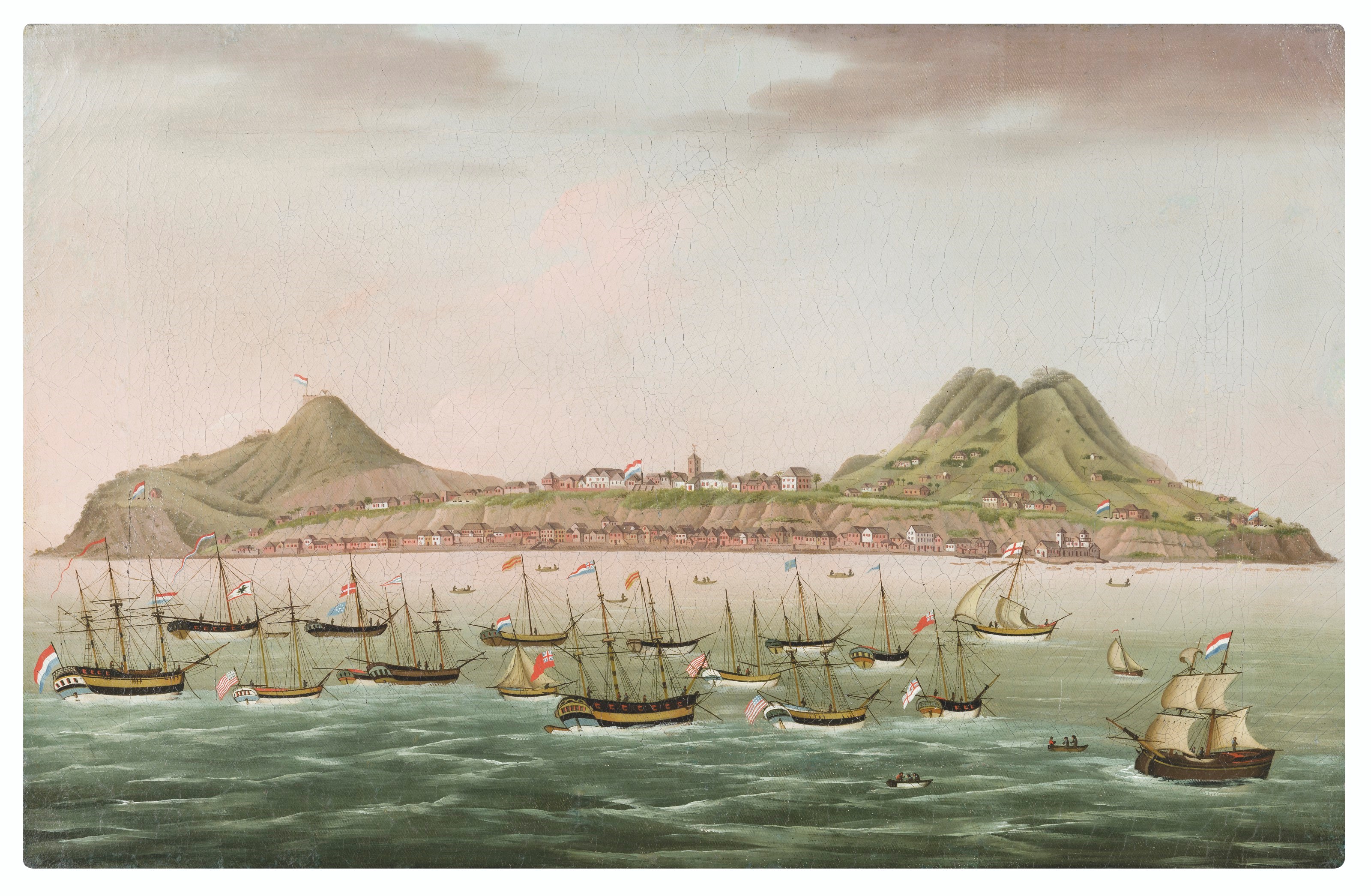
Sint Eustatius in the Dutch Antilles, with West Indiamen massed in the road off Oranjestad
已結束2020年11月5日
成交價
GBP 125,000
更多資訊
Dutch School, late 18th Century
Sint Eustatius in the Dutch Antilles, with West Indiamen massed in the road off Oranjestad
oil on canvas
16 ¾ x 26in. (42.5 x 66.1cm.)
We are most grateful to James L. Kochan for the identification of the subject.
The Dutch West India Company took possession of the uninhabited volcanic island of Sint Eustatius in the northern Leeward Islands of the Caribbean in 1636. The tiny island, just six miles long and three miles across, became an important independent mercantile entrepôt and freeport for the goods of the surrounding British, French, Danish and Spanish islands, and a centre of the slave trade. The island, which had supplied the North American rebels, is reported to have given the first international salute to the young American nation when its Dutch Governor, Johannes de Graaf, fired the guns of Fort Oranje to greet the arrival of the American brig Andrew Doria in November 1776. Sint Eustatius was taken by Rodney for the vengeful British in 1781, after Britain had declared war on the Seven United Netherlands, and was recovered by the French on behalf of their Dutch allies in 1784. After further occupations by the British and French between 1795 and 1815, it was returned to the Dutch in 1816 and remains a special Dutch municipality today. Dubbed 'the Golden Rock' for its commercial riches, this rare painting of the island in the late 18th century depicts it at its height: West Indiamen of many nations are gathered in the road of Oranjestad, and the voluminous storehouses of the lower town and buildings of the upper town all described in fine topographical detail, the Dutch flag flying from the fort and all outposts. The cone of the dormant volcano Quill rises on the right of the town, and Signal Hill, another dormant volcano, rises on the left.
Anon. sale, Phillips, London, 17 Jan. 2001, lot 283 (where misidentified as a view of Rhun Island, Banda Islands, Indonesia).
Hong Kong, Hong Kong Maritime Museum, The Dragon and the Eagle: American Traders in China, A Century of Trade from 1784 to 1900, Dec. 2019-April 2019, 1.11 (where misidentified as a view of Rhun Island, Banda Islands, Indonesia).
This lot has been imported from outside the EU for sale and placed under the Temporary Admission regime. Import VAT is payable (at 5%) on the hammer price. VAT at 20% will be added to the buyer’s premium but will not be shown separately on the invoice. Please see the Conditions of Sale for further information.