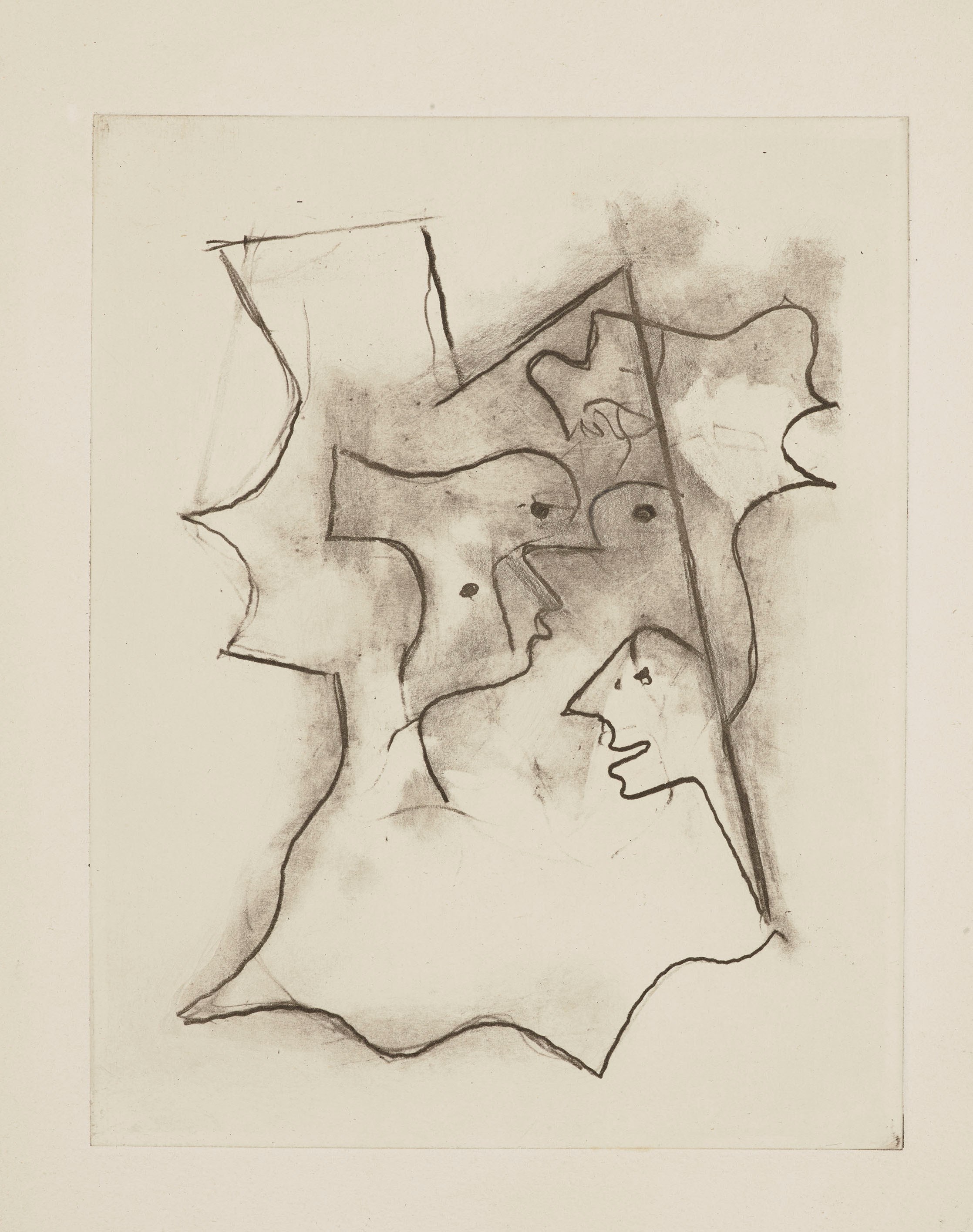
拍品 1Hommage à Arp
Collection Greta Stroeh
Greta, mon premier "Envol"
J’ai connu Greta au début des années 1990. Conservateur à la Fondation Arp à Clamart, elle avait pris l’initiative de faire une exposition en ce lieu inspiré.
Une association des amis de Sophie Taeuber-Arp et de Jean Arp a permis de faire connaître aussi d’autres artistes dont Greta l’animait. Tant qu’elle fut en vie, plusieurs artistes sculpteurs ont pu exposer à la Fondation, ce qui lui donnait un relief exceptionnel de transmission. Cette Fondation devenait vivante grâce à son enthousiasme.
Sa beauté rayonnante et son courage m’ont accompagnée dans les moments difficiles. Je me rappelle qu’elle disait que la souffrance, au lieu de vous anéantir, devait vous faire grandir. Maintenant encore, j’y pense lorsque des ombres planent sur mon existence. J’ai été inspirée par elle lorsque j’ai entrepris de faire une œuvre: « En vol » en matériau léger qui se tient sur un seul point, symbolisant l’Envol qu’elle a pris pour rejoindre ce lieu dans l’univers, comme un adieu ineffable.
Greta, my first ‘Flight’
I got to know Greta in the early 1990s. As curator at the Fondation Arp in Clamart, she had taken the initiative to host an exhibition in this inspired setting.
An association of friends of Sophie Taeuber-Arp and Jean Arp also made it possible to introduce other artists whose work Greta curated. While she was alive, a number of sculptors were able to exhibit at the Fondation Arp, thus giving it exceptional prominence as a disseminator of their work. The Fondation came to life thanks to her enthusiasm.
Her radiant beauty and her courage supported me through some difficult times. I remember she used to say that suffering, rather than destroying you, should make you grow. Even now, I think of her when there are shadows hanging over my life. I was inspired by her when I undertook a piece, En vol, in lightweight material that clings to a single point, symbolising the ‘Flight’ she took to reach this place in the universe, like a last, ineffable farewell.
Parvine Curie
Meudon, le 15 décembre 2019
« Pour Arp, il ne s’agit pas de reproduire l’image de l’homme, ni d’en faire une abstraction ; l’humain, le vivant est au cœur de son œuvre.»
(Greta Stroeh, ‘Etienne Martin – Propos recueillis par Greta Stroeh’, Paris, 23 avril 1992).
Lors de sa saison de ventes d’art impressionniste et moderne en mars 2020 Christie’s consacrera une vente à la collection de Greta Stroeh (1939-2001). Précédant la vente d’Œuvres modernes sur papier du 26 mars prochain, cette vente se déroulera pendant la Semaine du dessin à Paris. Riche d’une centaine d’œuvres, principalement du sculpteur Jean (Hans) Arp (1886-1966), cette collection comprend également quelques œuvres de la première femme de ce dernier, Sophie Taeuber-Arp (1889-1943), de son ami Alberto Magnelli (1888-1971), et d’autres artistes contemporains de Arp : Joan Miró (1893-1983), Georges Vantongerloo (1886-1965) et Gino Severini (1883-1966).
« Du début à la fin, Greta Stroeh, aux côtés de Marguerite Arp-Hagenbach, me prêta son concours dans ces recherches. Souvent elle m’apportait spontanément des indications et contribuait d’une manière non négligeable à la réussite de mon travail. C’est avec plaisir que je lui exprime ma plus profonde reconnaissance. »
B. Rau, ‘Avant-propos’ (daté du 1er août 1980), in Hans Arp – Die Reliefs : Œuvre-Katalog, Stuttgart, 1981.
Greta Stroeh, un nom qui n’a pas été assez mis en avant et qui pourtant résonne dans l’âme de la Fondation Arp de Clamart. Il est également bien connu de nombreux historiens de l’art, conservateurs de musée, galeristes et artistes. Née dans le nord de l’Allemagne en 1939, Greta grandit sur la grande ferme familiale. Cette période de jeunesse est marquée par divers passages de réfugiés allemands et russes, que la ferme dût accueillir pendant la guerre, en échange de leur participation aux travaux agricoles. Cette expérience a développé chez Greta Stroeh un grand sens de la solidarité et du partage, mais aussi une prise de conscience du courage. L’artiste contemporaine Parvine Curie se rappelle que Greta disait que " la souffrance, au lieu de vous anéantir, devait vous faire grandir " (15 décembre 2019).
L’éducation conventionnelle de Greta Stroeh l’amène à faire une école de femme au foyer, contre son gré. Vers la fin des années 1950, elle décide de fuir ce milieu, prenant des postes de jeune fille au pair en Angleterre et en France, puis en Égypte au sein d’une famille très aisée. Elle fait du mannequinat ainsi que de la traduction, avant d’épouser vers 1970 un Égyptien au Brésil. Peu après, elle se sépare de son mari et rentre en Europe vers 1975. Elle arrive alors à Paris et fait la connaissance de Marguerite Arp-Hagenbach (1902-1994), la seconde femme du peintre, poète, sculpteur et graphiste Jean Arp. Leur première rencontre annonce une solide amitié qui durera jusqu’à la mort de Marguerite en 1994. C’est aussi le début d’une collaboration fructueuse d’archivage et de promotion de l’œuvre de Jean Arp ; un travail entrepris par Marguerite Arp pour son mari depuis les années 1950. Vers 1976-77, elles feront ensemble un voyage en Inde. Lorsque Greta Stroeh donna naissance à sa fille Ava en 1977, elle vivait déjà au 21, rue des Châtaigniers à Clamart dans les Hauts-de-Seine, où se trouve le bâtiment de l’actuelle Fondation Arp, reconnue publiquement en 1979. Ava Stroeh, qui confie aujourd’hui à Christie’s la précieuse collection d’œuvres de Arp de sa mère, se souvient d’ailleurs d’avoir fait ses premiers pas entre les murs de la Fondation et grandi parmi les sculptures de Jean Arp.
Cette rencontre spontanée avec Marguerite Arp constitue sans aucun doute une étape charnière dans la vie de Greta Stroeh. Selon sa fille Ava, le couple Jean Arp et Sophie Taeuber-Arp était la famille spirituelle de Greta Stroeh, alors même qu’Ava considérait Marguerite Arp comme sa grand-mère. Le nouveau foyer familial de Greta Stroeh tournait autour de ces deux grands artistes qu’elle n’avait pas pu rencontrer. Toutefois, elle pouvait encore rendre hommage, aux côtés de Marguerite Arp, en créant la Fondation Arp de Clamart. Greta avait beaucoup d’admiration pour le couple artiste Arp, mais également pour Sophie Taeuber-Arp, en tant que femme indépendante. Cette dernière avait dessiné et fait construire son atelier, qu’elle partageait avec son mari Jean Arp, au 21 rue des Châtaigniers à Clamart. Ils s’y installèrent en 1929, lorsqu’ils obtinrent tous deux la nationalité française. Géré par la Fondation Arp de Clamart, cet atelier abrite aujourd’hui une sélection d’œuvres du couple Arp, commémorant ainsi le rôle d’effervescence artistique et intellectuelle que cet atelier a tenu du vivant des Arp. En effet, toute une communauté d’artistes et d’écrivains s’y retrouvaient régulièrement, tels que Max Ernst, Hans Richter, Kurt Schwitters, Joan Miro, Tristan Tzara, André Breton, les couples Robert et Sonia Delaunay, Nelly et Théo van Doesburg, Francis et Gabrielle Picabia ou encore Alberto et Susie Magnelli. Consciente de la signification de ce lieu historique, Greta Stroeh était déterminée à faire revivre ce foyer de l’Avant-Garde du XXème siècle. Elle prit des initiatives au sein de la Fondation Arp pour s’assurer qu’elle constitue un espace vivant d’accueil, de convivialité et de rencontres entre artistes contemporains. Les nombreuses fêtes et soirées pleines de joie et de vie organisées par Greta Stroeh à la Fondation ont d’ailleurs beaucoup marqué l’enfance de sa fille Ava.
Greta Stroeh a véritablement fait vivre la Fondation Arp de Clamart en donnant l’opportunité à plusieurs jeunes artistes de mettre en valeur leurs œuvres. Dans cet espace inédit, elle organisait des expositions et des vernissages, notamment pour Alicia Hernandez (1945-2012) et Ricardo Fernandez (1947-2006) en 1992, Parvine Curie (née en 1936) en 1994, ou encore Esther Hess (1919-2016) et François Weil (né en 1964) en 1995. L’une des contributions les plus remarquables de Greta Stroeh pour la diffusion de l’œuvre de Jean Arp en France fut l’exposition rétrospective itinérante Arp : Sculptures, reliefs et papiers de 1913 à 1966 (1992-1994). A cette occasion, Stroeh était commissaire générale aux côtés de Jean-Pierre Arnaud, président de la P.A.C.A. (Présence de l’Art Contemporain d’Angers) qu’il avait fondée en 1989. Par ailleurs, Stroeh eût un rôle clé dans la restitution à l’Etat français de plâtres originaux de Arp, initialement détenus par la Fondation Arp de Clamart, et qui se trouvent aujourd’hui dans les collections du Centre Georges Pompidou.
Ainsi, la collection de Greta Stroeh que Christie’s mettra en vente en mars prochain constitue un véritable hommage à Jean Arp. Couvrant plus de trente ans de sa production artistique, elle témoignera de l’éclecticisme de son œuvre, tant par la variété de son langage artistique novateur que par la diversité des techniques utilisées : sculptures en bronze ou en laiton, reliefs en duraluminium ou en bois peint, œuvres sur papier, collages, papiers déchirés, lithographies, sérigraphies, gravures, eaux-fortes, illustrations de livres, ou encore recueils de poèmes. Dans son introduction pour le catalogue de l’exposition itinérante de 1992-1994, Stroeh relève « l’attitude précocement critique et non-conformiste » de Arp, reflétant peut-être ses propres choix de vie anticonformistes (‘Jean Arp : « Dada est une révolution morale »’ in cat. exp., Arp : Sculptures, reliefs et papiers de 1913 à 1966, Exposition itinérante 1992-1994, P.A.C.A., Angers, 1992). Dans un entretien avec l’artiste Olivier Debré, Stroeh explique clairement les propos de Arp : « En fait, Arp essayait de réagir contre son époque en ne voulant pas paraître mais être. Les formes qu’il créé, qu’il trouve en lui ne représentent pas pour lui la réalité, mais il souhaite pénétrer au fond des choses pour exprimer l’essentiel qui est derrière les apparences (…) l’art de Arp c’est ça, élémentaire et concret » (‘Olivier Debré’, entretien avec Greta Stroeh et Jean-Pierre Arnaud, Angers, dimanche 8 mars 1992 in op. cit., p. 60-61). De plus, Stroeh souligne le rôle critique, voir même de « catharsis », que Sophie Taeuber-Arp a tenu dans l’évolution artistique de Arp (ibid., p. 61). Elle lui permit de se trouver lui-même et d’identifier son propre style. Stroeh ira même jusqu’à dire que Taeuber-Arp « brille comme une étoile rayonnante » pour guider artistiquement son mari lorsque cette dernière meurt prématurément (ibid., p. 39).
L’œuvre phare de la collection est un magnifique Torse en bronze, pièce emblématique de la Sculpture de Arp. Il la conçut en 1931 et elle est décrite en détail par Greta Stroeh : « Arp arrive à rendre extrêmement vivante la matière inanimée (plâtre, bois, bronze, pierre). Leur portée sensorielle est forte et nous pousse à les toucher, à les explorer, à les caresser même, pour participer davantage à leur pulsation et comme pour sentir leur souffle vital. Les torses de Arp sont d’ores et déjà conçus fragmentés et confirment son génie de ne mettre dans l’œuvre que l’essentiel. Le Torse de 1931 a été saisi dans un élan fugitif. La cuisse droite l’ancre au sol et l’emporte en même temps par un envol dans une torsion inversée. La cambrure le fléchit comme un ressort. Sans membres et sans tête, il n’a plus de caractère anecdotique, mais nous incite, en même temps, à imaginer des solutions innombrables » (ibid., p. 31).
Cette collection met en valeur l’engagement de Greta Stroeh dans la promotion de l’œuvre de Jean Arp, ainsi que d’autres artistes contemporains. Elle témoigne également de la complicité entre Greta Stroeh et Marguerite Arp-Hagenbach, et leur détermination commune à défendre l’œuvre du couple Jean Arp et Sophie Taeuber-Arp.
“For Arp, it was not a question of reproducing man’s image, nor of turning it into an abstraction; the human, the living being, is central to his work.”
(Greta Stroeh, ‘Etienne Martin – Propos recueillis par Greta Stroeh’, Paris, 23 April 1992).
As part of its season of sales of Impressionist and Modern art in March 2020, Christie’s is devoting a sale to the collection of Greta Stroeh (1939-2001). Preceding the Modern Works on Paper sale on 26 March, this sale will take place during Drawing Week in Paris. This collection of some 100 or so works, mainly by sculptor Jean (Hans) Arp (1886-1966), also includes some works by his first wife, Sophie Taeuber-Arp (1889-1943), his friend Alberto Magnelli (1888-1971), and other artists who were Arp’s contemporaries: Joan Miró (1893-1983), Georges Vantongerloo (1886-1965) and Gino Severini (1883-1966).
“From beginning to end, Greta Stroeh, together with Marguerite Arp-Hagenbach, lent me her support in this research. On many occasions she spontaneously offered me suggestions, and the successful outcome of my work is thanks in no small part to her. I am delighted to have this opportunity to express to her my deepest thanks.”
B. Rau, ‘Foreword’, 1 August 1980, in Hans Arp – Die Reliefs: Œuvre-Katalog, Stuttgart, 1981.
Greta Stroeh: a name mentioned all too infrequently, yet having a particular resonance for the Fondation Arp in Clamart. It is also well known to a great many art historians, museum curators, gallerists and artists. Born in northern Germany in 1939, Greta Stroeh grew up on her family’s large farm. Her early years were marked by various interludes when German and Russian refugees were accommodated at the farm in return for helping with the work there. This experience instilled in her a deep sense of solidarity and sharing, and also an awareness of courage. The contemporary artist Parvine Curie recalls that Stroeh used to say that “suffering, rather than destroying you, should make you grow” (15 December 2019).
Stroeh’s conventional education led to her attending a school for domestic science, much against her wishes. As the 1950s drew to a close she decided to escape this milieu, taking positions as an au pair, initially in England and France, and later in Egypt with a very well-to-do family. She also worked as a model and a translator before getting married, sometime around 1970, to an Egyptian man in Brazil. Shortly afterwards, around 1975, she separated from her husband and returned to Europe. It was then she came to Paris and got to know Marguerite Arp-Hagenbach (1902-1994), the second wife of painter, poet, sculptor and graphic designer Jean Arp. Their first meeting was the start of a firm friendship that was to last until Arp-Hagenbach’s death in 1994. It was also the beginning of a fruitful collaboration in archiving and promoting Arp’s work, a job Arp-Hagenbach had been doing for her husband since the 1950s. Around 1976-77, the two women travelled to India together. When Stroeh gave birth to her daughter Ava in 1977, she was already living at 21, rue des Châtaigniers in Clamart, Hauts-de-Seine, in the building that houses the present-day Fondation Arp, which was publicly recognised in 1979. Ava Stroeh, who is now entrusting Christie’s with her mother’s precious collection of works by Arp, remembers taking her first steps within the Fondation’s walls and growing up among Arp’s sculptures.
Her chance meeting with Arp-Hagenbach was unquestionably a turning point in Stroeh’s life. According to her daughter Ava, the couple of Jean Arp and Sophie Taeuber-Arp were Stroeh’s spiritual family, while Ava thought of Arp-Hagenbach as her grandmother. Stroeh’s new family home revolved around these two great artists, even though she had never had the opportunity to meet them. That didn’t prevent her paying tribute to them, alongside Arp-Hagenbach, by setting up the Fondation Arp in Clamart. Greta had a great deal of admiration for the Arp couple as artists, as well as for Sophie Taeuber-Arp as an independent woman. The latter designed her own studio and had it built at 21, rue des Châtaigniers in Clamart, sharing it with her husband. They moved there together in 1929, when they both obtained French nationality. Managed by the Fondation Arp in Clamart, this studio today houses a selection of works by the Arp couple, thus commemorating the role the studio played as a seething cauldron of artistic and intellectual excitement when the Arps were alive. Indeed, an entire community of artists and writers used to meet there regularly, including Max Ernst, Hans Richter, Kurt Schwitters, Joan Miró, Tristan Tzara and André Breton, and the couples Robert and Sonia Delaunay, Nelly and Theo van Doesburg, Francis and Gabrielle Picabia and Alberto and Susi Magnelli. Conscious of the significance of this historic place, Stroeh was determined to bring this home of the 20th century avant-garde back to life. She launched a series of initiatives at the Fondation Arp to make it a friendly and welcoming place, full of life, where contemporary artists could meet one another. The many joyous, lively parties and soirées organised by Stroeh at the Fondation Arp were also very memorable events in her daughter Ava’s childhood.
Stroeh truly brought the Fondation Arp in Clamart to life by giving many young artists the opportunity to showcase their work. In this original setting, she hosted exhibitions and private viewings, notably for Alicia Hernandez (1945-2012) and Ricardo Fernandez (1947-2006) in 1992, Parvine Curie (born 1936) in 1994, and Esther Hess (1919-2016) and François Weil (born 1964) in 1995. One of her most notable contributions to the dissemination of Arp’s work in France was the travelling retrospective exhibition Arp: Sculptures, reliefs et papiers de 1913 à 1966 (1992-1994). On this occasion, Stroeh was the overall organiser alongside Jean-Pierre Arnaud, the President of PACA (Présence de l’Art Contemporain, Angers), which he founded in 1989. In addition, Stroeh played a key role in the return to the French state of Arp’s original plaster casts, originally held by the Fondation Arp in Clamart, and now in the collections of the Centre Pompidou.
And so the Greta Stroeh collection, which Christie’s will be putting on sale this coming March, constitutes a genuine tribute to Jean Arp. Covering more than 30 years of his artistic output, it will be a testament to the eclecticism of his work, both in the varied nature of its innovative artistic language and in the wide range of techniques used: sculptures in bronze and brass, reliefs in Duralumin or painted wood, works on paper and with torn paper, collages, lithographs, screen prints, engravings, etchings, book illustrations and poetry anthologies. In her introduction to the catalogue for the 1992-1994 travelling exhibition, Stroeh mentions Arp’s “precociously critical and nonconformist attitude”, perhaps reflecting her own nonconformist life choices (‘Jean Arp: “Dada est une révolution morale”’ in exhibition catalogue Arp: Sculptures, reliefs et papiers de 1913 à 1966, Exposition itinérante 1992-1994, PACA, Angers, 1992). In an interview with the artist Olivier Debré, Stroeh gives a clear explanation of her remarks about Arp: “Arp was actually attempting to react against his era, by wanting not to seem, but to be. The forms he created, which he found within himself, did not represent reality for him, but he wanted to get the bottom of things in order to express the essence that is behind appearances […] that’s what Arp’s work is, elemental and concrete” (‘Olivier Debré’, interview with Greta Stroeh and Jean-Pierre Arnaud, Angers, Sunday 8 March 1992 in op. cit., p. 60-61). Stroeh also highlights the role of critic, perhaps even of “catharsis”, played by Sophie Taeuber-Arp in her husband’s artistic development (ibid., p. 61), enabling him to find himself and identify his own style. Stroeh even went so far as to say that Taeuber-Arp “shines like a radiant star”, guiding her husband artistically after her premature death (ibid., p. 39).
The most outstanding work in the collection is a magnificent bronze Torse, a piece that is emblematic of Arp’s sculpture. He created it in 1931 and Stroeh describes it in detail: “Arp manages to make inanimate materials (plaster, wood, bronze, stone) very much alive. They have a powerful sensory impact, inciting us to touch them, explore them, even caress them, as if to feel more intimately the rhythm of their heartbeat and their living breath. Arp’s torsos are created ready-fragmented and are proof of his genius for including only the essential. The 1931 Torse has been caught in a fleeting burst of movement: the right thigh anchors it to the ground and at the same time propels it into an inverted torsion. The small of the back flexes like a spring. With no limbs or head, it has no superfluous details, yet incites us to imagine any number of solutions” (ibid., p. 31).
This collection highlights Greta Stroeh’s commitment to promoting the work of Jean Arp, and of other contemporary artists. It is also a testament to the close relationship between Stroeh and Marguerite Arp-Hagenbach, and their shared determination to champion the work of couple Jean Arp and Sophie Taeuber-Arp.
Jean (Hans) Arp (1886-1966)
Visages
已結束2020年6月9日
成交價
EUR 2,250
更多資訊
專家說明
Nous remercions la Fondation Arp pour les informations communiquées à propos de cette œuvre.