拍品 11
Signals cannot exceed the speed of light
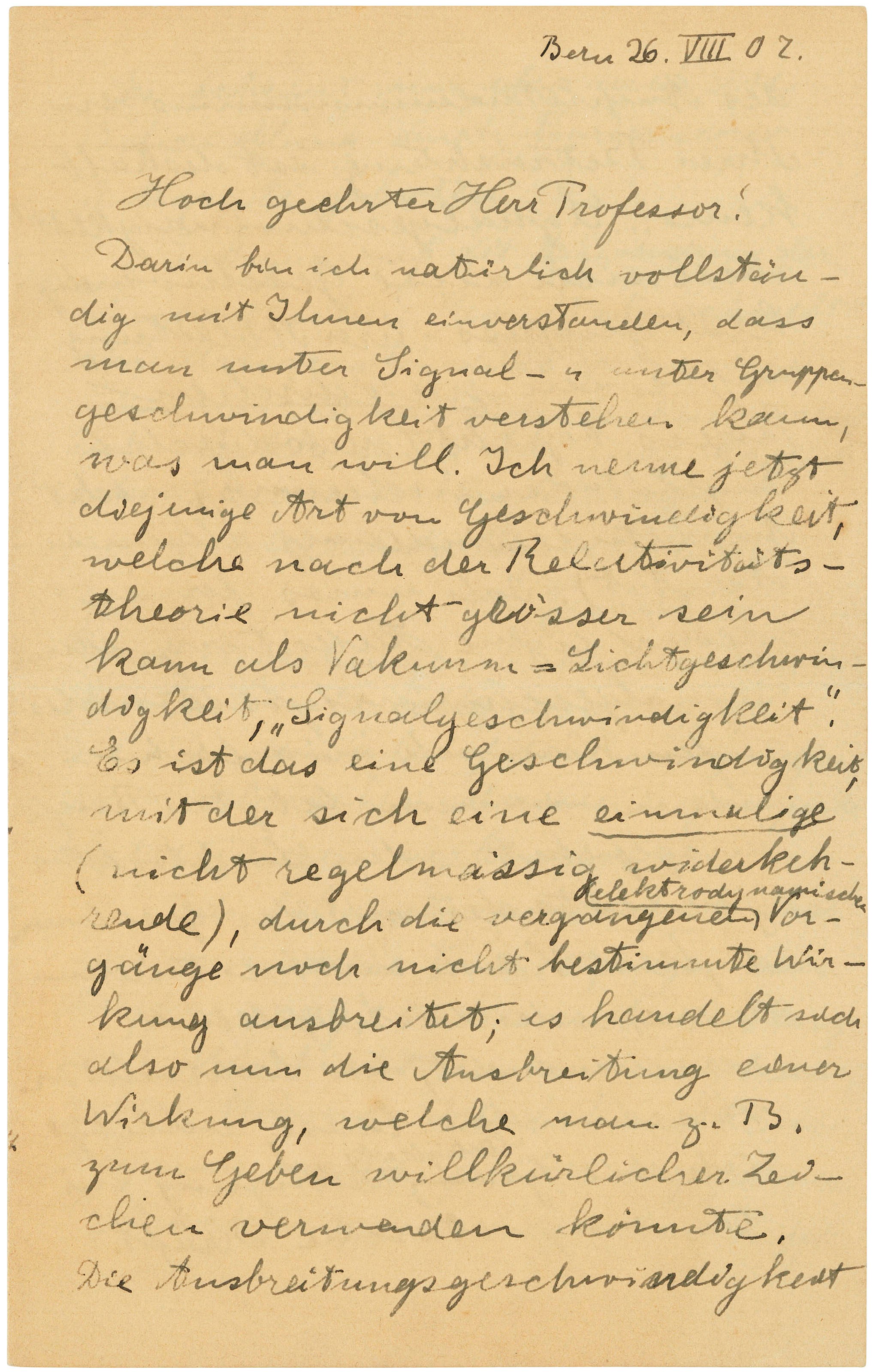
Albert Einstein. 26 August 1907
已結束2019年5月23日
成交價
GBP 25,000
更多資訊
Signals cannot exceed the speed of light
Albert Einstein. 26 August 1907
Albert Einstein (1879-1955).
Autograph letter signed (‘A. Einstein’) to [Wilhelm Wien], Bern, 26 August 1907.
In German, four pages, 179 x 113mm, on a bifolium. Provenance: by descent from the recipient.
On ‘signal velocity’ and ‘group velocity’, and the potential for electrical masses to exceed the velocity of light. Einstein is ‘completely in agreement’ with Wien that ‘by signal- and group-velocity one can understand what one wishes. I now designate that type of velocity which according to the theory of relativity cannot be greater than the velocity of light in a vacuum as “signal velocity”’: but Wien’s use of the term for the ‘propagation velocity of the amplitude minimum in your analysis’ is inaccurate as this is a periodic, not one-off, process. Einstein then attempts to clear up a misunderstanding regarding a result given by Emil Wiechert on the motions of electrical masses: ‘Now I do not assert that, however one may now make these stipulations, propagations with velocity greater than light cannot exist. I only, as a consequence of the argument given earlier, assert the following: If one formulates those stipulations in such a way that an electrical current can be only induced at a given location by the electromagnetic field at the same spatial location, then no signal can possess velocity greater than light … But the theory of dispersion does fulfil the mentioned condition…’.