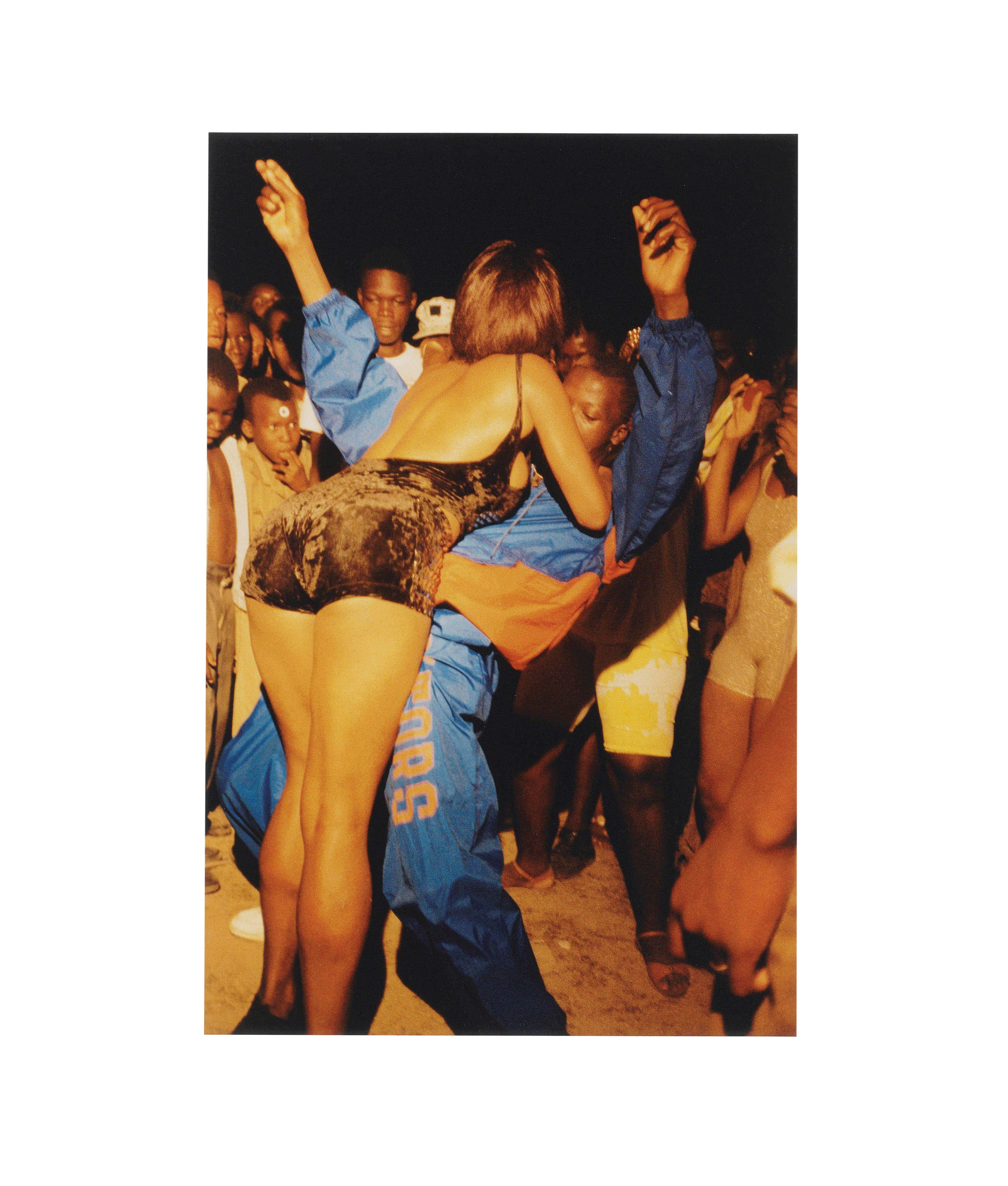
拍品 40
WOLFGANG TILLMANS (B. 1968)
ragga dancers (Kingston)
已結束2019年4月11日
成交價
GBP 7,500
更多資訊
專家說明
Christie’s is thrilled to present three works by Wolfgang Tillmans, each embodying the intimacy and openness that so suffuses his photographic practice. Tillmans was awarded the Turner Prize in 2000, and was the subject of a 2017 retrospective at Tate Modern, London. Part of an edition of three, one of which is held in the collection of the Museum of Modern Art, New York, ragga dancers (Kingston), 1992, captures a man and woman dancing, and although their faces are obscured, both radiate ecstatic joy. Taken one year later, Gillian and Christopher on the floor and Moby (lying) present intimate moments of exceptional vulnerability. In Gillian and Christopher on the floor, Tillmans witnesses the titular subjects fighting playfully and lovingly with each other, whereas Moby (lying) is a quieter scene. Tillmans photographed the singer Moby reclining in the sunshine atop a floral bedspread. By presenting an ideal of beauty that is entwined with the commonplace and every day, all three photographs warmly welcome the viewer. As curator Mark Godfrey wrote, ‘Tillmans not only welcomes all sorts of people before his camera lens: his work welcomes all kinds of viewers… I never feel excluded from them even though they sometimes show communities with whom I have no links. Instead, I think back to my own friends and experiences’ (M. Godfrey, ‘Worldview’, in Wolfgang Tillmans: 2017, exh. cat., Tate Modern, London, 2017, p. 22).
These photographs date to Tillmans’ early career, a period when he was particularly inspired by the imagery of popular media including magazines and record sleeves. In these he found ways of fashioning an identity that was not contingent upon socially accepted understandings of cool. Instead, Tillmans wanted to capture a freedom where ‘you could actually be having a great time, be sort of glamorous, and at the same time not buy into any commercialism’ (W. Tillmans in conversation with P. Halley, Wolfgang Tillmans, London, 2016, pp. 12, 14). Indeed, his photographs reveal the ordinary and unconventional with extraordinary grace to present an alternative understanding of community and family; Tillmans’ practice affirms and embraces an expressive subjectivity. In ragga dancers (Kingston), Moby (lying), and Gillian and Christopher on the floor, Tillmans allows his subjects the space to be wholly themselves, an emotional, striking, and beautiful effort that shows the world as it is experienced. These photographs are acts of love.
These photographs date to Tillmans’ early career, a period when he was particularly inspired by the imagery of popular media including magazines and record sleeves. In these he found ways of fashioning an identity that was not contingent upon socially accepted understandings of cool. Instead, Tillmans wanted to capture a freedom where ‘you could actually be having a great time, be sort of glamorous, and at the same time not buy into any commercialism’ (W. Tillmans in conversation with P. Halley, Wolfgang Tillmans, London, 2016, pp. 12, 14). Indeed, his photographs reveal the ordinary and unconventional with extraordinary grace to present an alternative understanding of community and family; Tillmans’ practice affirms and embraces an expressive subjectivity. In ragga dancers (Kingston), Moby (lying), and Gillian and Christopher on the floor, Tillmans allows his subjects the space to be wholly themselves, an emotional, striking, and beautiful effort that shows the world as it is experienced. These photographs are acts of love.