拍品 43
Childe Hassam (1859-1935)
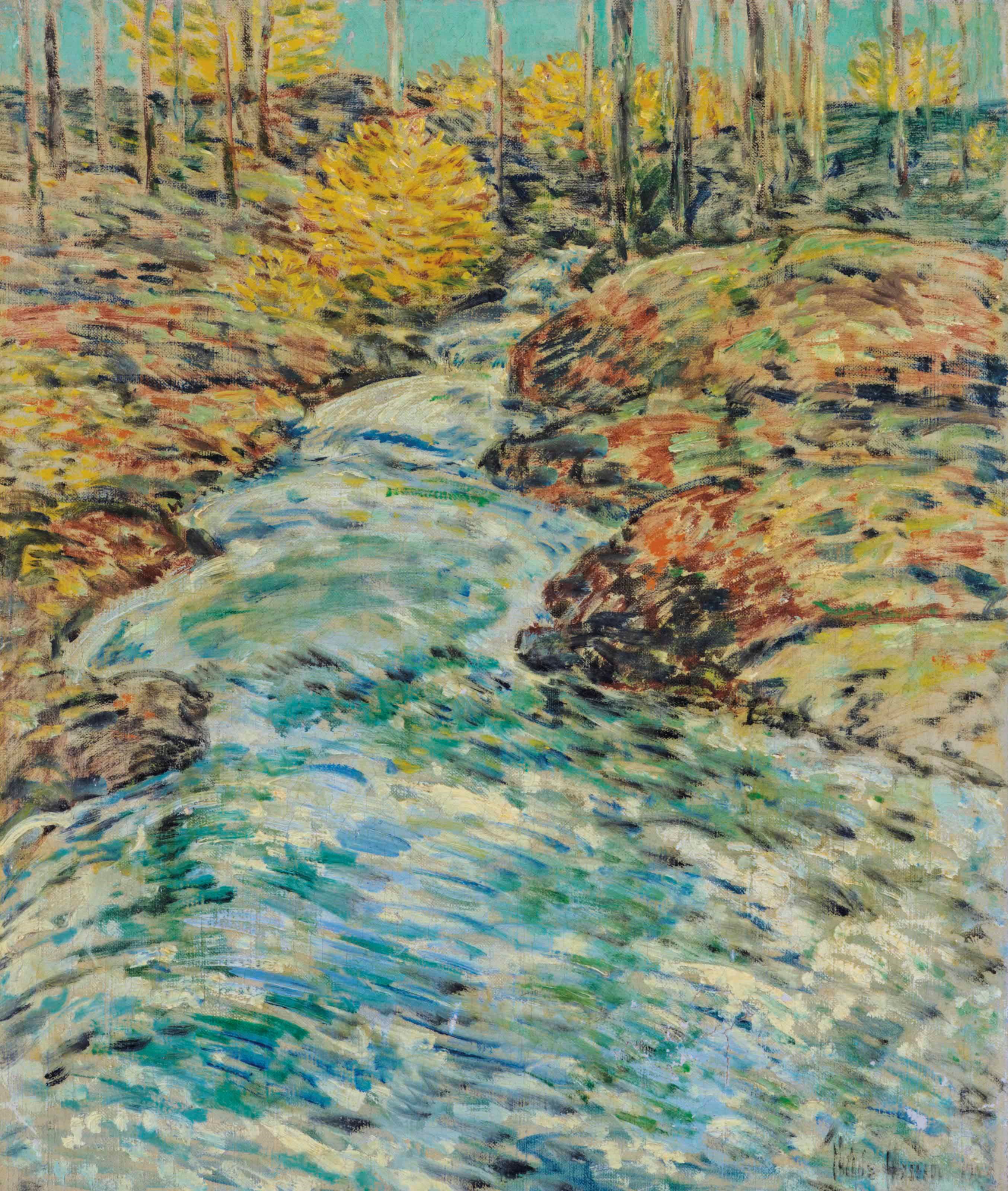
Landscape with Brook
成交價
USD 100,000
更多資訊
專家說明
We would like to thank the Hassam catalogue raisonné committee for their assistance with cataloguing this work.
This work will be included in Stuart P. Feld and Kathleen M. Burnside's forthcoming catalogue raisonné of the artist's work.
After refining his Impressionist palette and techniques in France, in works like Landscape with Brook, Childe Hassam looked to the New England landscape to experiment with texture and color. Composed of varying swatches and strokes of brilliant yellows, oranges, and blues, Landscape with Brook transforms a wooded scene into an explosion of color, texture and light. Hassam's affinity for New England, including places that may have inspired the present work such as Old Lyme and Cos Cob, stems from his traditional New England upbringing, deep rooted in American culture and patriotism. Jay Cantor writes, "In keeping with the increasing retrospection of his work, his visits to Portsmouth, Gloucester, Newport, Old Lyme, and Cos Cob provided opportunities for him to reclaim his patrimony and assert his Americaness at a time of expanding foreign incursions. Hassam had become seriously interested in his own ancestry and genealogy, and he enjoyed tracing the direct line from his New England forebears back to their Anglo-Saxon roots. After interviewing Hassam for an article about his etchings, Carlo Beuf noted: 'This American painter, powerfully built, with bull neck and torso of an athlete, is generally considered the exponent par excellence of French Impressionism this side of the Atlantic. This, however, does not prevent him from being one of the most representative North Americans, one of the most Anglo-Saxon types, that I have ever met.'" ("Hassam's Twentieth-Century Work," in Childe Hassam, Impressionist, New York, 1999, p. 108)
Likely painted in the early fall, just when the rich, golden tones are encroaching upon the verdant leaves of the summer months, Landscape with Brook is a glorious celebration of the American landscape. Depicting from a close vantage point a stream in the middle of the woods, the work celebrates the changing of the seasons. Rich, textural surfaces comprised of a myriad of brushstrokes emphasize the materiality of the paint. The palette alternates between the warm tones of the turning foliage to the crisp cool hues of the water. Instead of using color to delineate space and define the composition, Hassam has used a variety of broken brushstrokes to create a patterned surface with rhythm that suggests the quick movement of the water. Ulrich Hiesinger notes that his "mosaic like patterning produces not the atmospheric quality of a soft continuous dissolve, but a fracturing of space through the alternation of light and shade." (Childe Hassam, New York, 1994, p. 115) In works such as Landscape with Brook, Hassam's treatment of the surface becomes paramount, creating a decorative, almost tactile surface that simultaneously heralds the flatness of the canvas and bestows subtle, atmospheric effects.