拍品 304
Madame de Staël (Anne-Louise Germaine, Baronne de Staël-Holstein, 1766-1817)
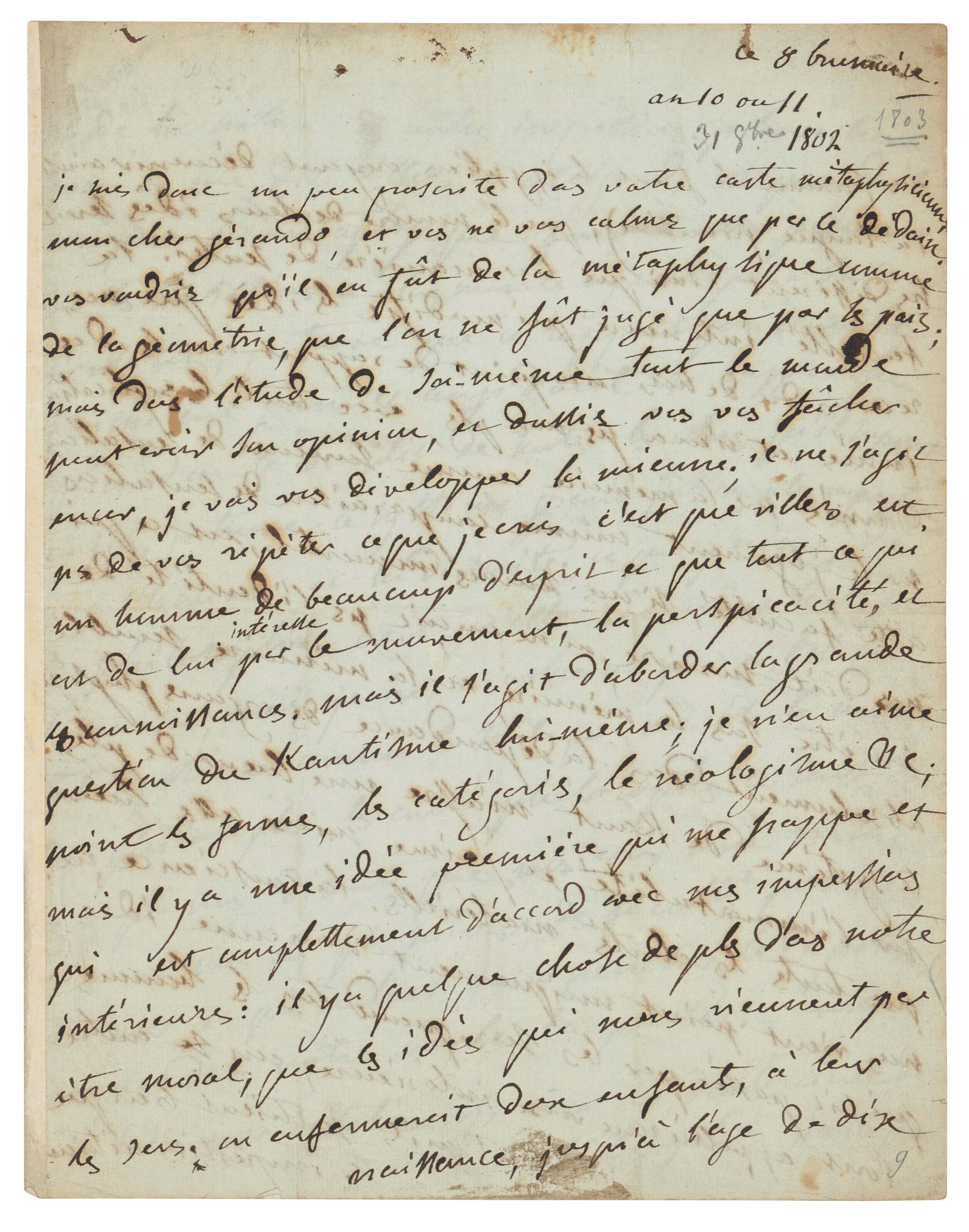
Autograph letter to [Joseph Marie, baron de] Gérando, n.p., ‘8 brumaire’ [?31 October 1803]
已结束2023年12月15日
成交价
GBP 1,134
更多信息
Madame de Staël (Anne-Louise Germaine, Baronne de Staël-Holstein, 1766-1817)
Autograph letter to [Joseph Marie, baron de] Gérando, n.p., ‘8 brumaire’ [?31 October 1803]
In French. 4 pages, 240 x 186mm, bifolium. Provenance: Christie’s New York, 18 May 1984, lot 67.
‘Our sanctuary: the realm of thought’. Madame de Staël’s thoughts on Kant and her reflections on questions of the senses and immortality. ‘The crux of the matter is to ask the essential question of Kantism itself. I do not like forms, categories, or neologisms. But there is an underlying idea which strikes me and which agrees completely with my inner feeling: there is something more to our moral being than the ideas which come to us through our senses. Were two children to be isolated from birth until the age of 10, as the Egyptians did, trying to discover the primitive language, their ideas would be quite different, as would be their manner of sensing … Kant’s system offers me yet another glimmer of light on the question of immortality, and I prefer this glimmer to all material illuminations … What I like about philosophy is that it examines everything according to reason, but I do not bind myself to considering any particular system as being the only one worthy of the name “philosophy”. The people who are anti-philosophy are those who say that we have a reason which we mustn’t wear out, and who wish to preach despotism within the confines of our sanctuary: the realm of thought.’ She praises the work of Charles de Villers but criticises his ‘anger against the encyclopaedists; one should respect the men who delivered us from superstition … but I think, as he does, that they could have had more influence had they supported natural religion, which alone can deliver us from fanaticism’.