拍品 107
Hermann Hesse (1877-1962)
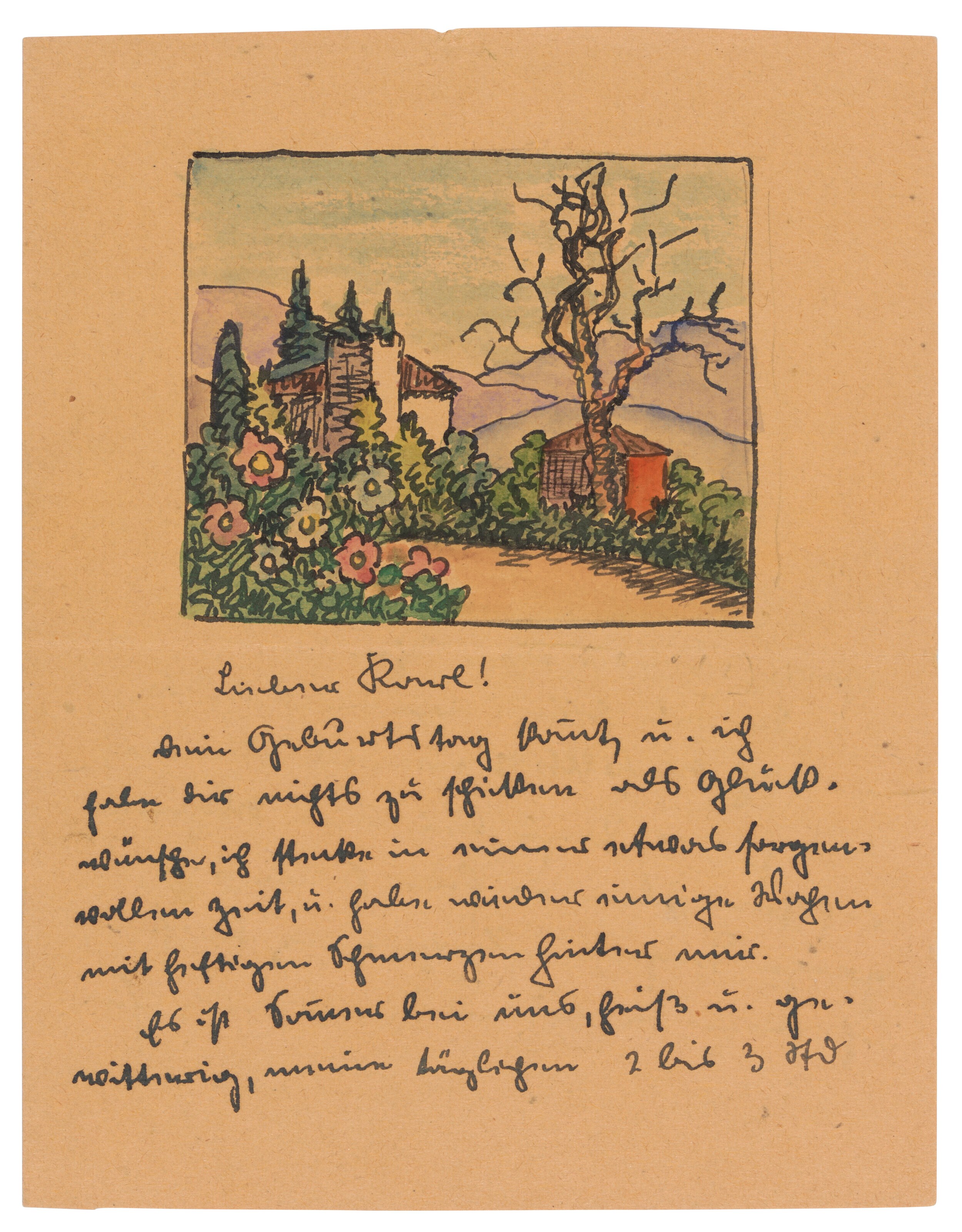
Two autograph letters and one postcard signed (‘Hermann’) to his half-brother Karl [Isenberg], Montagnola and Czechoslovakia, 14 March 1919 – 16 July 1936.
已结束2023年12月15日
成交价
GBP 4,410
更多信息
Hermann Hesse (1877-1962)
Two autograph letters and one postcard signed (‘Hermann’) to his half-brother Karl [Isenberg], Montagnola and Czechoslovakia, 14 March 1919 – 16 July 1936.
In German. Seven pages, various sizes (148 x 105mm postcard to 215 x 134mm bifolium), the letters each illustrated with a watercolour. Provenance: Sotheby’s, 21 & 22 May 1987, lot 256.
On the ‘three lives’, the short stories which conclude his Das Glasperlenspiel (The Glass Bead Game, 1943), giving insight into the novel’s development. Hesse tells his half-brother how he plans to present two of the three lives which form the end of The Glass Bead Game: 'The Rainmaker' and 'The Father Confessor'. He describes his feelings of alienation as an Auslandsdeutscher – his pacifism made him a pariah in Nazi Germany – and his sadness at being far from his family. He is happy that Karl has enjoyed his short story Die Morgenlandfahrt (Journey to the East, 1932) and his essay Dank an Goethe (1932).