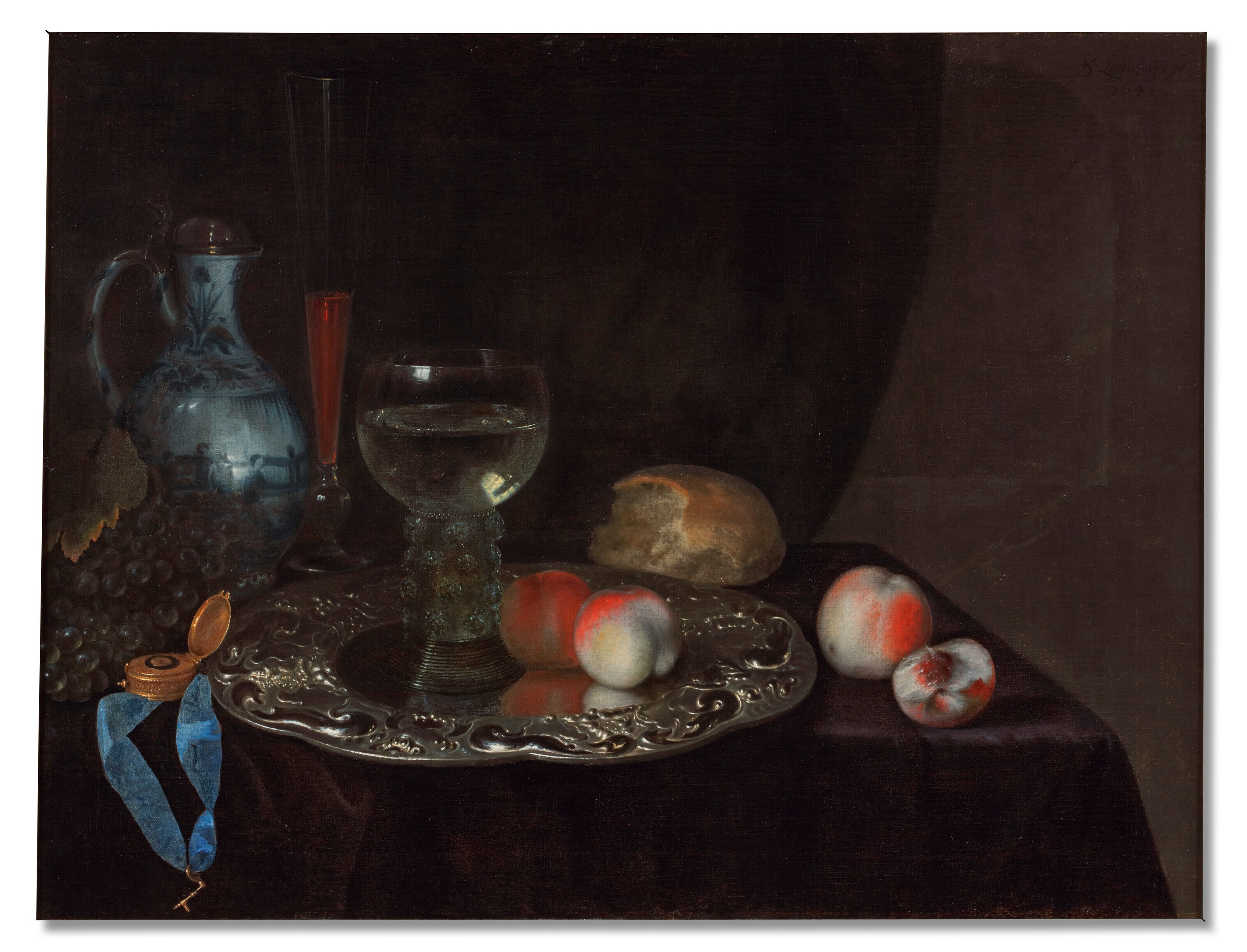
拍品 44
SIMON LUTTICHUYS (LONDON 1610-1661 AMSTERDAM)
A roemer with white wine and two peaches on a silver plate, with a golden watch, grapes, a porcelain jug with a silver lid, a tall glass, a bread roll and peaches on a draped table before a curtain
已结束2023年10月10日
成交价
EUR 20,160
更多信息
专家说明
In the present signed and 1648 dated still life Luttichuys creates an illusionism with his masterful way of handling light and depicting the textures of the various objects and fruits, preluding the work of Willem Kalf.
Simon Luttichuys began his career by painting portraits in a somewhat stiff English style. His portrait of the bishop Thomas Morton of Saint John’s College, Cambridge, completed in 1638, places him still in England. In the same year, his younger brother, Isaack (London 1616-1673 Amsterdam), is mentioned as a painter of portraits in Amsterdam. Whether Simon subsequently spent time in England with a Dutch still life painter or continued his education in The Netherlands, is not known. His first still life arrangement is dated 1644. By 1649, Simon moved to Amsterdam and quickly turned to favour banquet and ‘splendour’ still lifes, which, as Dr. Bernt Ebert has argued, were to be of strong influence on the young Willem Kalf. Although Luttichuys spent the best part of his career in The Netherlands, his fame also continued to be praised in England.
Simon Luttichuys began his career by painting portraits in a somewhat stiff English style. His portrait of the bishop Thomas Morton of Saint John’s College, Cambridge, completed in 1638, places him still in England. In the same year, his younger brother, Isaack (London 1616-1673 Amsterdam), is mentioned as a painter of portraits in Amsterdam. Whether Simon subsequently spent time in England with a Dutch still life painter or continued his education in The Netherlands, is not known. His first still life arrangement is dated 1644. By 1649, Simon moved to Amsterdam and quickly turned to favour banquet and ‘splendour’ still lifes, which, as Dr. Bernt Ebert has argued, were to be of strong influence on the young Willem Kalf. Although Luttichuys spent the best part of his career in The Netherlands, his fame also continued to be praised in England.