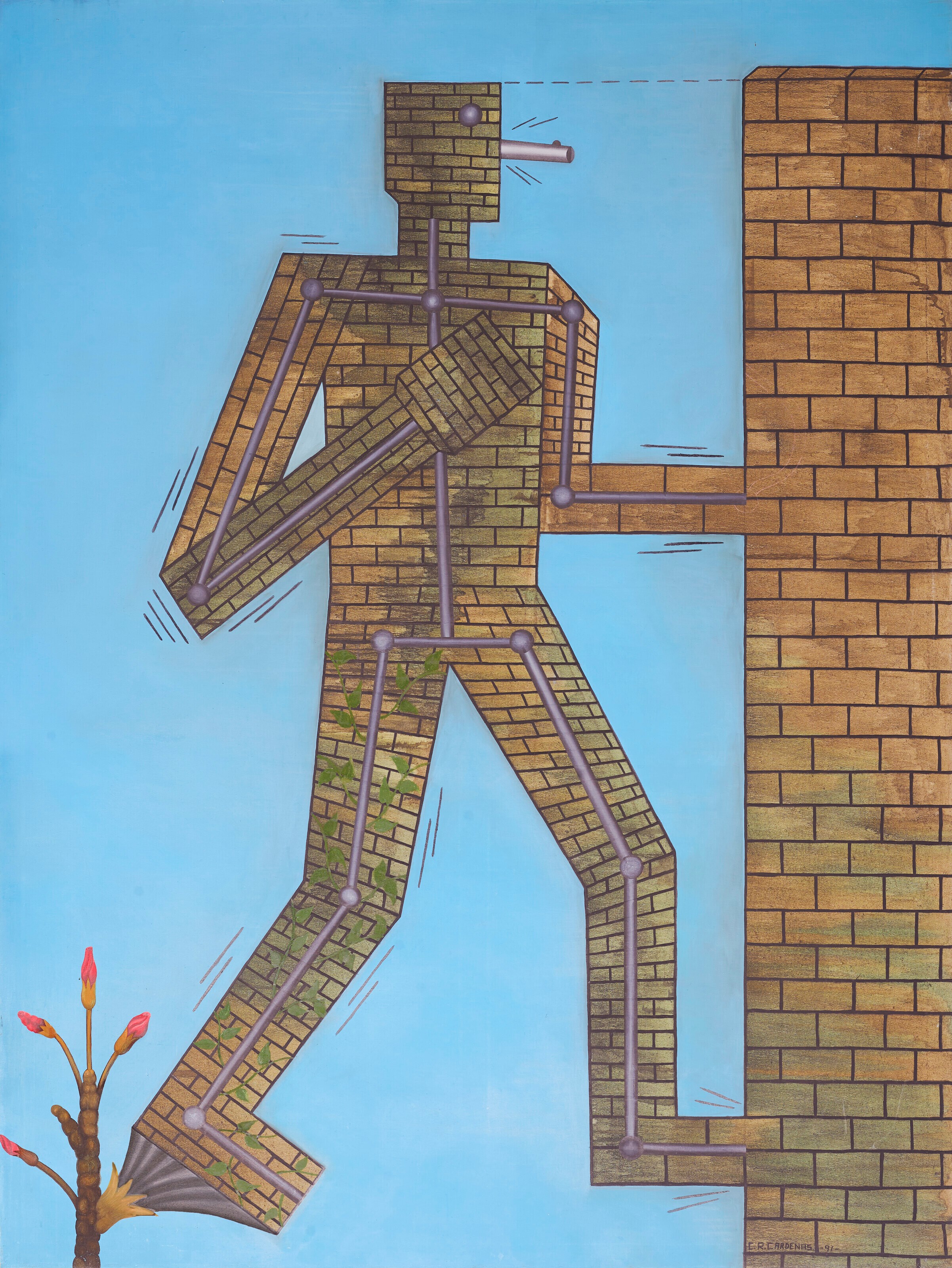
拍品 65OUTSIDE CUBA INSIDE: PROPERTY FROM THE FARBER COLLECTION OF CONTEMPORARY CUBAN ART
CARLOS CÁRDENAS (b. 1962)
Autodestrucción
已结束2023年10月5日
成交价
USD 5,040
更多信息
专家说明
A graduate of Havana’s Instituto Superior de Arte, Cárdenas came of age in 1980s Cuba, his practice ground in the irreverent humor and irony (“choteo”) that characterized the work of his generation. In the wake of his critical (and censored) exhibition Artista de calidad at Galería Línea (1988), he went to Mexico and from there to the United States, arriving in January 1993. “In Cuba he had used the language of revolutionary propaganda to articulate the imminent demise of the regime,” reported critic Judy Cantor. “As a consequence, he says, he feared for his life there. And he also feared for his art, dismayed that it was becoming a purely political tool” (“Carlos Cárdenas at Fredric Snitzer,” Art in America 81, June 1993, p. 109).
Cárdenas set up his studio in South Beach and opened his first solo show in the United States at Fredric Snitzer just months later, showing paintings—among them Autodestrucción—made since his departure from Cuba. Among works that retained the “graphic accessibility of a neighborhood mural” and “[began] to define a surreal iconography of universal displacement,” Autodestrucción “most specifically conveys Cárdenas’s ideas through images of frustration and shuttered expression,” Cantor noted. “It depicts a figure with a brick body, an iron spine and a jutting gun-barrel nose, who is shown repeatedly hitting his head, punching and kicking a solid brick wall. In a corner, the red flowers of a tropical plan are tightly closed, not budding but drawn up after a once-brilliant bloom” (ibid., p. 110).
Abby McEwen, Assistant Professor, University of Maryland, College Park