拍品 15
OLUWOLE OMOFEMI (B. 1988)
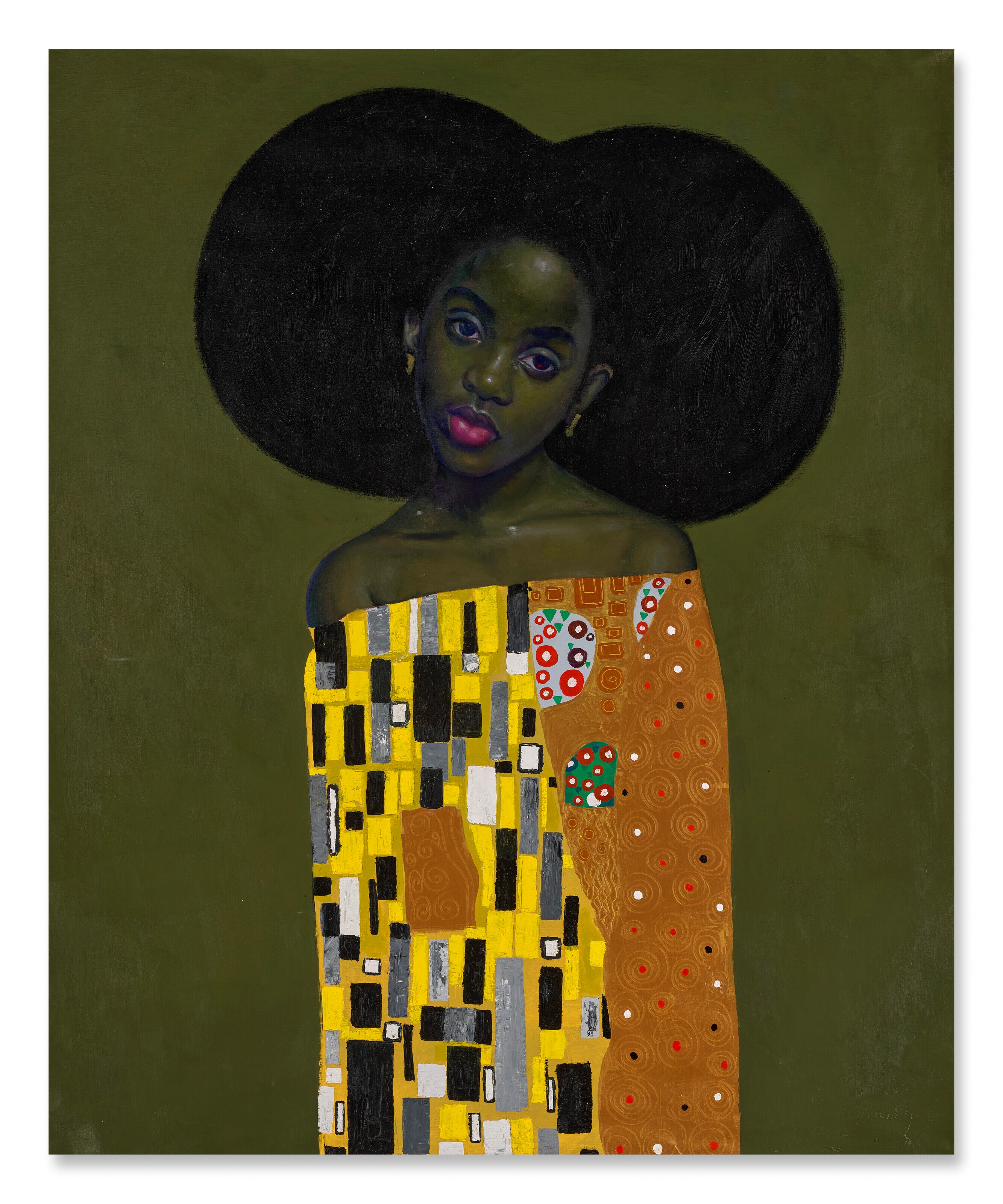
Providence
已结束2022年10月18日
成交价
GBP 138,600
更多信息
OLUWOLE OMOFEMI (B. 1988)
Providence
signed and dated 'Oluwole Omofemi 2021-22.' (on the reverse)
oil and acrylic on canvas
67 ¾ x 56in. (172 x 142.2cm.)
Painted in 2021-2022
Providence
signed and dated 'Oluwole Omofemi 2021-22.' (on the reverse)
oil and acrylic on canvas
67 ¾ x 56in. (172 x 142.2cm.)
Painted in 2021-2022
Acquired directly from the artist by the present owner.
Oluwole Omofemi will offer an NFT related to the lot free of charge to the successful bidder for the lot. If you are the successful bidder of this lot, Christie’s can put you in direct contact with the artist to discuss the NFT. The transfer of any NFT will be directly between the artist, Oluwole Omofemi, and the successful bidder for the lot.
The woman in Oluwole Omofemi’s Providence, 2021-2022 is magisterial. Set against an olive ground, she is radiant, her gaze fixed and determined. Wrapped in dazzling, tactile gold, Providence, offers a rejoinder to Gustav Klimt’s The Kiss (Lovers), 1908, which depicts a couple embracing; the Viennese Secessionist has long been a favourite of Omofemi. In Klimt’s painting, each figure wears robes of gold leaf, each adorned with decorative patterns suggestive of Art Nouveau curlicues, medieval manuscripts, glittering Byzantine mosaics. Love, according to Klimt’s pictorial allegory, is fundamental to human existence. If, however, The Kiss concerns romantic love, represented in the painting by its entwined figures, then Omofemi’s interpretation is more individual in narrative. His protagonist stares resolutely ahead, draped in fabric that references each of the outfits worn by Klimt’s figures. Moreover, by recasting a Black figure within an icon of Modern art, Omofemi wrests art history away from its previous and marginalizing discourses, thrusting it instead wholly into the now.
Born in 1988, Omofemi spent his childhood in Ibadan, Nigeria, dreaming of becoming a painter. While not encouraged by his family, he was active in his pursuit of an artistic career, befriending many local artists, studying the works of Ebenezer Akinola and Tope Fatunmbi, his city’s most renowned artists, and learning ceramics, textiles, and sculpture in addition to painting; his medium voracity can be seen in the textured drapery of Providence, 2021-2022. Soon Omofemi was sustaining himself through the sales of his art: In fact, some of his earliest portraits were commissioned by his schoolteachers. As his star rose, Omofemi began to look beyond Nigeria’s art scene, discovering artists such as Picasso and Klimt who became formative touchstones. By 2017, Omofemi’s subject matter became more political, drawing on the civil rights struggles, in particular the natural hair movement of the 1960s and 1970s during which individuals of African descent embraced the natural textures of their hair. Indeed, hair is the central motif in Omofemi’s practice, which he sees as a vehicle for addressing colonial racism and as a means of exploring identity and selfhood. In Providence, his figure wears her afro proudly, a crown to Klimt’s golden gowns. Hair to the artist is, above all, a ‘symbol of power’ and a ‘metaphor for freedom’ (O. Omofemi, cited in R. Assheton, ‘Oluwole Omofemi’s rapid rise to Nigerian art royalty’, Financial Times, 19 August 2022, https://www.ft.com/content/48217065-1aa9-403d-bf5d-feab6bd10cf1). It provides a motif for challenging what once was by offering up a new vision of what could be.
This lot has been imported from outside of the UK for sale and placed under the Temporary Admission regime. Import VAT is payable at 5% on the hammer price. VAT at 20% will be added to the buyer’s premium but will not be shown separately on our invoice.