拍品 5
Anonymous (Villa Alta de San Ildefonso, Oaxaca, 17th century)
Anonymous (Villa Alta de San Ildefonso, Oaxaca, 17th century)
已结束2022年2月18日
成交价
USD 11,875
更多信息
专家说明
Since the arrival of the Spanish in the sixteenth century, the production of coffers, escritorios or writing desks, baules or chests, and other typically adorned boxes that provided storage for an elite’s home, was assumed initially by carpenters from Spain. Indeed, these early carpenters, carvers, joiners and even lute makers, were all essential in the building of the first settlements or towns and by 1568, had organized their own guild. One of the requirements for membership in the guild included marquetry skills. In Spain, this special training in woodwork was part of the Islamic legacy that had come down from highly skilled masters during the various caliphates. Thus, after more than 700 years, the fusion of Christian and the pre-dominantly Arabic motifs had created a new stylistic tradition which was uniquely local. In Mexico, the thriving commerce with Asia via the Manila Galleon, made possible a profusion of stunning objects arriving from China and Japan. These would further add yet another aesthetic influence on the work by the local craftsmen who by the seventeenth century included creole, mestizo and the various indigenous groups. Furthermore, the arrival of Asian artisans, who often travelled in search of opportunities, also imparted new techniques.1
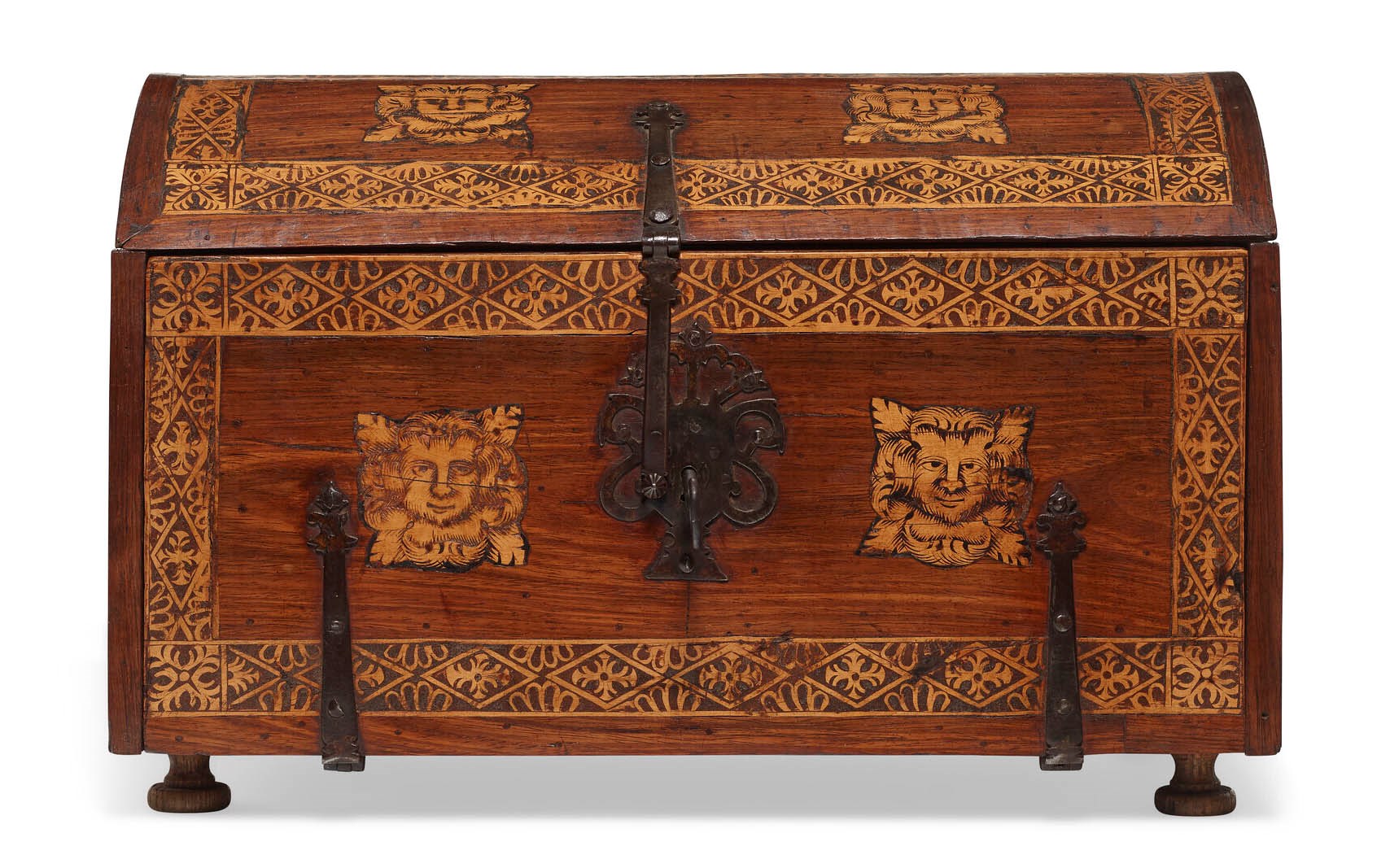
By the seventeenth century, the town of Villa Alta de San Ildefonso in Oaxaca was known for its dazzling marquetry which was uniquely developed by the artisans there. The designs used in their decorative patterns or scenes for objects such as this coffer were inspired by European engravings, mostly Flemish, which were prevalent at this time. These were incised in wood with great care and filled with a black substance known as zulaque--a bitumen-like paste of burnt lime, oil, and black vegetable dye extracted from the palo tinte or palo de Campeche, a tree that is abundant in the region. This oblong coffer, with an arched lid, is decorated with incised bands of geometric and floral patterns along its edges; these are complemented with mythical animal motifs. The locks and fittings are made of iron and the interior may have been covered in velvet or silk. A coffer such as this would have held papers or important documents belonging to its owner.2
M. J. Aguilar, Ph.D.