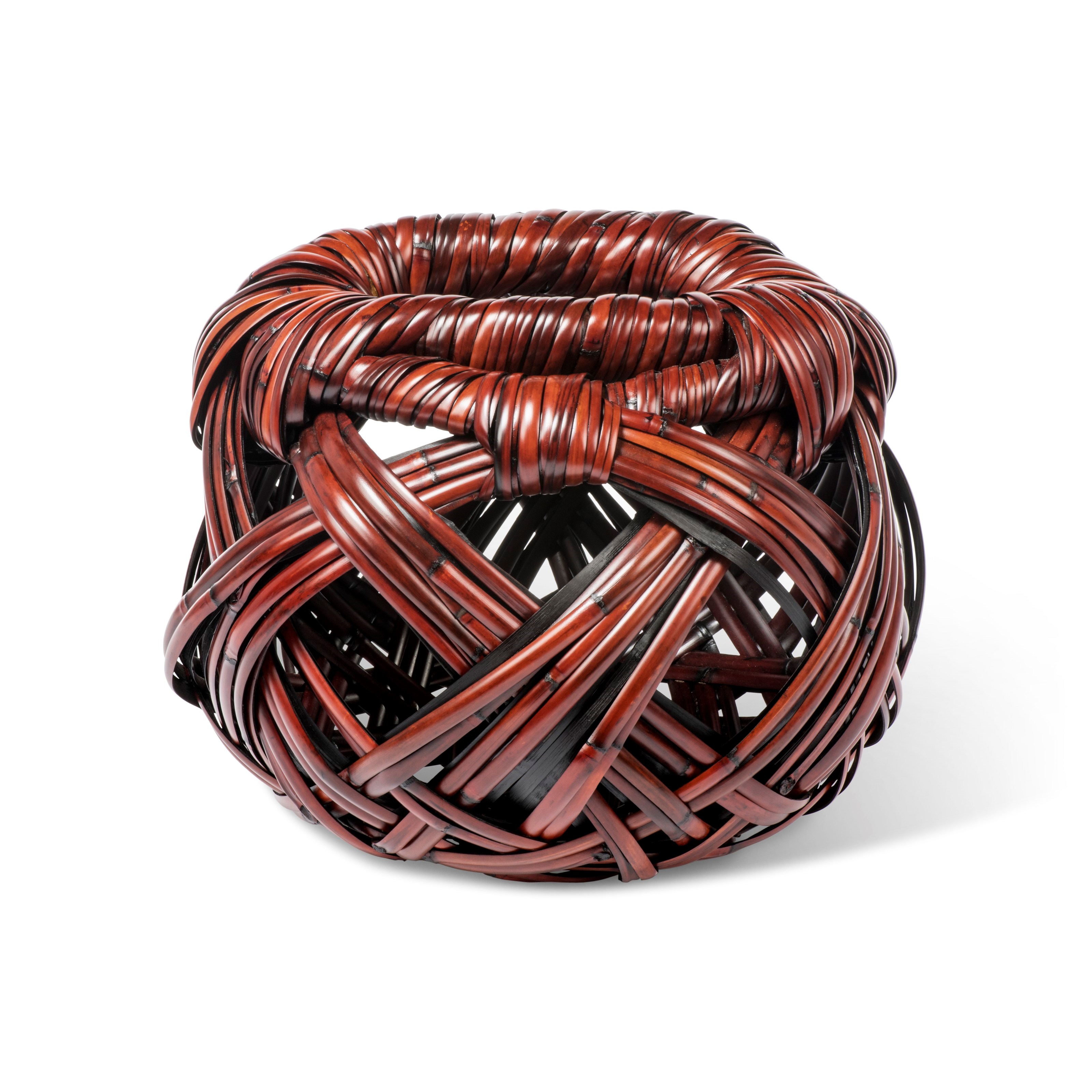
拍品 160
FUJINUMA NOBORU (B. 1945)
Energy I, 2004
已结束2021年12月9日
成交价
GBP 12,500
更多信息
专家说明
Fujinuma Noboru is considered amongst the most important bamboo basket artists currently active in Japan. He travelled to Paris aged 27 and decided to study traditional Japanese arts on his return to Japan, becoming an apprentice to the respected bamboo artist Yagisawa Keizo (1926 – 2005). For some years Fujinuma struggled to execute his ideas, but over time his style developed and his reputation grew. Finally in 1992 he was awarded the Tokyo Governor’s Prize at the 39th Traditional Craft Arts Exhibition, with the piece being purchased by the National Museum of Modern Art, Tokyo, go to:
https://search.artmuseums.go.jp/search_e/records.php?sakuhin=27
As noted by The British Museum: ‘Fujinuma works in two main styles. One is more traditional and aligned with his teacher, in which he employs alkaline dyes on very thin bamboo that he meticulous and carefully weaves into complex shapes that look at if they are vibrating or rippling (see Lot ?? SN00638207/154). In his other style he uses rattan and other types of bamboo in a more free-form style to capture movement and power in a sculptural form that is less traditional and more expressive’, as seen in the present lot.
See The British Museum, museum no. 2011,3018.1: https://www.britishmuseum.org/collection/object/A_2011-3018-1
In 2012 Fujinuma was designated as a Holder of Important Intangible Property (Living National Treasure) by the Japanese government for his bamboo craft technique and his works are in the collections of the Metropolitan Museum of Art, New York; British Museum, London; National Museum of Modern Art, Tokyo; Art Institute of Chicago; Asian Art Museum, San Francisco; Minneapolis Institute of Art; and the Denver Art Museum.