拍品 614PROPERTY OF A PRIVATE COLLECTOR (LOTS 614 - 625)
This collection mainly acquired in the 1970s and 1980s offers a comprehensive view of the glorious years of Transylvanian silver when the area was still part of Hungary. This historical region inhabited by Hungarians, Saxons and Romanians is located in the centre of Romania and developed a very strong identity through its complex culture and varied political history.
Hungary emerged as a recognized European force under the rule of King Matthias Corvinus (r. 1458–90). During his reign, the country became one of the most sophisticated cultural centres in early Renaissance Europe, which coincided with the arrival of skilled immigrants; the Saxons, from Luxembourg, Flanders and Germany who settled near the salt, copper, silver, and gold mines and proceeded to establish thriving merchant towns.
Matthias’ successors, however, were unable to repel the mighty Ottoman empire’s advances into Hungarian territory. The country’s political structure collapsed after the Turkish army won the decisive battle at Mohács in 1526 and western Hungary fell under the control of the Catholic Austrian Habsburgs.
During this period of economic and political instability that took hold in the early sixteenth century, artisans left war-torn Buda and the surrounding region and moved to the calmer regions of Royal Hungary in the northwest and Transylvania in the east. Workshops flourished under the guidance of strong guilds benefiting from the patronage of churches and monasteries as well as from the aristocracy and the rich merchants.
The demands of these affluent patrons were satisfied by new forms and designs developed by well-travelled Hungarian artists and by journeymen goldsmiths returning from their obligatory tours of the European cultural centres in Italy and Germany. Silver objects in an astonishing variety of shapes and sizes reflect the wide array of influences that artisans translated into a characteristic Transylvanian style. Standing cups and beakers were typically made with a flared cylindrical body raised on a hollow, spreading foot. Shallow bowls with small handles were used for serving brandy and other spirits as well as sweets and fruits. Decoration such as the so-called snakeskin ornament as well as floral decoration composed of large blooms entwined with foliage, were the most popular ornaments sometimes combined with animals and figures.
By adapting and innovating, these craftsmen created forms and motifs that seem to be unique to the region and would define Hungarian style.
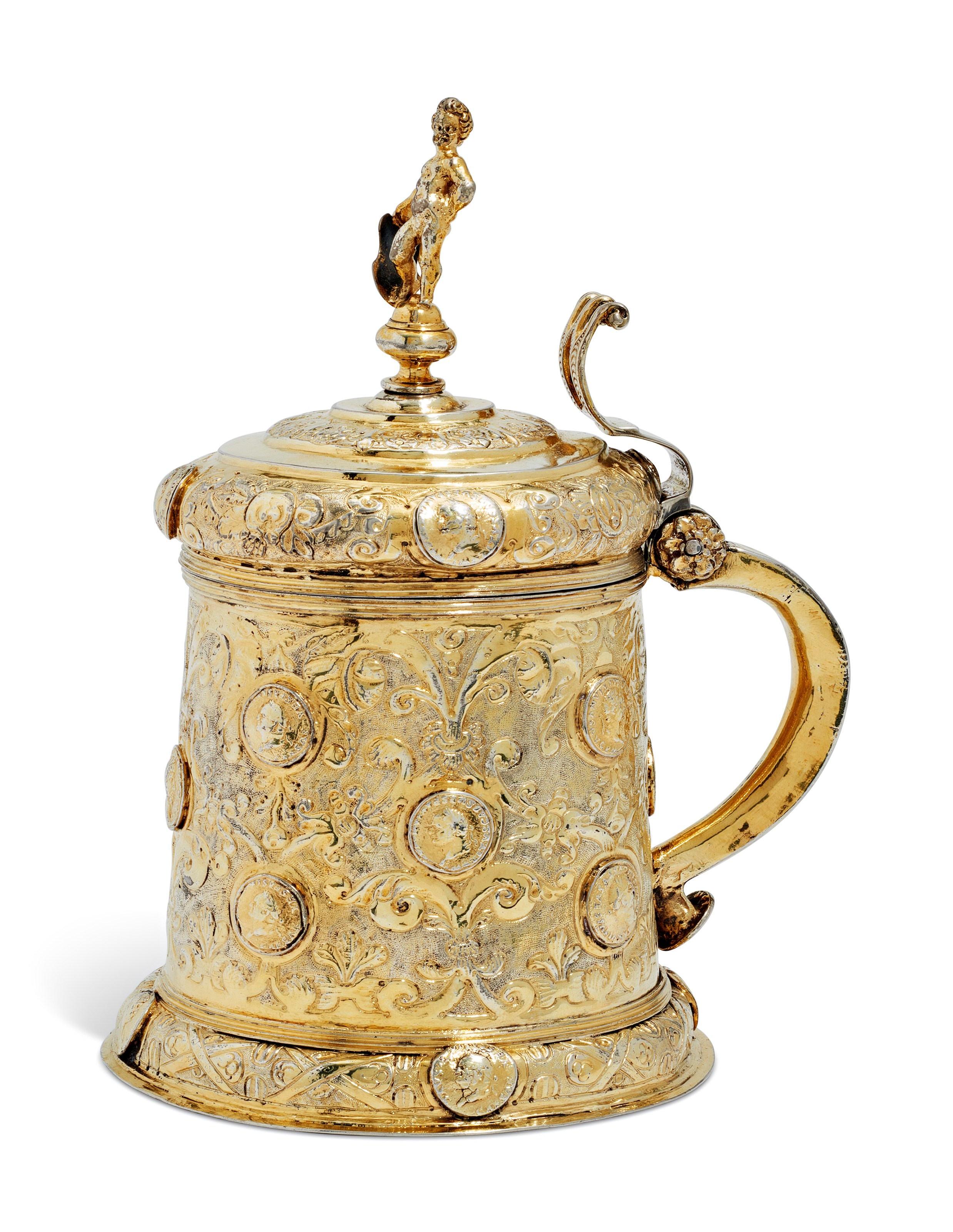
A HUNGARIAN SILVER-GILT TANKARD
MARK OF GEORGIUS RENNER, NAGYSZEBEN (SIBIU / HERMANNSTADT), CIRCA 1630
已结束2021年11月16日
成交价
GBP 16,250
更多信息
专家说明
For the maker's mark see E. Kőszeghy, Magyarországi őtvősjegywk a kőzépkortòl 1867-ig [Goldsmiths’ hallmarks in Hungary from the Middle Ages to 1867], Budapest, 1936, p. 246, no. 1391.