拍品 12
Jan Havickz. Steen (Leiden 1641-1676)
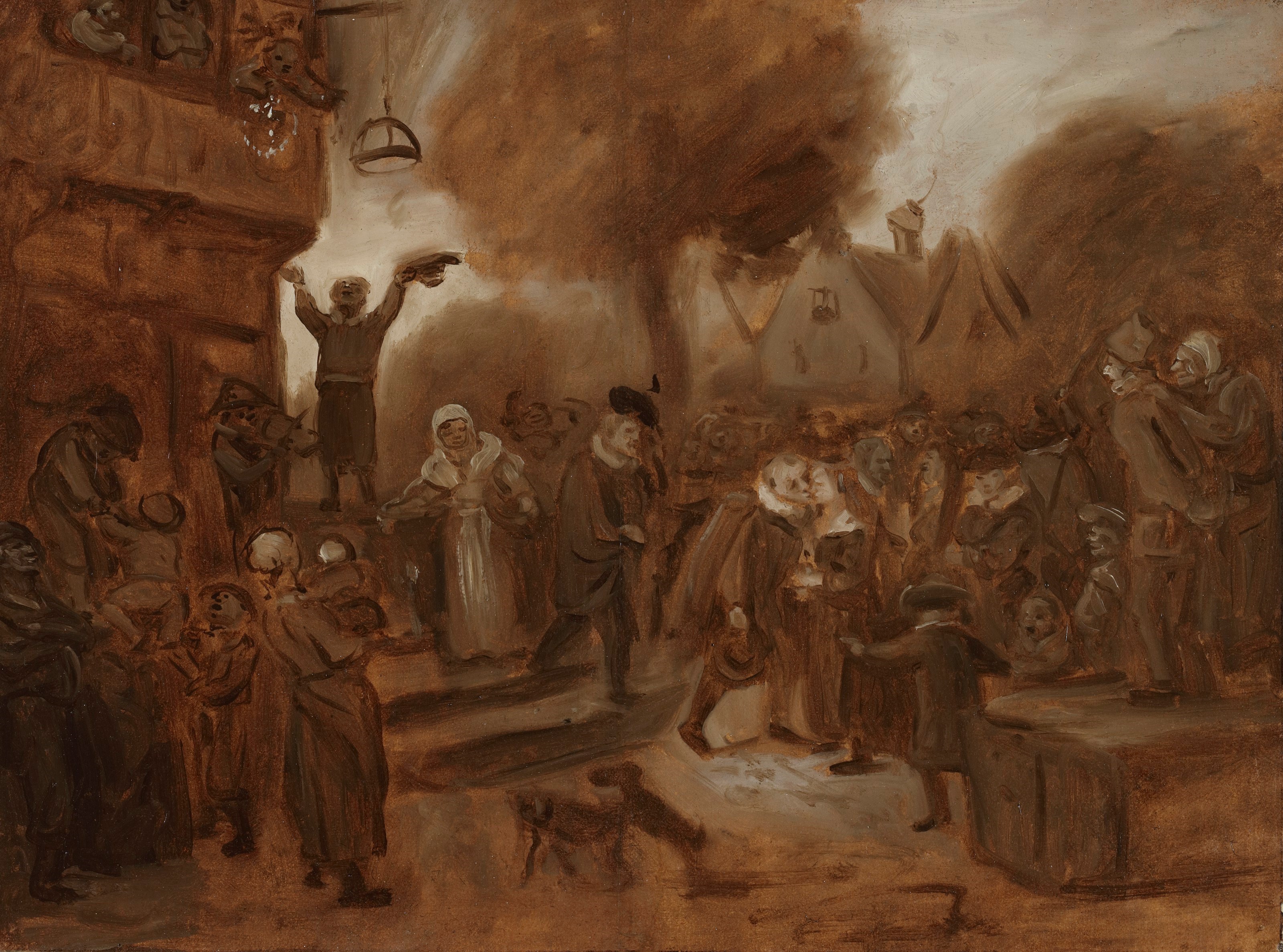
The village wedding - an oil sketch
已结束2021年10月6日
成交价
EUR 32,500
更多信息
专家说明
Sold in these premises in the sale of the heirs of Jacques Goudstikker in 2007 with an attribution to Steen, this charming and unique oil sketch has since again been fully attributed to Jan Steen by both Wouter Kloek and Guido Jansen.
Wouter Kloek, to whom we are grateful for his help in cataloguing this lot, regards this work as one of the very rare oil sketches by Jan Steen which has been preserved. He argues oil sketches such as the present must have been part of Steen's own collection and key for the artist in maintaining his enormous stock of various motifs. He must have possessed a large collection of sketches that he drew from time and again, sometimes much later, as models for certain figures and groups that he would reuse in the same poses in a variety of compositions. Curiously almost no drawings can be attributed to Steen with any confidence and oil sketches on paper were not often employed by artists working in the northern Netherlands. Indeed, it is only found in the oeuvres of Dirck Hals and his pupil, Anthonie Palamedesz., both, like Steen, specialists in genre painting (see P. Schatborn, Figuurstudies, The Hague, 1981, pp. 74-6). Wouter Kloek further points out that X-ray examination and close observations with the naked eye or through the microscope of a number of works revealed Steen's characteristic style of underpainting, which corresponds very closely to the technique of the present oil sketch. In preparation of the 1996 exhibition Jan Steen, painter and storyteller, “such sketches with the brush were found in almost all the paintings examined, executed in dark brown or black” (see: M. Bijl, ‘The artist’s working method’ in: Jan Steen, painter and storyteller, Washington/Amsterdam, 1996, p. 86).
The peasant wedding was one of Steen’s favourite subjects and was repeatedly painted by him. Closest in composition to the present sketch are the finished work formerly in the Goudriaan Collection, Rotterdam (Hofstede de Groot, no. 471, Braun, no. 39), dated to circa 1655 and the painting in Tokyo (Hofstede de Groot, no. 482, Braun, no. A-294), which was probably finished by a different hand. Multiple figures, groups of figures, gestures and compositional elements are either identical or alike to those in the oil sketch. Also in the peasant wedding in The Royal Scottish Academy in Edinburgh, several passages are exactly like those in the oil sketch.
Kloek suggests Steen must have painted this sketch around 1655.