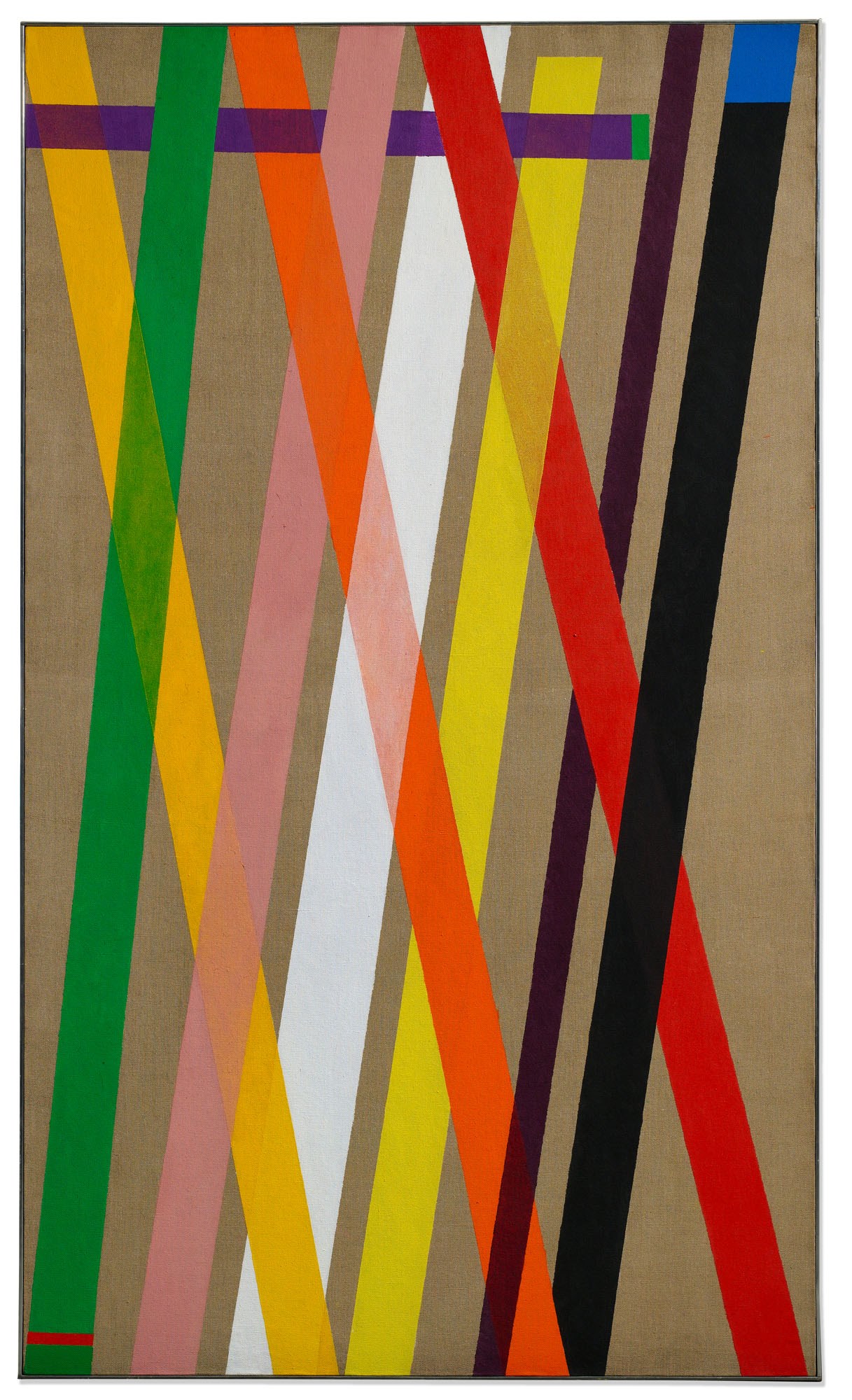
拍品 82PROPERTY FROM THE ESTATE OF PIERO DORAZIO
PIERO DORAZIO (1927-2005)
Senza bleu (Without Blue)
已结束2020年7月14日
成交价
GBP 112,500
更多信息
专家说明
Brilliant shafts of diagonal colour criss-cross, overlap and intersect across the tall, raw canvas of Senza bleu (Without Blue) (1967), an instantly recognisable abstraction by Piero Dorazio. The carefully-arranged beams of red, orange, green, pink, white, black and purple create an interactive chromatic dance that vibrates with light and sensation. An ongoing dialogue with optical experience lay at the heart of Dorazio’s practice. Evolving from his earlier experiments with Mondrian-esque grids, his canvases of the 1960s orchestrate spectra of translucent and opaque pigments into crisp, complex and captivating interplay.
In 1953, Dorazio had travelled from Rome to the United States, where he met the critic Clement Greenberg and the artists Robert Motherwell and Mark Rothko, among others, and absorbed some of the same utopian themes that occupied the Abstract Expressionists and Colour Field painters. Dorazio would visit New York and Philadelphia continually over the following years, splitting his time between Italy and the United States until 1970. He was also heavily inspired by the velocity and vivid colour of the works of the Italian Futurist Giacomo Balla, whose Roman studio he would visit often, and who became a close friend. Gradually, Dorazio crystallised his own language of reticular abstract structures that could communicate what he saw as universal, phenomenological experiences of light and colour: a vision he explored in works such as Senza bleu.
While his compositions were non-representational and concerned with the dynamics of surface, their regulated, formal patterning distinguished them from the gestural works of the Abstract Expressionists. Its lush beauty underlined with a tight, analytical logic, Senza bleu encapsulates Dorazio’s unique approach to the subtleties of seeing. As art historian Edward S. Fry wrote, ‘Painting of this kind does not come about as the result of psychic catharsis. It is to the contrary a celebration of the freedom, control, and self-awareness that support the highest levels of classical consciousness’ (E. Fry, ‘Piero Dorazio and the Crisis of European Values’, in Piero Dorazio: A Retrospective, exh. cat., Albright-Knox Art Gallery, Buffalo, New York 1980, p. 23).