拍品 4PROPERTY FROM A PRIVATE EUROPEAN COLLECTION
FERNAND LÉGER (1881-1955)
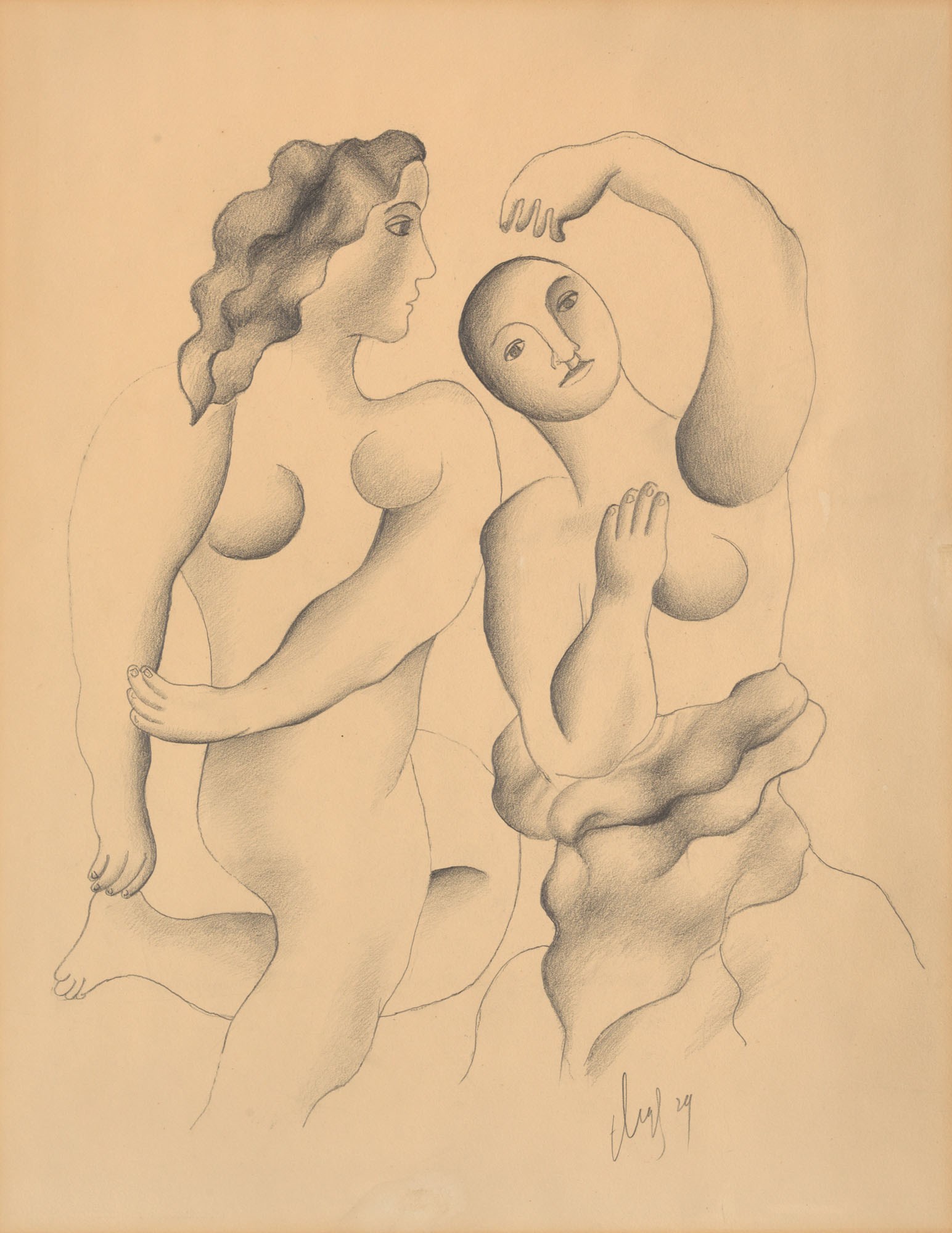
La danse
已结束2020年7月14日
成交价
GBP 81,250
更多信息
专家说明
Drawn in 1929, Fernand Léger’s La danse dates from a pivotal moment in the artist’s career as he left behind the austere mechanical aesthetic that had defined his immediate post-war work, and began to depict a more natural and organic conception of the world. Female figures, as well as natural objects, dominate his art of the late 1920s, as his paintings and works on paper became freed from the rigid, geometric stasis that governed his earlier work and infused with a new rhythm and heightened sense of life.
In the present work, La danse, Léger explores the undulating lines of his human figures to full effect, their languid yet statuesque bodies appearing to swim in reverie through the cloud-like pictorial space like Classical goddesses, creating a sense of dynamic flow around the composition. Gone are the mechanical, geometric forms with which Léger had constructed the human figure at the beginning of the 1920s; instead, the women’s bodies are depicted with a greater sense of naturalism, their undulating forms created with soft tonal gradations. It is these monumental women who would come to dominate Léger’s large-scale paintings of the 1930s and beyond.
The female figure had boldly entered Léger’s art in the early 1920s. Like many of his contemporaries in post-war Europe, the artist had responded to the ‘rappel à l’ordre’ or ‘return to order’ – an artistic movement that embodied the aesthetics of Classicism in response to the catastrophic chaos and devastation wrought by the war – and had begun to introduce reclining odalisques and nudes into his art. As the decade progressed, Léger’s compositions loosened: objects floated and hovered, while his depictions of the human form became softer and less mechanised. The figures depicted in La danse are no longer composed of distinct facets, and are undoubtedly softer and more human than their earlier robotic antecedents.
The two figures present in La danse figure across several significant compositions in oil, often in combination with other objects. Their tone as the focal point here remains beautiful, classical, eternal and monumental, suggestive of the joy and cyclical nature of life as reflected in their curvilinear movements, whilst remaining resolutely avant-garde. Their treatment on paper shows an appropriate sensitivity, an elegant consideration of balance and form and delicately assertive contrast that is characteristic of Léger’s best work in this medium.