拍品 97
The federal Constituion comes into force
Charles Thomson, 13 September 1788
已结束2020年6月18日
成交价
USD 18,750
更多信息
The federal Constituion comes into force
Charles Thomson, 13 September 1788
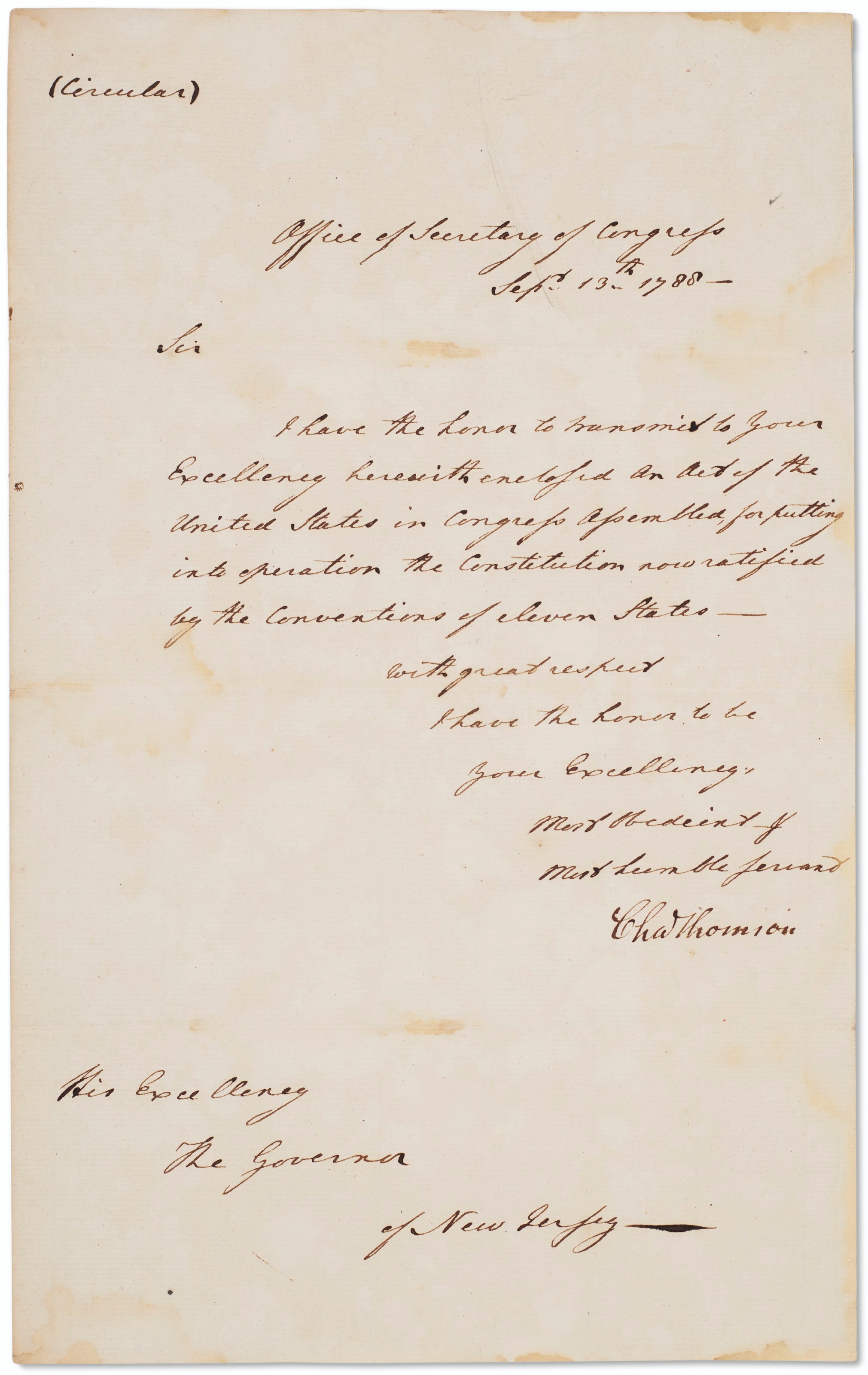
THOMSON, Charles (1729-1824). Letter signed ("Chas Thomson") as Secretary of Congress to [William Livingston], the Governor of New Jersey, "Office of Secretary of Congress," [New York,] 13 September 1788.
One page, bifolium, 320 x 198mm (light dampstains and mildly toned spots, minor marginal loss to blank integral leaf).
Putting the new federal Constitution into force: Charles Thomson forwards the Congressional resolution calling for the states to appoint electors and meet to choose the first President. Thomson signs this "circular" letter that would have been accompanied by "an Act of the United States in Congress Assembled, for putting into operation the Constitution now ratified by the Conventions of eleven States." That resolution called for 10 January 1789 to be the states to appoint electors, and for 4 February 1789 to electors to assemble to make their choice for President and Vice President. Only ten states participated in the first Presidential election. North Carolina and Rhode Island were ineligible having yet to ratify the Constitution, and New York was unable to appoint its apportionment of electors in time to vote on the appointed date. On 6 April, the recently convened House and Senate convened jointly to count the electoral votes and George Washington would take the oath of office in New York on 30 April 1789. Provenance: Forrest Sweet, 1950.