拍品 30|PROPERTY FROM THE COLLECTION OF DR. AND MRS. GREGORY ZILBOORG
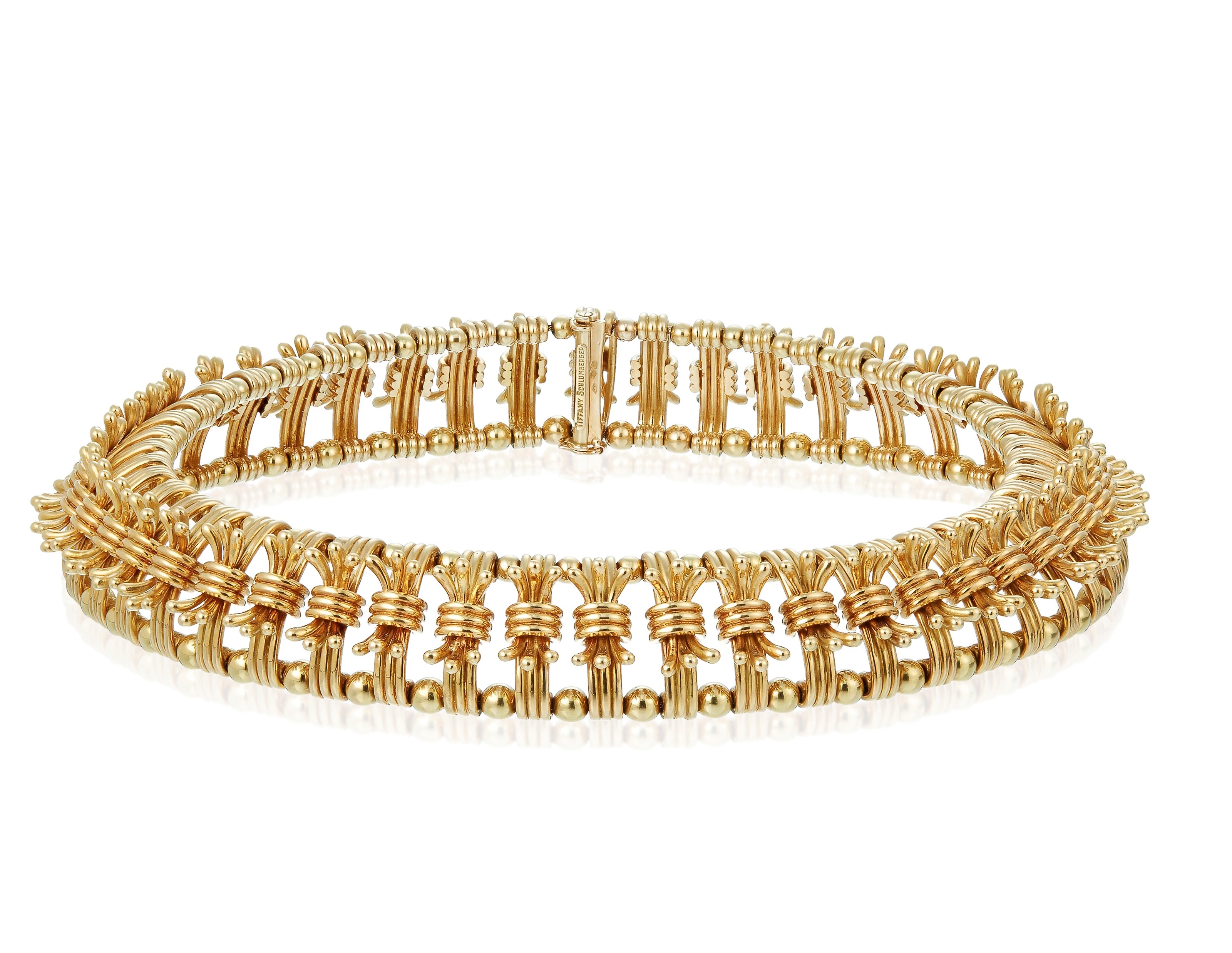
TIFFANY & CO. SCHLUMBERGER GOLD 'BOWTIE' NECKLACE
已结束2019年9月27日
成交价
USD 20,000
更多信息
TIFFANY & CO. SCHLUMBERGER GOLD 'BOWTIE' NECKLACE
Designed as a series of 18k gold bow tie links, to the sculpted gold boule trim
Metal: 18k yellow gold
Signature: TIFFANY SCHLUMBERGER
Marks: MADE IN FRANCE, French export marks, jeweler's mark
Size/Dimensions: 35 cm length, 2 cm width
Gross Weight: 209.1 grams
Accompanied by the orignal Tiffany & Co. Schlumberger box
Dr. Gregory Zilboorg (December 25, 1890 – September 17, 1959) was an influential psychiatrist and prominent psychoanalyst, as well as being a medical historian and writer. Russian-born, he obtained his medical degree in St. Petersburg and fought in the Russian Revolution, fleeing the country when the Bolsheviks surged to power in 1919. Emigrating to the United States, he gained a second medical degree from Columbia in 1926 and settled happily into New York society.
A prolific writer and researcher in his field, Zilboorg published thirteen books, including A History of Medical Psychology (1941) and Mind, Medicine and Man (1943), as well as being an originating editor of The Psychoanalytic Quarterly. Throughout his illustrious career, he treated such notable figures as Lillian Hellman, Judy Garland and George Gershwin, among others.
Avid art collectors during the pivotal post-war years in New York city, Dr. Zilboorg and his second wife, Margaret Stone, built an important collection of works, including Collective Suicide, by the politically radical Mexican muralist David Alfaro Siqueiros, which they donated to the MoMA during the 1940s. The couple fostered a close relationship with fellow art collectors John and Dominque De Menil, which no doubt was partially fueled by their shared interest.
According to the family, Dr. Zilboorg purchased this necklace for his wife from Tiffany & Co. in New York City, under the advisement of the De Menils, during the 1950s. A stunning early example of the “Bow Ties” design by Jean Schlumberger, this intricate sculptural motif endures as a timeless classic, and yet is refreshingly modern today. As a passionate innovator in the jewelry field, it is not surprising that Dr. Zilboorg was drawn to one of Schlumberger’s iconic designs.
Jean Michel Schlumberger (1907 - 1987) was an innovative French jewelry designer with a long and prolific career. Today he is most closely associated with Tiffany & Co. However, prior to joining the firm, Schlumberger had already made his mark on the world of jewelry design. He was born into a family in the textile industry in Alsace, France. As a child, Schlumberger was a burgeoning artist, always sketching. His parents refused to encourage this passion and prohibited him from receiving any kind of formal training. Instead, they sent him to Berlin to begin a career in finance. Despite this, Schlumberger was determined to pursue his passion and began his career in the world of fashion. In the 1930’s, starting with Elsa Schiaparelli, the cutting-edge clothing designer in Paris, he designed jewelry for her couture collection.
The end of the decade brought with it World War II and Schlumberger served in the French Army. Schlumberger served under General Charles de Gaulle and fought in the Middle East and at the Battle of Dunkirk. Following the war, Schlumberger made his way to New York, where he opened his own jewelry salon with Nicolas Bongard, who would become his longtime business partner. It was here that Schlumberger’s fanciful style was seen for the first time and soon became admired by fashionable women including Babe Paley, Elizabeth Taylor, and Jacqueline Kennedy.
The end of the decade brought with it World War II and Schlumberger served in the French Army. Schlumberger served under General Charles de Gaulle and fought in the Middle East and at the Battle of Dunkirk. Following the war, Schlumberger made his way to New York, where he opened his own jewelry salon with Nicolas Bongard, who would become his longtime business partner. It was here that Schlumberger’s fanciful style was seen for the first time and soon became admired by fashionable women including Babe Paley, Elizabeth Taylor, and Jacqueline Kennedy.