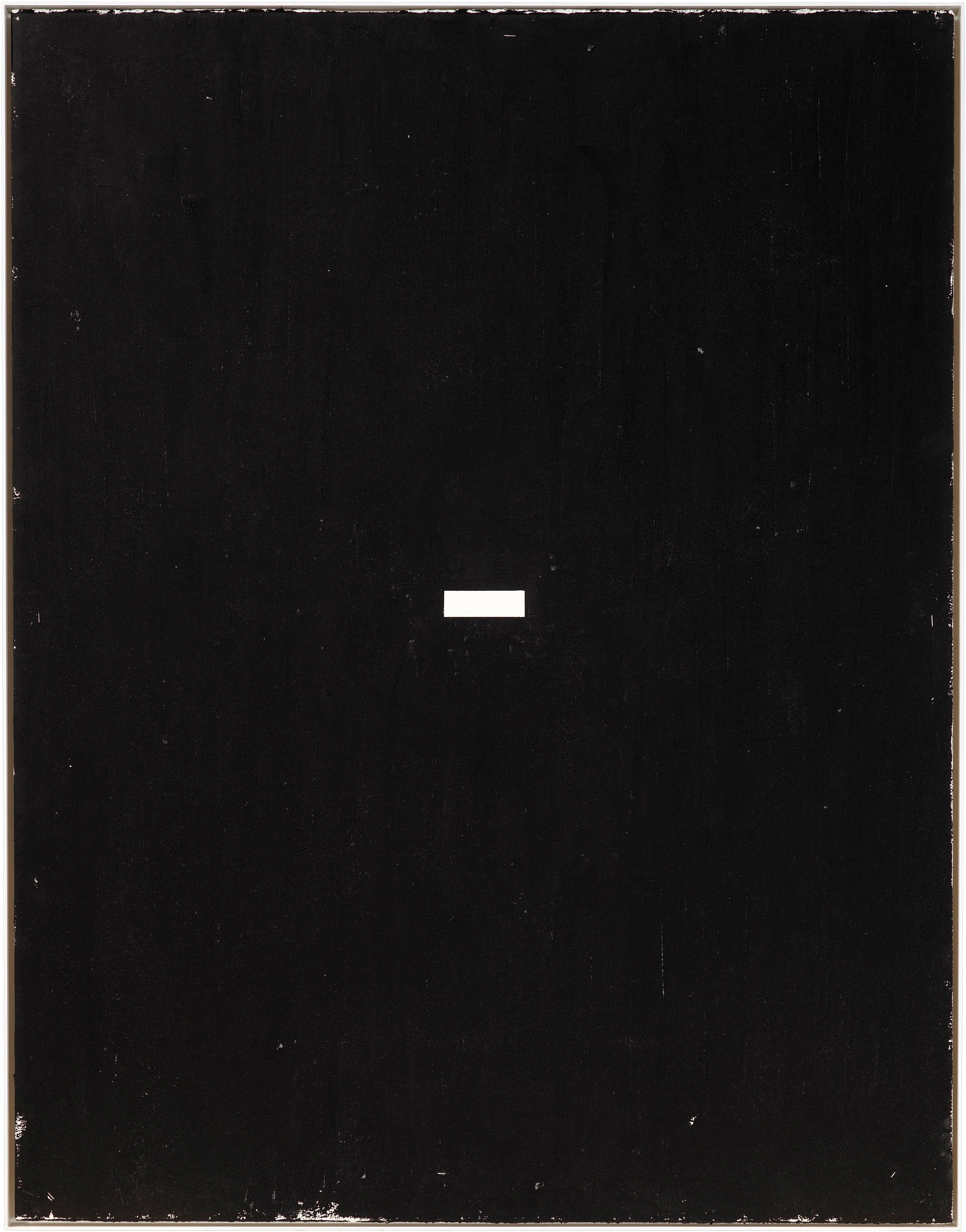
拍品 57Property from an Important Private Collection
Harold Ancart (b. 1980)
Perfect Idea (2) (After You Have No Idea)
已结束2018年9月20日
成交价
GBP 27,500
更多信息
专家说明
‘When, in the year 1913, in my desperate attempt to free art from the ballast of objectivity, I took refuge in the square form and exhibited a picture which consisted of nothing more than a black square on a white field. The critics and, along with them, the public sighed, 'Everything which we loved was lost. We are in a desert.. .Before us is nothing but a black square on a white background!' But the desert is filled with the spirit of non-objective feeling.. ..which penetrates everything.’
- Kazimir Malevich
Harold Ancart’s large-scale painting Perfect Idea (2) (After You Have No Idea) is a play of balanced forces. The work is covered entirely in black oil pastel save for a small white rectangle at its centre, which has the concentrated potency of a collapsed star. Ancart will be creating new work for the upcoming group exhibition Painting the Night, 2019, at Centre Pompidou-Metz. The show takes as its premise the thematic of night, and Ancart’s work will be exhibited alongside those by Francis Bacon, Brassaï, and Gerhard Richter among others. Executed in 2014, Perfect Idea (2) (After You Have No Idea) is tactile, each swipe and smudge visible on the panel; Dodie Kazanjian called Ancart’s paintings ‘vivid and utterly unpredictable’ (D. Kazanjian, ‘Up Close and Personal’, Vogue, September 2016, n. p.). Perfect Idea (2) (After You Have No Idea) presents a geometric minimalism, an exploration into the architectural properties of space through dynamic contrasting forms.
Ancart takes the whole of modern painting’s history as the subject of his practice. With its black surface, Perfect Idea (2) (After You Have No Idea) evokes a range of abstract works including Kasimir Malevich’s Black Square, 1915 and Ad Reinhardt’s series of square black paintings executed during the 1960s. If Malevich’s blackness gestured towards utopia—canvases liberated from depicting the world—Reinhardt wanted a ‘pure, abstract, non-objective, timeless, spaceless, changeless relationless, disinterested painting’ (A. Reinhardt, 'Autocritique de Reinhardt', reprinted as Art as Art: The Selected Writings of Ad Reinhardt, New York, 1975, pp.82-3). Ancart suggests no such ideology, but blackness does not mean absence. Instead, Perfect Idea (2) (After You Have No Idea) is wholly tied to the world, figural and explosive.