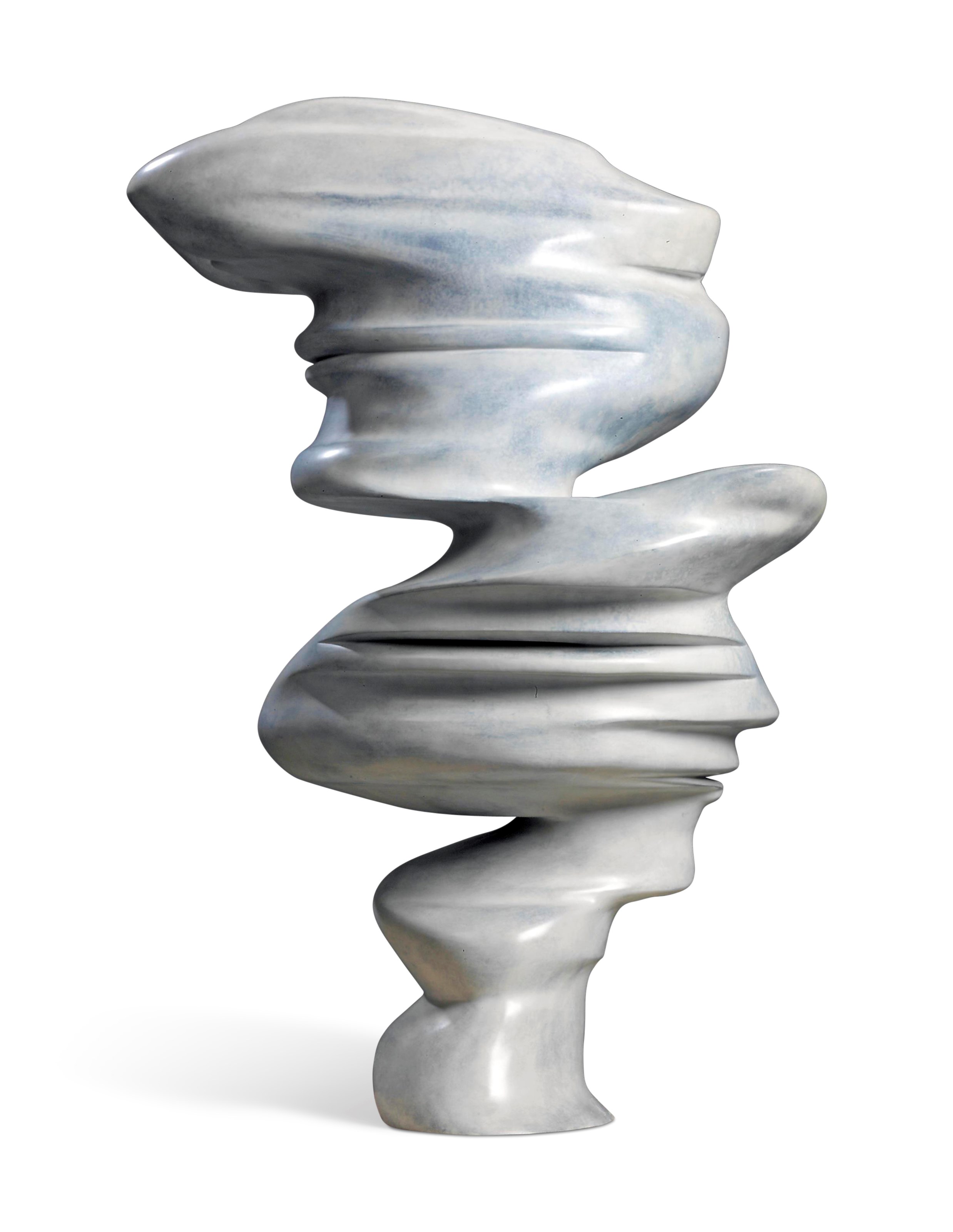
拍品 24Property from an Important Italian Collection
Tony Cragg (b. 1949)
Level Head
已结束2018年9月20日
成交价
GBP 112,500
更多信息
专家说明
‘Although I have rarely attempted to depict the figure it will always be a preoccupation. But, more in the sense of the question, “Why do we look like this?”’ (Tony Cragg)
'One step away from the axis and the faces start to grimace, and even further away from the axis the column melts into unexpected sculptural volumes. Normality often seems to be a desired balance of aesthetic and form, one with which we can cope and which does not challenge us too much. [...] Here we are exercising aesthetic values or, concepts of beauty for existential reasons, using the criteria with which we select our partners, or choose landscapes and other material sustenance we need to survive
In Tony Cragg’s Level Head, stacked human profiles emerge from a biomorphic bronze mass, resolving and dissolving from different angles. Executed in 2005, the work belongs to the artist’s iconic Rational Beings series: the culmination of decades of research into the relationship between material and form. Evolving from his Early Forms, which transformed familiar objects into unfamiliar apparitions, these works sought to interrogate our emotional responses to abstract edifices. Consisting of stacked circular discs coated in bronze – the artist’s favoured medium – the work’s present surface is distinguished by its resemblance to marble, placing it in dialogue with the lineage of classical sculpture. Cragg, however, ultimately breaks away from figurative tradition, exploring our propensity to identify natural and human forms in oblique manmade constructions. ‘The intention was not to make portraits’, Cragg explains, ‘but rather to mark the axial views with recognisable silhouette. One step away from the axis and the faces start to grimace, and even further away from the axis the column melts into unexpected sculptural volumes. Normality often seems to be a desired balance of aesthetic and form, one with which we can cope and which does not challenge us too much. A slightly larger nose, a blemish on the surface, or slight asymmetries, and although the material variations are very slight the emotional impact can be considerable. Here we are exercising aesthetic values or, concepts of beauty for existential reasons, using the criteria with which we select our partners, or choose landscapes and other material sustenance we need to survive’ (T. Cragg, In and Out of Material, Cologne 2006, p. 190).
Coming to prominence in the 1980s, Cragg has always been fascinated by the extent to which medium determines appearance. The word ‘material’, he points out, derives from the Latin ‘mater’, for ‘mother’: it effectively ‘gives birth’ to the finished sculptural creation. As a young man Cragg spent time as a lab technician at the National Rubber Producers Research Association, subsequently moving to Wuppertal, Germany in the 1970s. Many of his early creations consisted of found objects, which he assembled into site-specific installations. Gradually, through his Early Forms, he began to interrogate the properties of these objects, looking more closely at the materials that gave rise to their structures. The Rational Beings series, which Cragg began in the 1990s, witnessed a sustained engagement with the medium of bronze. ‘I call bronze the archaic plastic’, he has explained; ‘… When you melt bronze it’s more liquid than water. So you can cast very fine, complex forms from it. People knew this 6,000 years ago. Bronze has never lost its relevance’ (T. Cragg, quoted in M. Hudson, ‘Tony Cragg: Sculptor Who Looks Beneath the Surface’, in The Telegraph, 28 August 2012). Through this historically-charged medium, Cragg’s writhing, embryonic forms pose fundamental questions about human identity, pointing up our desire to view the world through our own image.