拍品 5PROPERTY FROM A PRIVATE ITALIAN COLLECTION
Lucio Fontana (1899-1968)
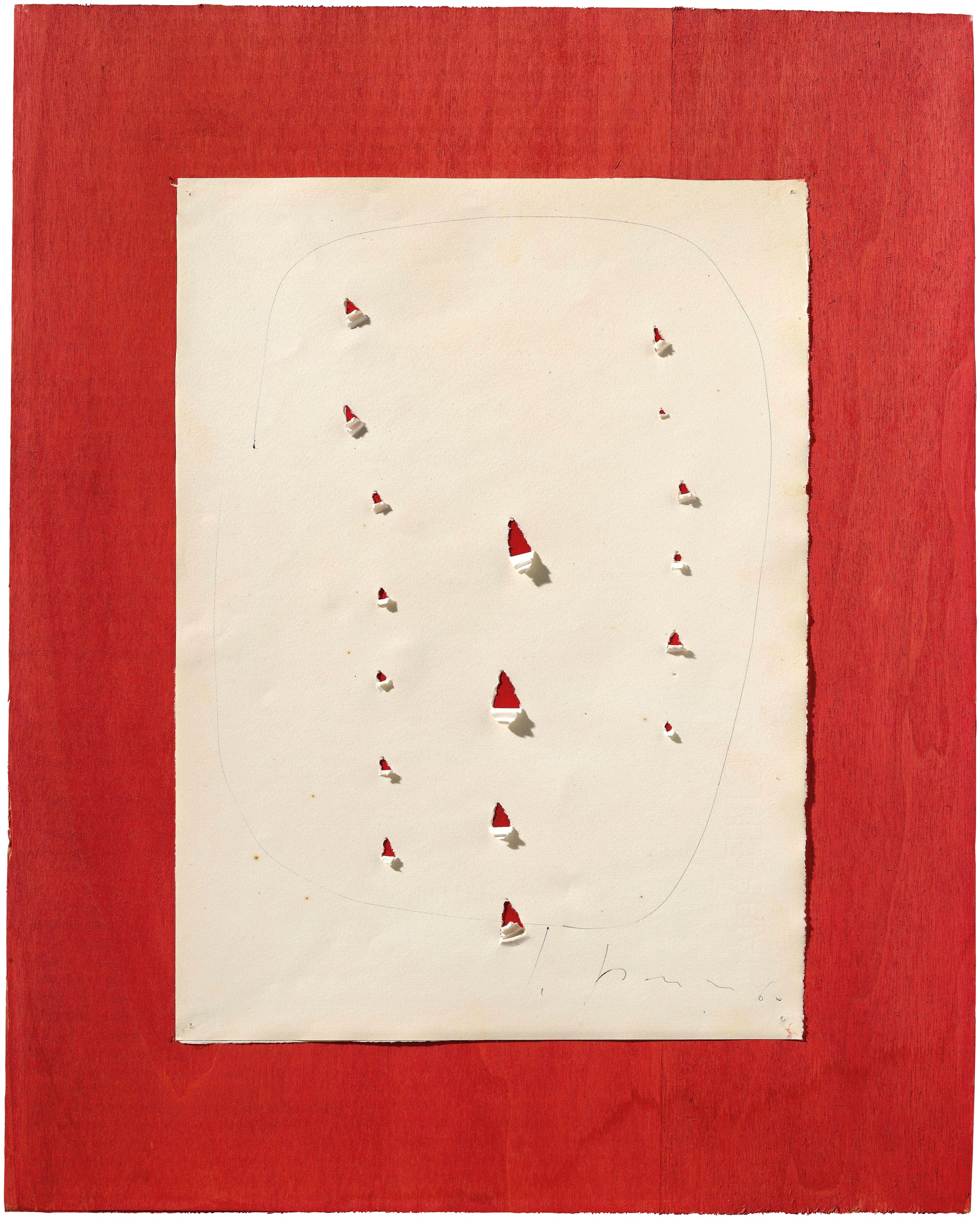
Concetto spaziale
已结束2018年9月20日
成交价
GBP 30,000
更多信息
专家说明
‘The hole is, precisely, creating this void behind there... And so here we have: foreground, middleground and background... to go farther what do I have to do?... I make holes, infinity passes through them, light passes through them, there is no need to paint' (Lucio Fontana, quoted in E. Crispolti, 'Spatialism and Informel. The Fifties', pp. 144-150 in: Lucio Fontana, E. Crispolti and R. Siligato (eds.), Milan 1998, p. 146).
Executed in 1960, Concetto spaziale is an elegant work on paper belonging to Lucio Fontana’s iconic series of buchi (‘holes’). Initiated in 1949, two years after releasing his First Spatialist Manifesto, these works launched his revolutionary mission: namely, to pierce the inviolable surface of the canvas and, in doing so, to reveal a new uncharted dimension for art. Fascinated by the discoveries of the Space Age, Fontana sought to create a visual language that corresponded to mankind’s renewed understanding of the cosmos, later expanding his buchi into sweeping tagli (‘cuts’). The works on paper formed a crucial strand of his practice, offering a vital forum for experimentation: ‘they amounted to a sort of laboratory of immediacy’, observed Enrico Crispolti (E. Crispolti, Lucio Fontana: paintings, sculptures and drawings, exh. cat., Ben Brown Fine Arts, London, p. 82). In the present work, the faint oval shape encircling the buchi points to the artist’s fascination with the symbolism of the egg, predating his landmark series La Fine di Dio begun three years later.
Executed in 1960, Concetto spaziale is an elegant work on paper belonging to Lucio Fontana’s iconic series of buchi (‘holes’). Initiated in 1949, two years after releasing his First Spatialist Manifesto, these works launched his revolutionary mission: namely, to pierce the inviolable surface of the canvas and, in doing so, to reveal a new uncharted dimension for art. Fascinated by the discoveries of the Space Age, Fontana sought to create a visual language that corresponded to mankind’s renewed understanding of the cosmos, later expanding his buchi into sweeping tagli (‘cuts’). The works on paper formed a crucial strand of his practice, offering a vital forum for experimentation: ‘they amounted to a sort of laboratory of immediacy’, observed Enrico Crispolti (E. Crispolti, Lucio Fontana: paintings, sculptures and drawings, exh. cat., Ben Brown Fine Arts, London, p. 82). In the present work, the faint oval shape encircling the buchi points to the artist’s fascination with the symbolism of the egg, predating his landmark series La Fine di Dio begun three years later.