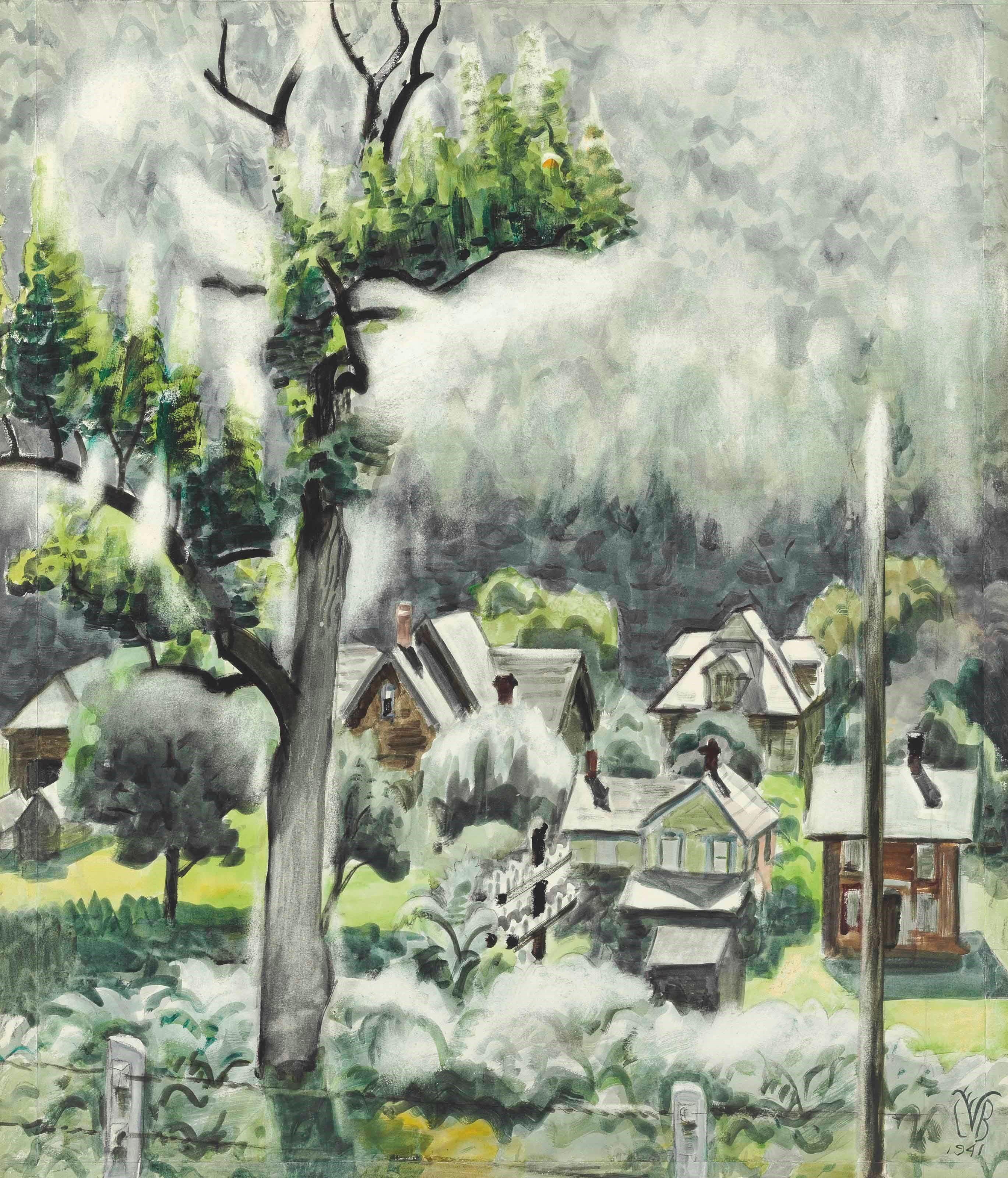
拍品 87Property from an Important Midwest Collection
Charles Ephraim Burchfield (1893-1967)
View Southeast of Emporium (Village by a Mountainside)
已结束2016年3月23日
成交价
USD 100,000
更多信息
专家说明
Charles Burchfield is one of the most celebrated American watercolorists of the twentieth century, and a true naturalist who painted with a deep understanding and true love of the landscapes of rural America.
In particular, Burchfield meditated at length about the place of the house in American life, a theme frequently explored in his paintings, such as View Southeast of Emporium (Village by a Mountainside). Kenneth L. Ames explains, "It should not be surprising that a painter weaned on picturesque sentimentalism would make houses prominent elements in his work. Growing up in the 1890s and early years of this century, Burchfield could hardly have escaped an awareness of Victorian America's obsession with houses and domestic life. In the Victorian ideology of domesticity, homes, as they were called, were aggressively promoted as the most important institutions within society. Literature on the architecture and furnishing of homes and on the proper conduct of domestic life was ubiquitous and inescapable...In Burchfield's work the Victorian obsession with houses take three distinct but interrelated forms. First, Burchfield sees houses as the locus of spirits or as anthropomorphic structures. Second, he is fascinated by the affective powers of old houses and houses that look old. Third, and perhaps most intriguing, he is drawn less to the facades of houses than to their backs, which he records in numerous images." ("Of Times, Places, and Old Houses," in N. Maciejunes, M. Hall, The Paintings of Charles Burchfield: North by Midwest, New York, 1997, p. 57)
In addition to this motif of the spirit of the American home, the present work also distinctly features a larger-than-life tree, an important symbol in Burchfield’s work variously employed to suggest life and regeneration, death and decay, or meant to take on religious significance. "Burchfield seems to have identified particularly closely with trees, and they play the role for him that figures do in the work of most other artists. As one looks through Burchfield's work, it becomes apparent that he divided trees into fairly distinct types, each of which seems to have a specific 'personality' and emotional significance...[as seen in the present work,] there is the tree, often a pine tree, that stands stiff and straight, often off by itself. It seems likely that such trees are a surrogate for Burchfield himself, a physically inhibited man, who stood stiffly erect and felt awkward in social settings." (H. Adams, "The Context of Meaning" in The Paintings of Charles Burchfield: North by Midwest, p. 114)
With a powerful combination of painterly, conceptual and poetic maneuvering, Burchfield combines these two motifs of the American home and the independent, resilient tree to create a work both timeless and fascinating.