拍品 52
Francis Augustus Silva (1835-1886)
Sailing Vessels off Cape Ann
已结束2016年3月23日
成交价
USD 87,500
更多信息
专家说明
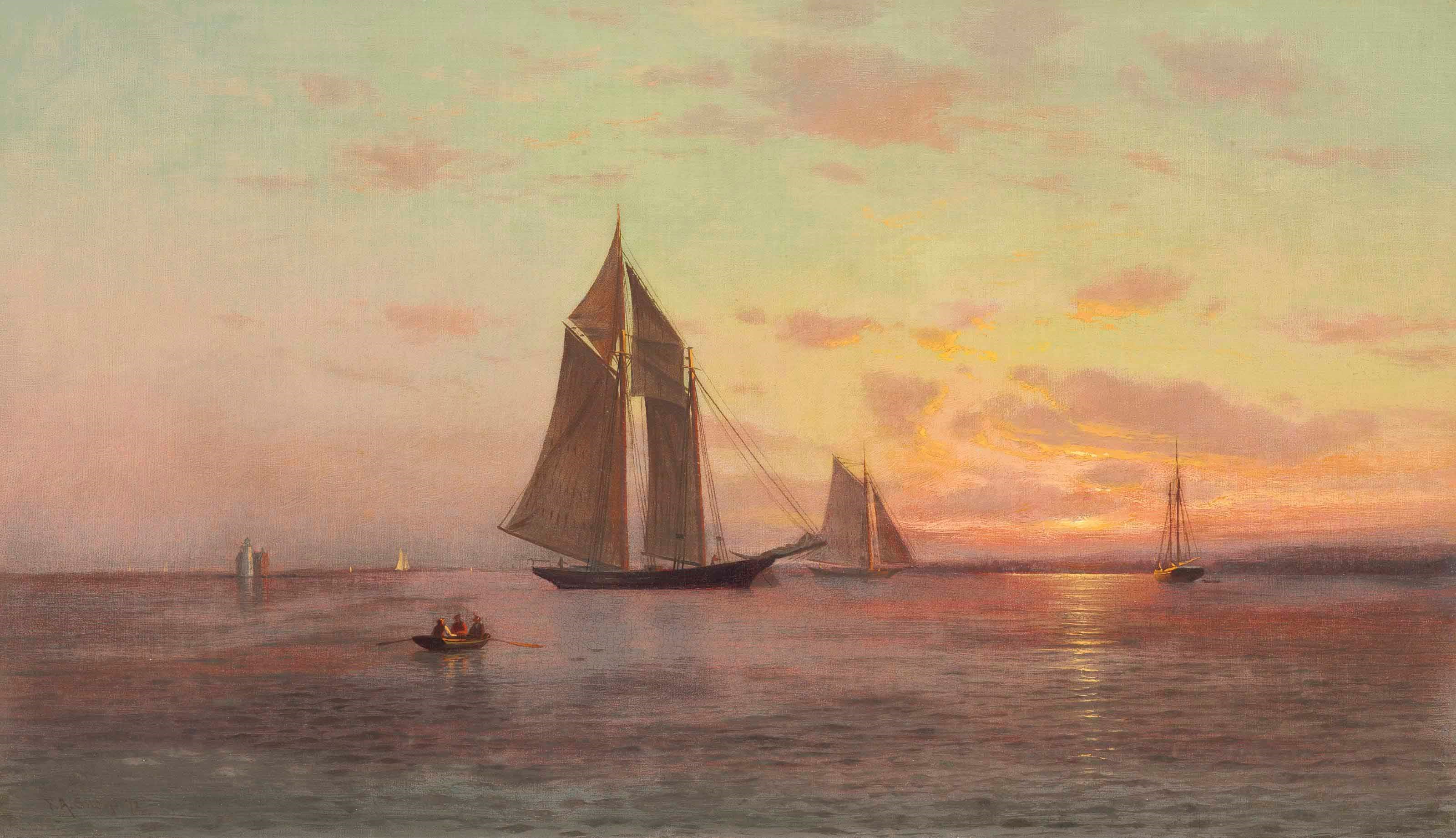
With time suspended within the few fleeting moments when twilight gives way to dusk and the sun makes its final descent below the horizon, Francis Augustus Silva's Sailing Vessels off Cape Ann captures the glowing remnants of a lingering sunset in vivid contrast to the umbrage of early evening. Silva's vivid palette bathes the sky and reflections on the water with an opalescent light, while cloaking the foreground of the scene in soft, dim shadows. As in the best of the genre, the work gleams with the brilliance of American Luminist painting, masterfully manipulating the effects of light off the coast of Massachusetts to create an evocative mood.
Luminism, deemed by scholar John Wilmerding as "the culminating phase of Hudson River Painting," (American Light: The Luminist Movement, 1850-1875, exhibition catalogue, Washington, D.C., 1980, p. 1) reflected the particularly American consciousness of the effects of light and atmosphere and is widely considered to be the aesthetic counterpart to Ralph Waldo Emerson's treatise Nature and the writings of Henry David Thoreau. While the Luminist movement was not formally categorized until 1954 by noted art historian J.I.H. Baur, artists' preoccupation with depicting a nature of empty quietude can easily be found in the works of Silva's predecessors Fitz Henry Lane, Martin Johnson Heade and Sanford Robinson Gifford, among others. The work of these artists is characterized by a common preference for marine subject matter, rendered with meticulously polished brushwork and theatrical effects of luminous light and color that imbue their coastal scenes with a remarkable transcendental quality.
As embodied by the present work, Silva stands out among the nineteenth-century painters of marine subjects due to his deep understanding of a spiritual, meaningful use of light in his work. Indeed, Silva himself wrote, “A picture must be more than a skillfully painted canvas;--it must tell something. Some men can never paint from memory or feeling--they give us only cold facts in the most mannered way. Many of our artists learn certain artists' tricks and then repeat them continually, with no idea of the deeper meaning of the art, but only of the outside of things, and very trivial things at that. All earnestness of purpose is lost, and with them art becomes a useless field of affectation where their tricks of color and handling are displayed. The subject must convey no sentiment--call up no emotion, awaken no interest." (as quoted in J.I.H. Baur, "Francis A. Silva, Beyond Luminism," Antiques, November 1980, p. 1018)
In Sailing Vessels off Cape Ann, Silva demonstrates his mastery of this all-important use of dramatic, evocative light. The setting sun glints from behind cloud cover, casting a purple-pink glow into the sky and a smoky shadow over the bright white sails that would gleam by day in the Cape Ann harbor. Silva's attention to detail is evident in his rendering of the subtle gradations of light caused by the hazy evening air. Adding to this sense of precision, and fitting within the Luminist aesthetic, is Silva's expert rendering of the sailboats, and even the small rowboat, that populate the harbor. The artist's refined use of color, deliberately applied nuances of tinted light and crystalline surfaces of calm waters in this work define Silva's unique and celebrated pictorial vision.