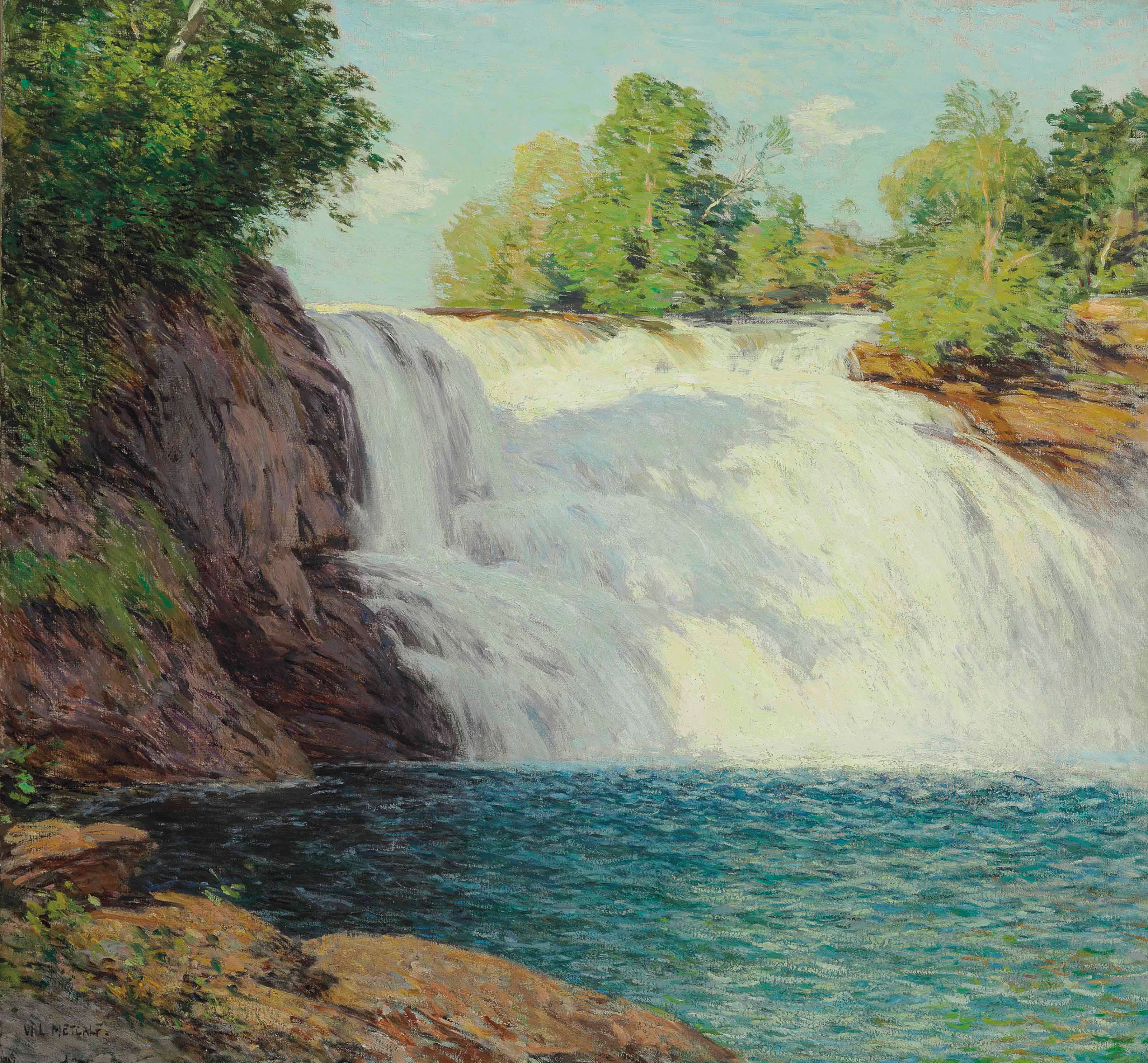
拍品 25Property of Alma College, Proceeds go to the Annie Reid Knox Endowment Fund to Support Student Scholarships and Operations of the College
Willard Leroy Metcalf (1858-1925)
The Waterfall
已结束2016年3月23日
成交价
USD 173,000
更多信息
专家说明
This work will be included in the forthcoming catalogue raisonné in formation by the Willard Leroy Metcalf Catalogue Raisonné, Inc. being compiled by Betty Krulik.
The Waterfall, by Willard Leroy Metcalf, exemplifies the combination of his consummate Impressionist technique and palette with his "insistence upon sure, pronounced draftsmanship and a careful delineation of space, often through emphasis upon a series of strong and clear diagonals [which] point back into the distance." (W.H. Gerdts, American Impressionism, Seattle, Washington, 1980, p. 79) The attention to light, expressive brushwork and palette of the present work all recall Metcalf's time in Giverny, while the emphasis on detail and composition stem from his affinity for the New England landscape. This synthesis results in a highly personal and distinctly American approach that characterizes Metcalf's best work.
Metcalf eschewed identifying with a single artistic movement; it was the depiction of the landscape rather than an allegiance to a single school that governed his work. "Always reluctant to give unqualified commitment to any single style, school, or movement--if it compromised his freedom to respond in the way he wished in his portrayal of an American scene in what he deemed to be an American manner--he had usually kept his options open, despite Childe Hassam's persistent pressuring for allegiance to Impressionism." (E. de Veer, Sunlight and Shadow: The Life and Art of Willard L. Metcalf, New York, 1987, p. 88) The Waterfall represents a fresh and original approach to the American landscape in which Metcalf accurately depicts the scene, while also conveying the time and sentiment of the day through his attention to the characteristic light, color and atmosphere of summer. The air is thin and clear, the trees and pasture are lush, and the water features a play of light and shadow.
Critics in Metcalf's lifetime consistently extolled the strongly American character of his art, particularly with respect to his New England landscapes. The present work possibly depicts the great falls of the Housatonic River near Falls Village, Connecticut. Metcalf likely visited the area at various times between 1905 and 1911. The celebrated writer Royal Cortissoz said of his work from this period, "Mr. Metcalf is careful to paint what he sees, and nothing more...Yet neither does he give you a literal record, a routine statement of facts. On the contrary, he chooses...a thoroughly pictorial episode...and then in the painting of it strikes a chord of color that is as exquisitely balanced as it is fresh and beautiful. There is, too...a kind of energy coming out in the direct and nervous character of the brush work." (Willard Metcalf: Yankee Impressionist, exhibition catalogue, New York, 2003, p. 22) It is the sincere appreciation and skill with which Metcalf depicted the national landscape in works such as The Waterfall that account for their timeless appeal.