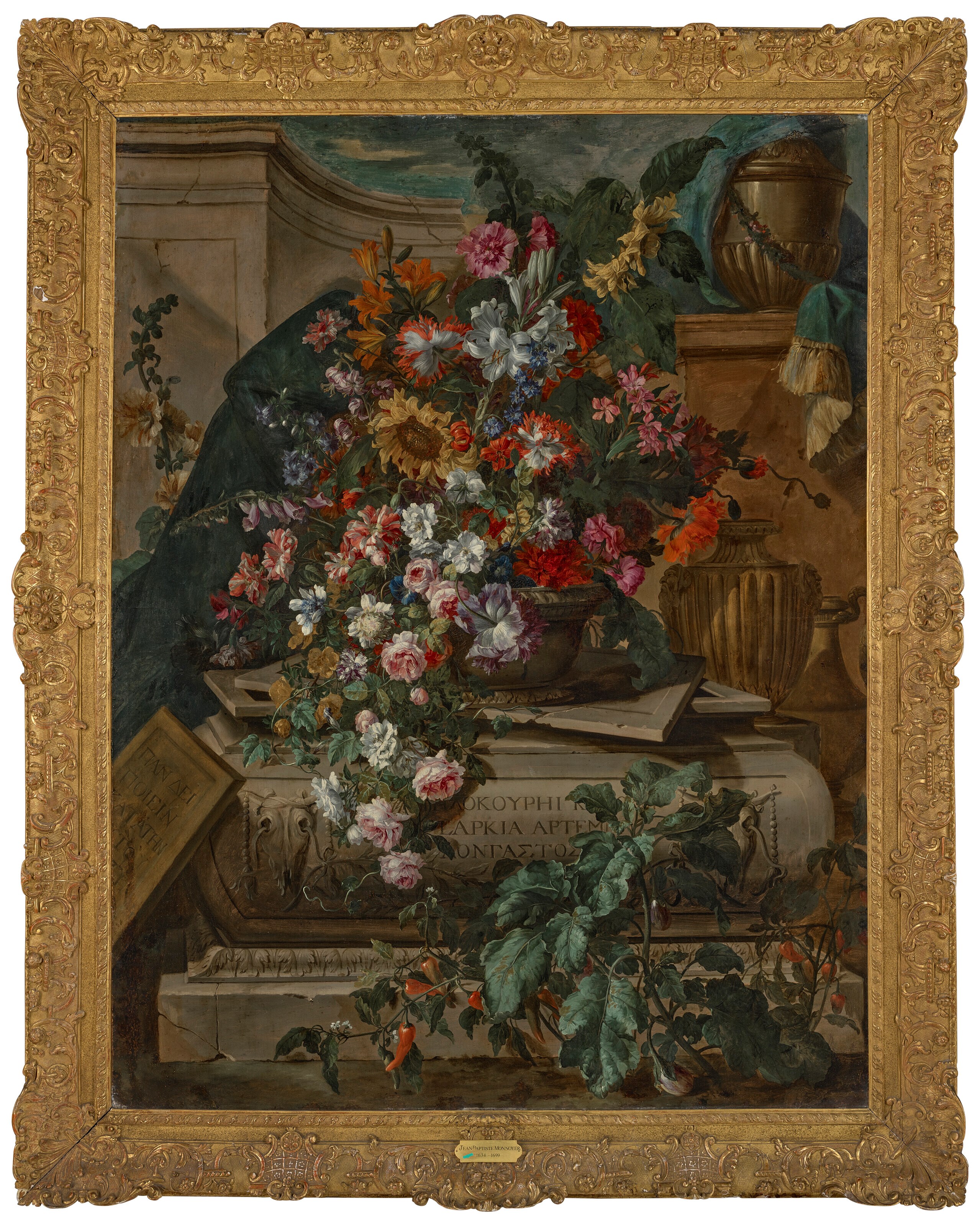
Lot 193
JEAN-BAPTISTE MONNOYER (LILLE 1636-1699 LONDON)
Flowers in an urn on a sarcophagus
Fermé8 July 2022
Prix réalisé
GBP 69,300
Plus d'informations
Note du spécialiste
The pseudo-Greek inscriptions on the tablet to the left of the canvas and the sarcophagus are taken from the Hypnerotomachia Poliphili, known in English as The Dream of Poliphilus. Purported to have been written by the Venetian monk Franceso Colonna, this was first published in 1499 and follows Poliphilo as he pursues his love, Polia, through a dreamlike landscape. After enjoying huge popularity at the beginning of the sixteenth century, Colonna's text experienced its own renaissance in mid-seventeenth century France, inspiring paintings, tapestries and decorative arts. Monnoyer used various nymphs from the text as inspiration in his series of grotesques tapestries designed in 1688 and produced by the Beauvais manufactory.
The original text was written in a strange Latinate Italian, with Greek, Arabic and Hebrew words mixed in, resulting in a complexity of meaning that has led to a variety of translations and interpretations. The extract on the tablet can be easily understood as 'everyone must act according to his nature', and indeed the narrator of the book gives it as such. The inscription on the sarcophagus is harder to decipher, puzzling even Poliphilo in the original text. Monnoyer has reproduced faithfully the woodcut of a tomb from The Dream of Poliphilus, including both the text and bulls’ skull motifs. The first two lines invoke Timocrates and the two goddesses Larkia and Artemis. These latter were both deities of Hades, and therefore appropriate to appear on a tomb. It may be that the inscription is calling the goddesses to Timocrates aid in the afterlife. However, the final word Monnoyer has chosen to include comes from a different woodcut, which appears earlier in the text. This seems to be a mis-transcription of 'ΓΕΛΟΙΑΣΤΟΣ', meaning 'ridiculous' or 'laughter inducing', which in the original illustration was inscribed below the pediment of a temple above the image of a child balancing on the hands of two female attendants. Why he chose such a combination remains a mystery.
The original text was written in a strange Latinate Italian, with Greek, Arabic and Hebrew words mixed in, resulting in a complexity of meaning that has led to a variety of translations and interpretations. The extract on the tablet can be easily understood as 'everyone must act according to his nature', and indeed the narrator of the book gives it as such. The inscription on the sarcophagus is harder to decipher, puzzling even Poliphilo in the original text. Monnoyer has reproduced faithfully the woodcut of a tomb from The Dream of Poliphilus, including both the text and bulls’ skull motifs. The first two lines invoke Timocrates and the two goddesses Larkia and Artemis. These latter were both deities of Hades, and therefore appropriate to appear on a tomb. It may be that the inscription is calling the goddesses to Timocrates aid in the afterlife. However, the final word Monnoyer has chosen to include comes from a different woodcut, which appears earlier in the text. This seems to be a mis-transcription of 'ΓΕΛΟΙΑΣΤΟΣ', meaning 'ridiculous' or 'laughter inducing', which in the original illustration was inscribed below the pediment of a temple above the image of a child balancing on the hands of two female attendants. Why he chose such a combination remains a mystery.