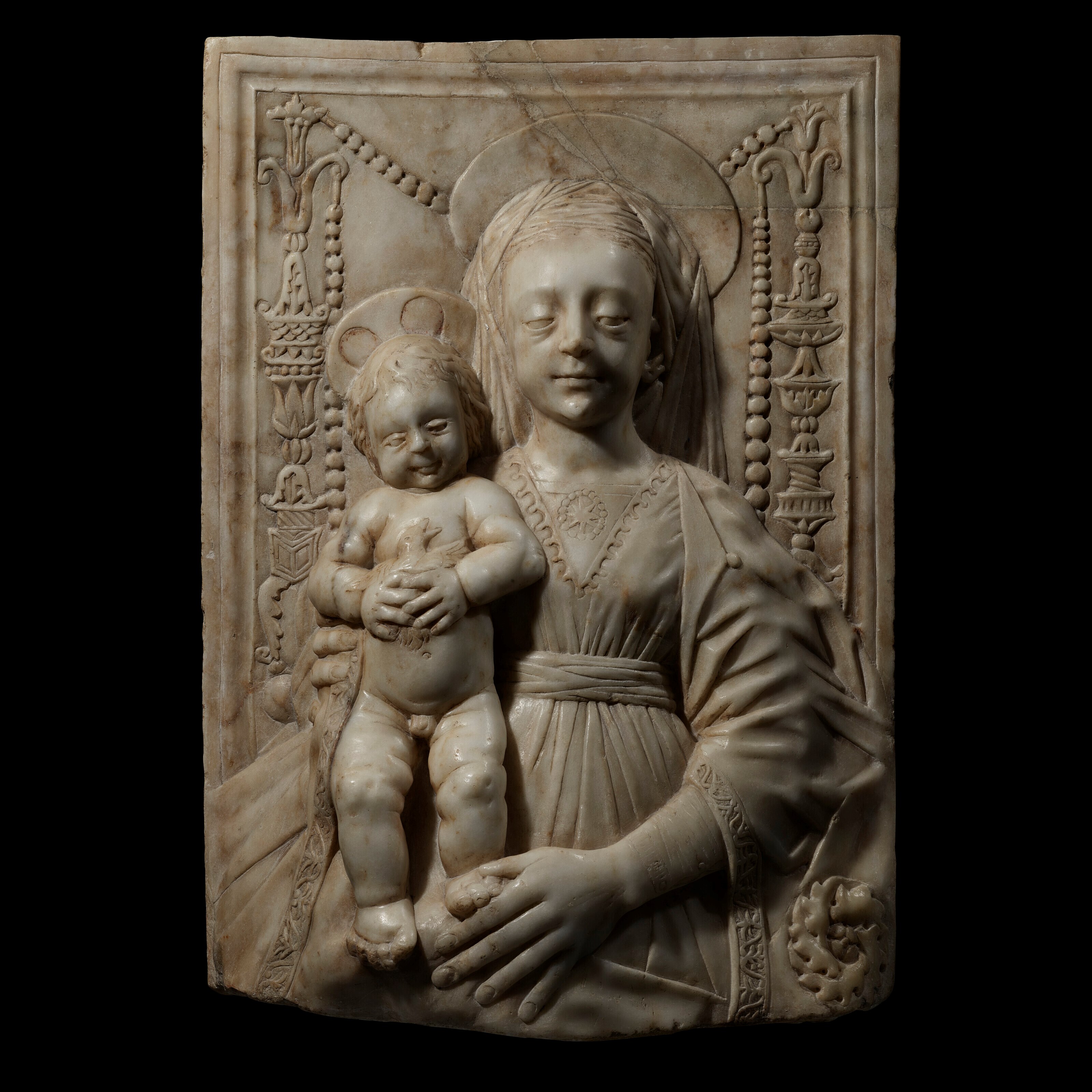
Lot 148PROPERTY OF A GENTLEMAN
GREGORIO DI LORENZO (FLORENCE C. 1436-1504 FORLI), CIRCA 1490-1500
Madonna and Child Enthroned
Fermé8 July 2022
Prix réalisé
GBP 63,000
Plus d'informations
Note du spécialiste
The ‘Master of the Marble Madonnas’ is a name coined by art historian Wilhelm von Bode in the late 19th century to identify the body of work of an unknown Tuscan sculptor with strong Florentine stylistic influences. However, more recent scholarship by Alfredo Bellandi has connected this pseudonym to artist Gregorio di Lorenzo documented in Florence in the latter half of the 15th century. Di Lorenzo began his career in the city in the workshop of Desidiero da Settignano before working in other Italian centres such as Naples and Ferrara. From circa 1475-90 he worked in Hungary for the court of Matthias Corvinus, King of Hungary and Croatia. Bellandi has suggested that execution of the present lot was after the artist’s time abroad, when he returned to his native city. Strong stylistic links can be made between other Madonna and Child reliefs by the artist, revealing similarities in the elaborate background, facial types and treatment of folds of the Virgin’s robe (see the National Gallery, Canada, Hermitage Museum and Victoria and Albert Museum). It has also been noted that the material of the relief, ‘giallo della Montagnola’, a Sienese marble, further strengthens the hypothesis that this work was completed in a Tuscan artistic centre (see Bellandi, 2021, loc. cit.).
The present lot’s size and format indicates that it was most likely intended for a private devotional context. The composition itself is one previously unknown in Di Gregorio’s body of work. His portrayal of Virgin and Child is intimate, both figures’ eyes cast down, giving the impression when viewed from below that they are gazing down at the supplicant. The small bird in Christ’s hand is the only ominous reference to his adult fate. A common iconographical trope in the Renaissance across painting and sculpture, it references the story that at Christ’s Crucifixion a goldfinch (or sometimes robin) removed a thorn from the crown on his head forevermore staining its feathers red with his blood.
The present lot’s size and format indicates that it was most likely intended for a private devotional context. The composition itself is one previously unknown in Di Gregorio’s body of work. His portrayal of Virgin and Child is intimate, both figures’ eyes cast down, giving the impression when viewed from below that they are gazing down at the supplicant. The small bird in Christ’s hand is the only ominous reference to his adult fate. A common iconographical trope in the Renaissance across painting and sculpture, it references the story that at Christ’s Crucifixion a goldfinch (or sometimes robin) removed a thorn from the crown on his head forevermore staining its feathers red with his blood.