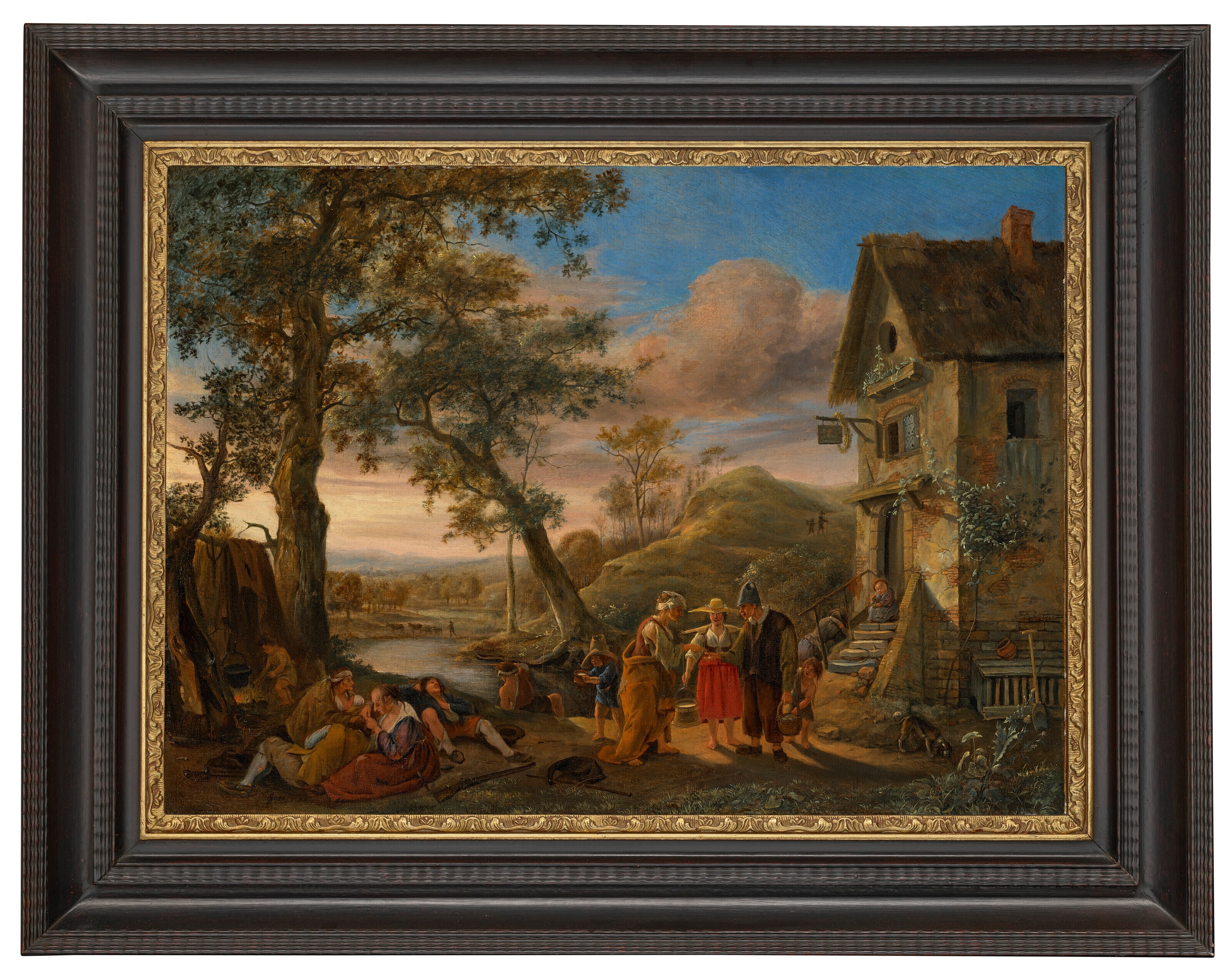
Lot 113
JAN STEEN (LEIDEN 1626-1679)
A fortune teller and peasants before an inn with a river landscape beyond
Fermé8 July 2022
Prix réalisé
GBP 56,700
Plus d'informations
Note du spécialiste
Throughout his career, Jan Steen repeatedly returned to the subject of tavern life, portraying boisterous merriment of peasants passing the time, enjoying music, card games and drink. In this particular composition, hailing from Steen’s early career, both young and old come together to enjoy the summer’s evening. In the centre, farming implements are strewn on the ground, whilst to the left of the composition the workers, having cast away their tools, lay back in the grass under the shade of the trees. Children are depicted carrying pales of drink and tending to an open fire while by the water a lounging man casts the thin line of a fishing rod into the river.
Although it is tempting to read such a scene as an idyllic description of country life, the composition rather serves to assert a criticization. Increasingly depicted later on his career, Steen would often would portray lustful and frivolous subject matters that sought to warn the viewer rather than encourage. In the present early work, the jovial atmosphere of the tavern scene, emphasised by the clear skies in the foreground, is underscored by the narrative of the work day, implied by the retreating sun and the discarded work tools. The depiction of the farmer in the background tending to his herd in the shadow of the clouds, and the two faint figures climbing the hills into the distance, reveal the true toil of daily peasant life and inform the viewer of the moralisation that respite can only be enjoyed after a hard day’s work.
Wouter Kloek, to whom we are grateful, dates this work to circa 1653, comparing it to Steen's The Village Wedding of the same year in the Museum Boijmans van Beuningen, Rotterdam .