Lot 110PROPERTY FROM AN IMPORTANT PRIVATE EUROPEAN COLLECTION
JAMES ENSOR (1860-1949)
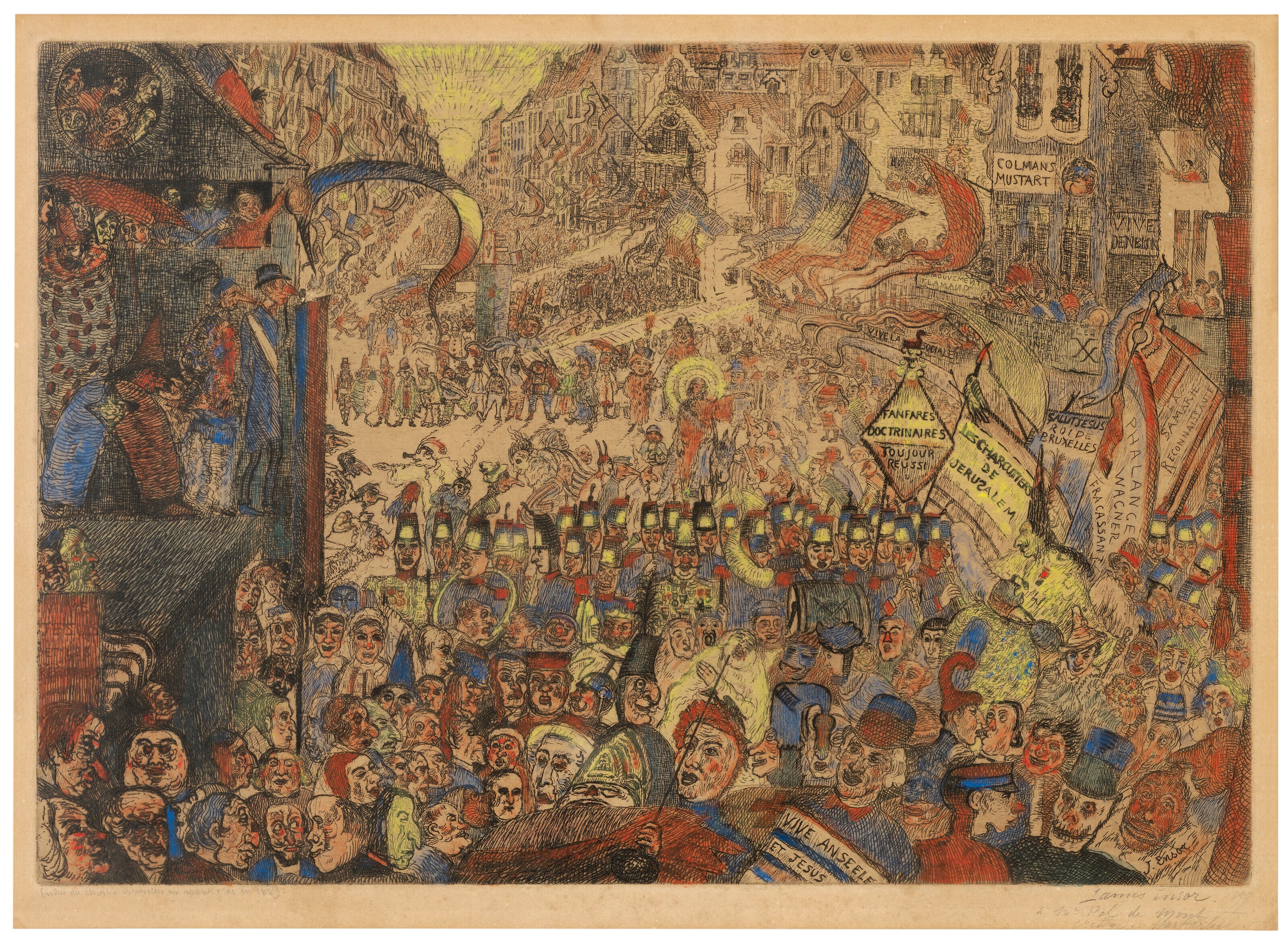
L'Entrée du Christ à Bruxelles le Mardi Gras en 1889
Fermé24 March 2022
Prix réalisé
GBP 239,400
Plus d'informations
Note du spécialiste
In an article for the anarchist magazine La Société Nouvelle, the 19th century socialist intellectual César De Paepe (1841-1890) described Jesus of Nazareth as the first Jewish socialist. In the same spirit, James Ensor's L’Entrée du Christ à Bruxelles imagines Christ arriving as a revolutionary political figure during the maelstrom of the Brussels carnival. Ensor regularly attended carnivals in Ostend and Brussels and was fascinated by the energy and noise of the crowds, and their latent potential for violence. According to the gospels Jesus entered Jerusalem on Palm Sunday and was hailed as a liberating king. A few days later, the same crowd shouted for his execution before the Roman authorities. The fickle nature of the throng is suggested by the many masked and grimacing faces, highly suggestive of Bosch and Brueghel, evoking a terrible sense of foreboding. As the critic Arsène Alexandre wrote in his review for Le Figaro of Ensor’s exhibition at Salon des Cent in 1898-99, ‘James Ensor [is] a visionary, a Flemish artist in the purest tradition of old Hieronymus Bosch and Hell Brueghel. A surprising imagination, an evoker of crowds, a creator of fantastical sights, sometimes horrible, sometimes burlesque, most often both. [Quoted in: F. Dornhöffer, James Ensor, in: Die Graphischen Künste, no. 23, Vienna, 1900, p. 35-42).
The etching L’Entrée du Christ à Bruxelles was executed after the painting of 1888-89, now in the Getty Museum, Los Angeles, and is a mirror image of the scene. It is however not an exact copy and contains several details not found in its painted precursor. Above all, the print retains the inflammatory slogans the artist had censored from the painting sometime before 1929, the year of his major retrospective at the Palais des Beaux-Arts, over concerns that it might offend King Albert I, who had recently granted the artist a noble title.
The etching displays a jumble of flags, banners and signs, emblazoned with the legends: ‘Fanfares doctrinaires/Toujours réussis’ [Doctrinal fanfares/Always successful], ‘Les Charcutiers de Jérusalem’ [The butchers of Jerusalem], ‘Salut Jésus, roi de Bruxelles’ [Hi Jesus, King of Brussels], ‘Phalange Wagner fracassant’ [Stunning Wagner Phalanx], ‘La Samarie reconnaissante’ [Grateful Samaria] and ‘Vive Judas’ [Long live Judas]; ‘Vive la Sociale’ [Long live Socialism], ‘Mouvement flamand’ [Flemish movement], 'Les vivisectures belges insensibles’ [Insensitive Belgian vivisectionists], ‘Les XX’, ‘Colmans Mustart’ [sic]; ‘Vive Demblon’ [Long live Demblon] and ‘Vive Anseele et Jésus’ [Long live Anseele and Jesus]. In the final slogan, Ensor hails Anseele, the leading figure of Belgian socialism as the inheritor of Christ.
Charles Polydore de Mont (1857-1931), to whom this impression is dedicated, was a writer, poet and art critic, and the first director of the Koninklijk Museum voor Schone Kunsten, Antwerp.