Lot 94PROPERTY FROM A PRIVATE EUROPEAN COLLECTION
PABLO PICASSO (1881-1973)
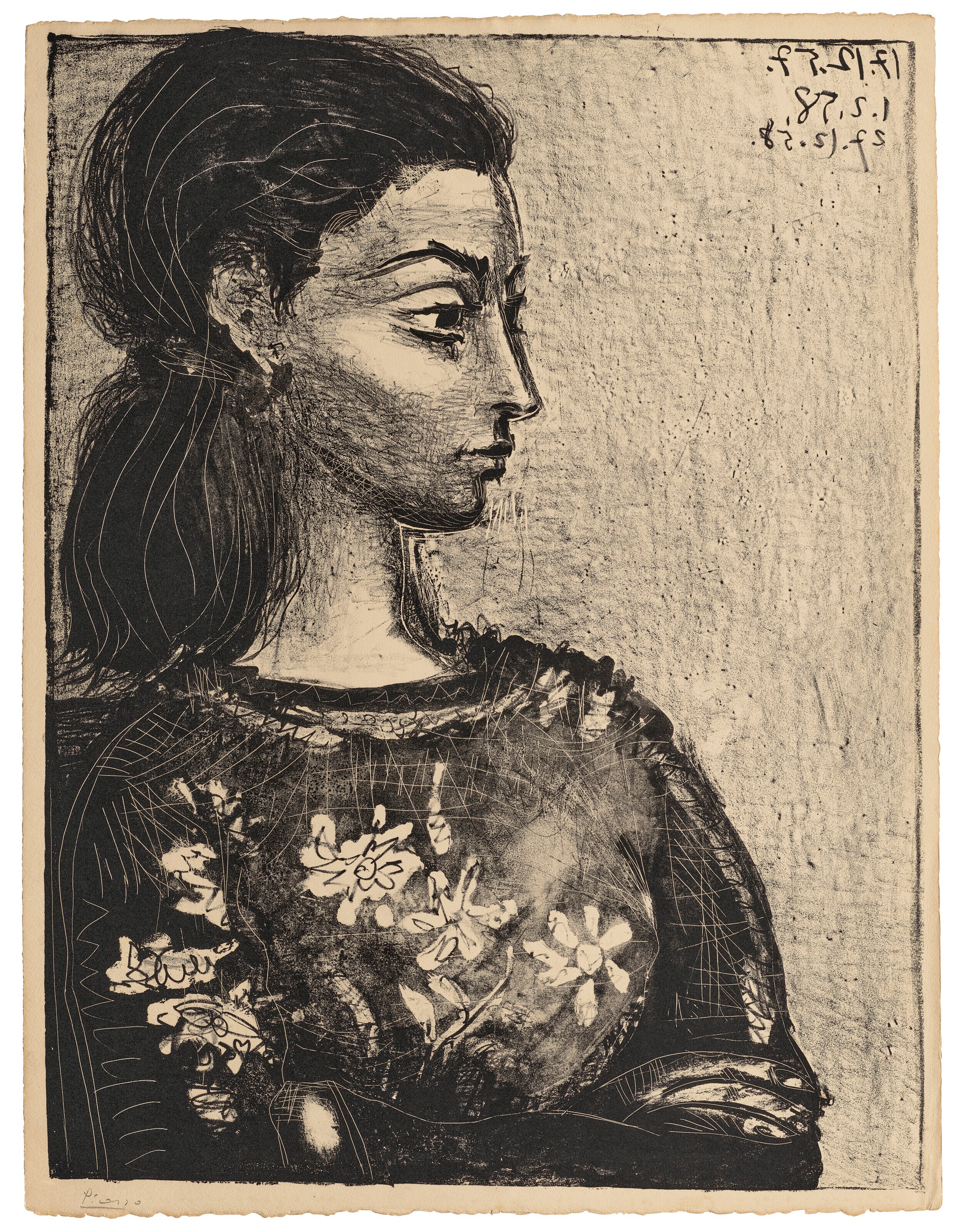
Femme au Corsage à Fleurs
Fermé24 March 2022
Prix réalisé
GBP 94,500
Plus d'informations
Note du spécialiste
As often happened to Picasso, his audacity and tireless commitment to art in all its forms provided him new and unexpected turning points in his multifaceted career. Since 1946 he had been producing ceramics at Madoura, in Vallauris, a small town in Côte d'Azur, where he lived from 1948 to 1955. It was at the ceramic workshop that the first encounter between the artist and the young sales assistant Jacqueline Roque took place in the summer of 1952. Six months later she agreed to go out with the 72-year-old artist and shortly after became his new muse, preferred subject and, in 1961, his fourth and last wife.
Jacqueline was portrayed over four hundred times by Picasso in various media, including lithography; more than any other women in his career. This series of portraits begun in December 1957 was completed over a period of a year. It harks back to the earlier portraits of Françoise Gilot, but here the subject looks away rather than towards the viewer. In Femme au Corsage à Fleurs, one of his most impressive and experimental lithographic series, the distinctive, almost mannered traits of Jacqueline's Spanish beauty - her long neck, elongated posture, high cheek bones - were accentuated by Picasso and reworked through a sequence of proofs in different states. The floral motif of the blouse is complete only in the third, final state, where Picasso also added some fine strokes to highlight some features and contrasts of the face. Jacqueline's hair seems to integrate into the blouse.
The present impression is a proof of the third, final state, aside from the numbered edition of fifty, and was originally acquired directly from Georges Sagourin, one of the three master lithographers at Mourlot's workshop.