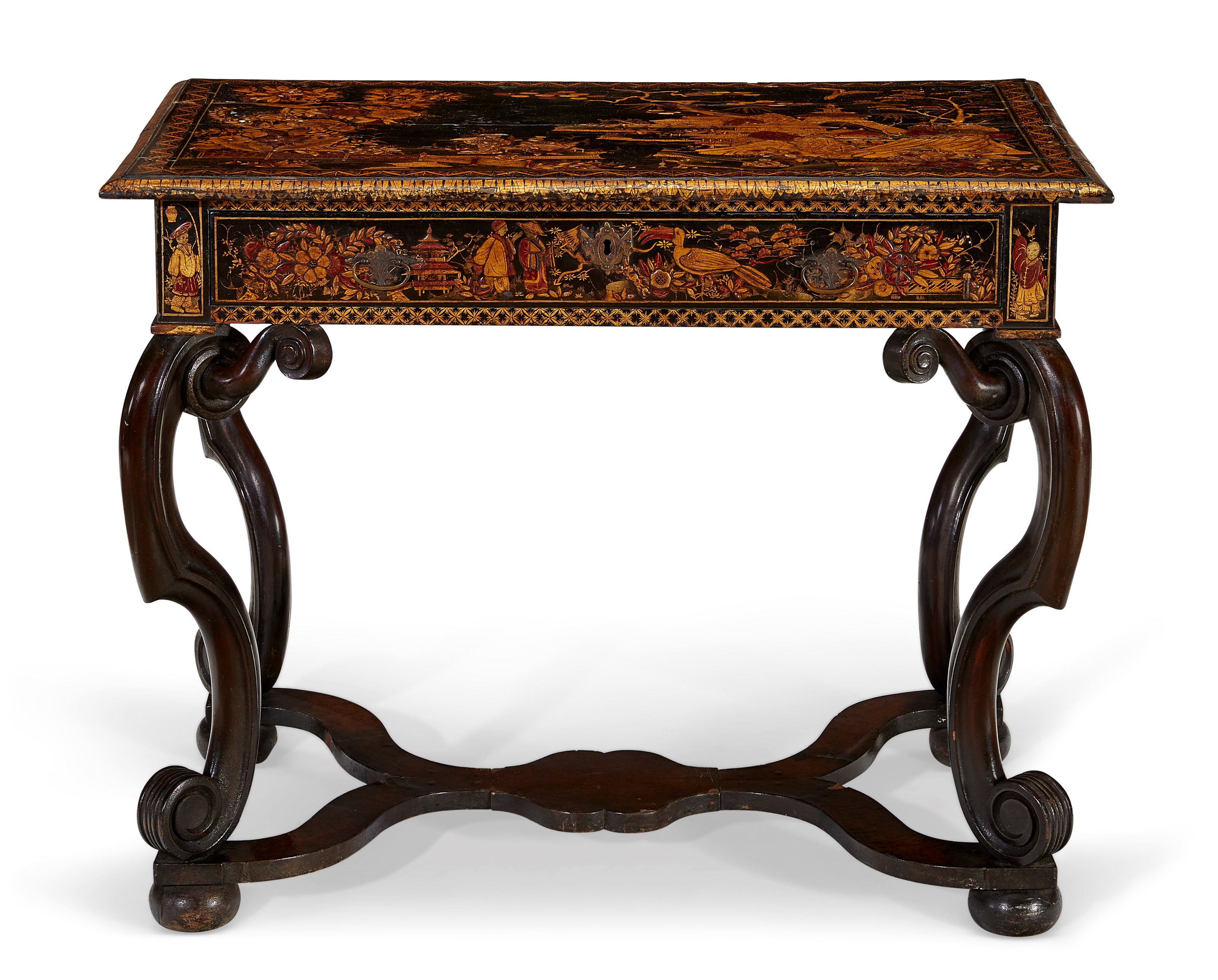
Lot 13PROPERTY FROM THE COLLECTION OF WINSTON F.C. AND C.Z. GUEST
A GERMAN GILT AND JAPANNED CENTER TABLE
EARLY 18TH CENTURY, ON LATER LEGS AND STRETCHER
Fermé20 October 2021
Prix réalisé
USD 9,375
Plus d'informations
Note du spécialiste
This densely decorated black and gilt lacquer table is representative of early eighteenth-century German production and typifies the fascination of local craftsmen with the alluring products of the Orient. Further English and Dutch influences in 'lacquerwork' came to Germany in the late 17th Century through the importation of Chinese and Japanese lacquer and porcelain as well as their European copies, and found their way to the mainly Protestant north German centers of Hamburg, Bremen and Brunswick and the courts of Saxony and Brandenburg. The combination of exotic foliage and landscapes with Chinese figures on the present lot is comparable to Chinoiserie work that was made in Berlin and Dresden during this time. It is closely related to the oeuvres of the lacquer specialists Gerhard Dagly and Martin Schnell.
Gerhard Dagly (1657-1715) was active in Berlin, and was celebrated following his appointment in Berlin in the 1680s as Kammerkustler to Frederick William, Elector of Brandenburg (d. 1688). Dagly was afterwards appointed Intendant des Ornements at the court of Frederick III, Elector of Brandenburg, later Frederick I of Prussia, see H. Huth, 'Lacquer Work by Gerhard Dagly', Connoisseur, vol. 95, 1935, p. 14. Dagly and his brother Jacques provided japanned furnishings of exceptional quality to Frederick I and his court, on one occasion the Kurfustin of Hanover sending an English clock-case to her son-in-law and feeling bound to mention that 'Dagly makes much better ones,' see H. Honour, Chinoiserie: The Vision of Cathay, London, 1961, p. 66).
Equally well-known is Martin Schnell (c. 1675-1740) was born in Dresden and began his career in Dagly's Berlin workshop in 1703. Returning to Dresden in 1710, Schnell founded his own workshop and was appointed 'lacquer-maker' to Augustus the Strong. Influenced by Dagly, Schnell produced japanned works with charmingly whimsical chinoiserie scenes, similar to those found on the present lot. (Monika Kopplin and Gisela Haase, exhib. cat. 'Sächssische Lacquirte Sachen', Lackhurst in Dresden unter August dem Starken, Munster, 1999).