Lot 517
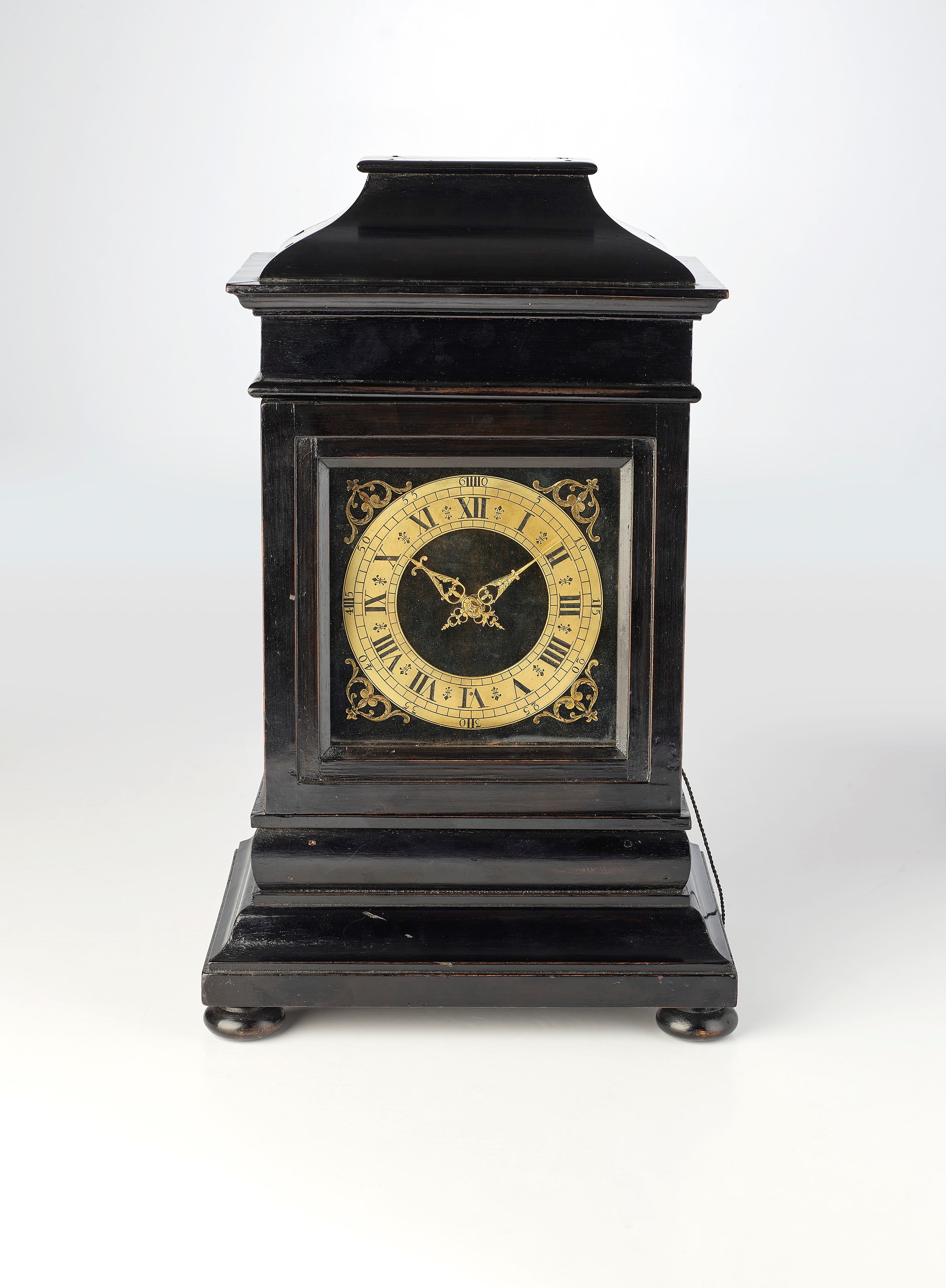
GIOVANNI FRANCESCO GIOLY (JEAN OR JOAN FRANÇOIS JOLY), GILT BRASS QUARTER REPEATING MOVEMENT WITH EARLY BALANCE AND STRAIGHT BALANCE SPRING, IN LATER WOODEN BRACKET CLOCK CASE
NO. 4321
Fermé18 May 2021
Prix réalisé
CHF 5,250
Plus d'informations
Note du spécialiste
The movement of the present clock is fitted with a fusée and cat-gut, verge escapement, four-arm steel balance with straight hog’s bristle balance spring, length regulated by micrometric screw regulator set on the two-footed solid cock with a diameter of 56 mm., decorated with engraved flowers, repeating activated by pulling the cord in the case, hours stroke by a hammer onto a bell on the top of the movement, the quarter on the one to the bottom. The dial consists of a gilt brass ring with champlevé radial Roman numerals, inner quarter and outer minute divisions, all set on dark blue velvet, each corner with a pierced and engraved applied foliage and fleur de lis decoration.
The balance wheel appeared with the first mechanical clocks in 14th century Europe, however it is unknown exactly when or where it was first used. It is an improved version of the foliot, an early inertial timekeeper consisting of a straight bar pivoted in the center with weights on the ends, which oscillates back and forth. The foliot weights could be slid in or out on the bar, to adjust the rate of the clock. The first clocks in northern Europe used foliots, while those in southern Europe used balance wheels. As clocks were made smaller, first as bracket clocks and lantern clocks and then as the first large watches after 1500, balance wheels began to be used in place of foliots. Since more of its weight is located on the rim away from the axis, a balance wheel could have a larger moment of inertia than a foliot of the same size, and keep better time. The wheel shape also had less air resistance, and its geometry partly compensated for thermal expansion error due to temperature changes.
It is believed that the flat balance spring was invented by the Dutch mathematician Huygens in 1675. Before that, balance wheels or foliots without springs were used in clocks and watches. Very sensitive to fluctuations in the driving force, they caused the movement to slow down as the mainspring unwound. The introduction of the balance spring effected an enormous increase in the accuracy, rendering them useful timekeepers for the first time.
The British physicist Robert Hooke aimed to improve the accuracy and reliability of such clocks so that they could be used to help navigation at sea. Before 1660 he had applied a spiral spring to the balance wheel of a clock so that the spring's natural oscillation would serve as a regulator of the mechanism, and had improved the anchor escapement. He demonstrated a spring-regulated watch to Lord Brouncker and others but, although advised to patent the invention, declined to do so. During the 1670s Hooke collaborated with Thomas Tompion, the father of English watchmaking.
A watchmaker Joan-François active in Rome in the 17th century is listed in Dictionnaire des Horlogers Français, Tardy, p. 331.