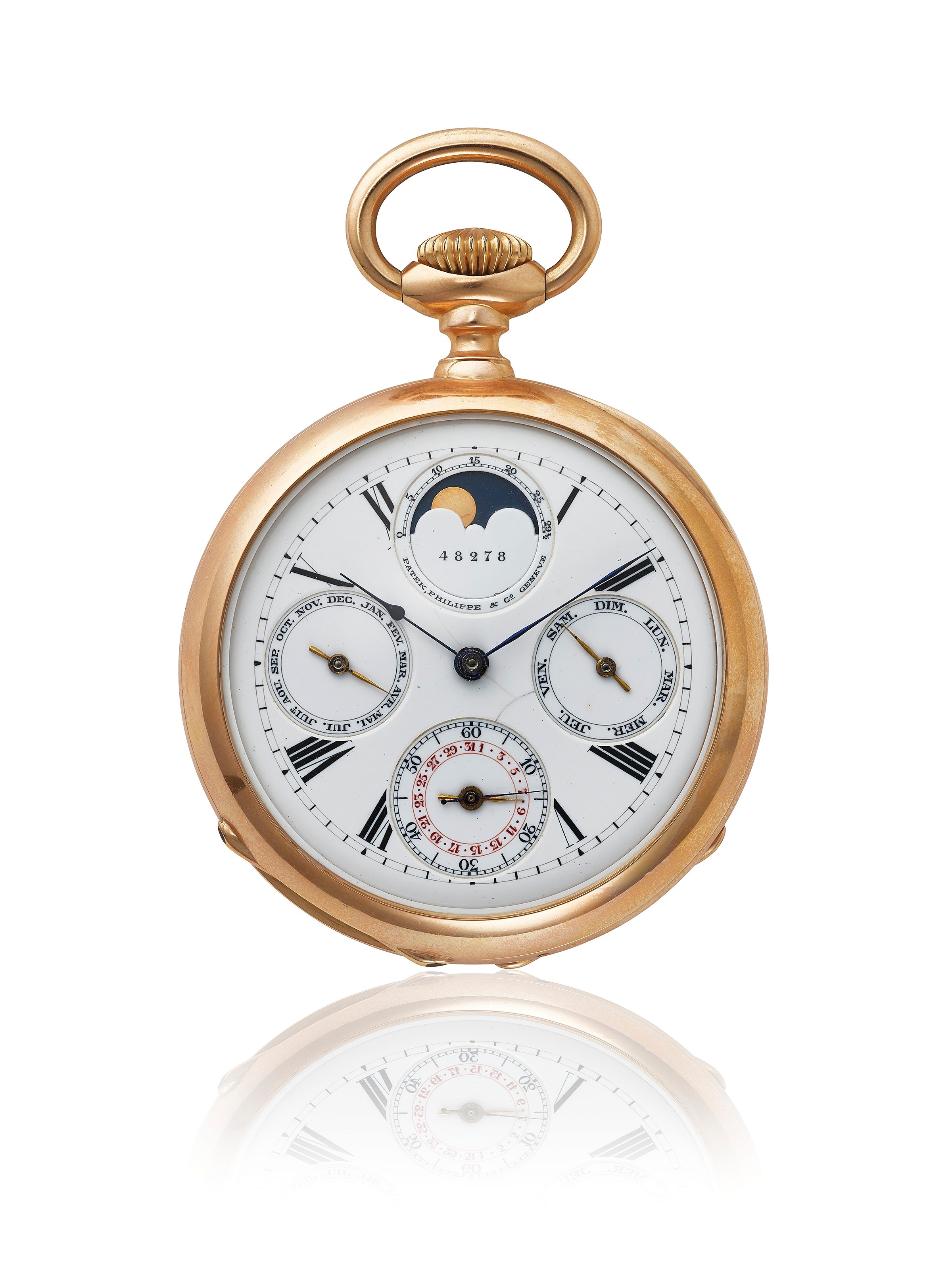
Lot 463
PATEK PHILIPPE, EARLY 18K PINK GOLD OPENFACE PERPETUAL CALENDAR KEYLESS LEVER WATCH WITH MOON PHASES AND LEAP YEAR INDICATOR
NO. 48’278
Fermé18 May 2021
Prix réalisé
CHF 18,750
Plus d'informations
Note du spécialiste
This timepiece is a notable rarity being one of Patek Philippe’s early timepieces made with perpetual calendar, moon phases and age as sole complications.
Only a handful of such pieces were made from around 1870 to 1910, during a period when the company was developing highly complicated watches. Adrien Philippe's perpetual calendar mechanism was patented in 1889 but was already in use before, such watches however often featured experimental systems which were improved over the years
In fact the first Patek Philippe keyless perpetual calendar watch was made around 1870 and in the following years the firm produced several dial display variations for perpetual calendars, including watches with day, date, months and moon phases/age without leap year indication, such as the present watch, day, date and months without leap year indication or moon phases and with date and days of the week only. These watches are in fact considerably rarer than those with more complications such as repeating and/or chronograph etc.
The traditional perpetual calendar indicates the date, the day of the week and the months. Unlike a standard calendar watch, the perpetual calendar mechanism ingeniously takes into account the months’ unequal lengths of either 28, 30 or 31 days and the intercalary day of February 29th in a leap-year without requiring manual adjustment. In fact, assuming the watch is kept running, adjustment is only required once per century for three centuries in a row out of every 400 years. This is because in the Gregorian calendar which is a 400 year cycle, the leap-year is omitted three times every 400 years.
A similar watch is described and illustrated in: Patek Philippe Watches, Volume I, Patek Philippe Museum, 2013, p. 277.