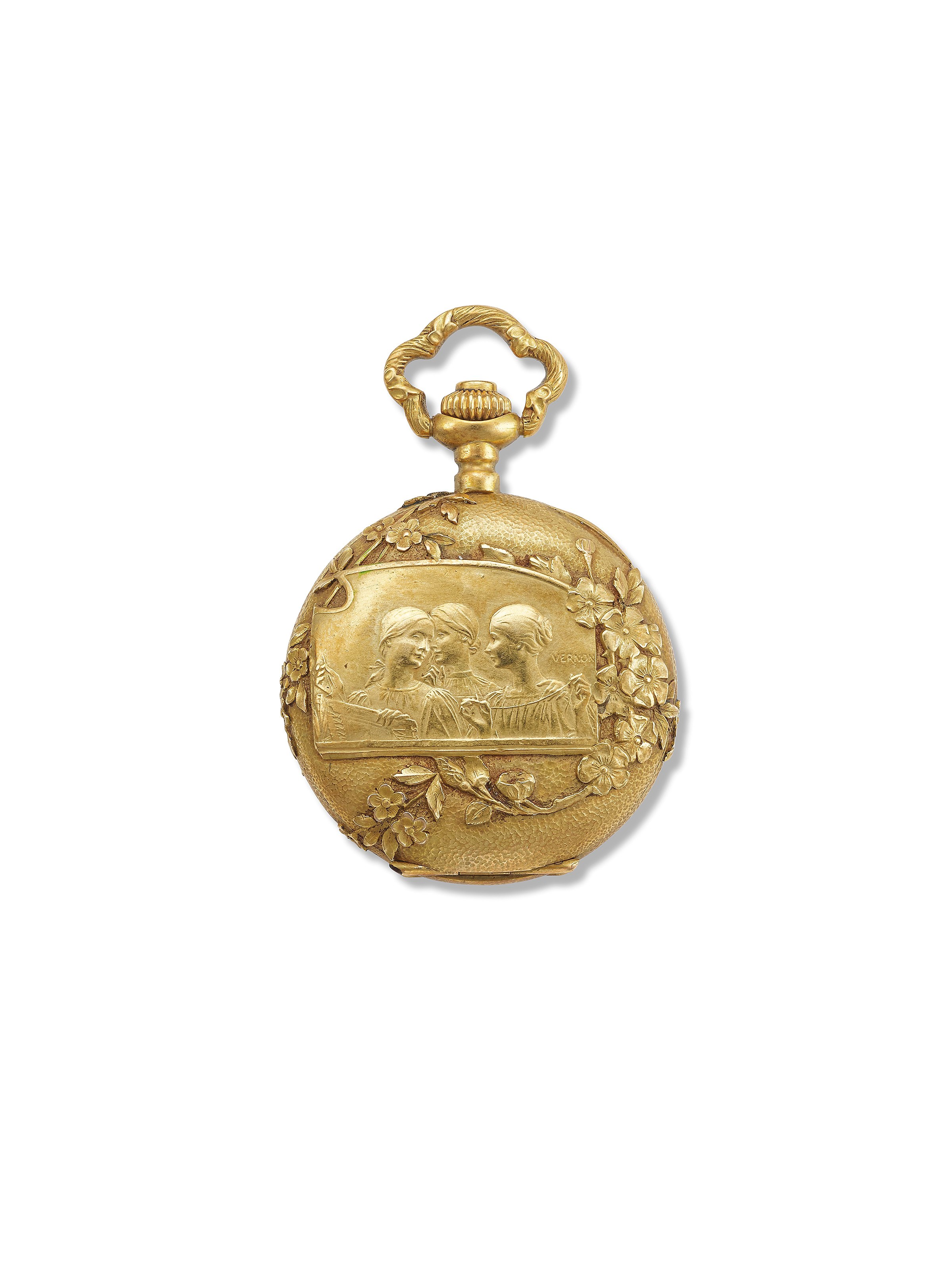
Lot 453
PAUL DITISHEIM, 18K GOLD AND DIAMOND-SET MINIATURE HUNTER CASED KEYLESS CYLINDER WATCH, CASE DECORATION BY FRÉDÉRIC DE VERNON
NO 19’691
Fermé18 May 2021
Prix réalisé
CHF 3,750
Plus d'informations
Note du spécialiste
Of small size and rare in a hunter case as opposed to the more common openface version, the present watch is the perfect example of a decorated timepiece that Paul Ditisheim made for the Brussels and Paris International Exhibitions of 1896 and 1900.
The covers of this typical and highly attractive Art Nouveau style watch, characterized by the curvilinear depiction of leaves and flowers, are set with gold plaques featuring three sewing ladies, the one to the back signed Vernon.
Frédéric Charles Victor de Vernon (1858-1912) was a celebrated medal engraver and sculptor. His pieces were shown in numerous exhibitions in the Salon des Artistes and also the Paris Universal exhibition in 1900, where his work was awarded a gold medal. He was named Chevalier de la Légion d'Honneur in the same year, and his works now form part of several museum collections in France.
Paul Ditisheim (1868-1945) is considered a genius in the world of horology. At the early age of 13 he entered the Horological School in La Chaux-de-Fonds where he obtained the Diploma of Honour. Before founding his own company in 1892 he worked for several renowned watch manufactures such as his father's, Vulcain, Ditisheim Frères. Around 1920, he entered into partnership with Solvil.
Paul Ditisheim is renowned for his highly precise chronometers for which he won an impressive number of prizes at various Observatory Contests. He also played an important role during the launch of Dr. Charles Guillaume's compensation balance, invented at the end of the 19th century and used in several of his watches during the Grand Prix in Paris in 1900.