Lot 427
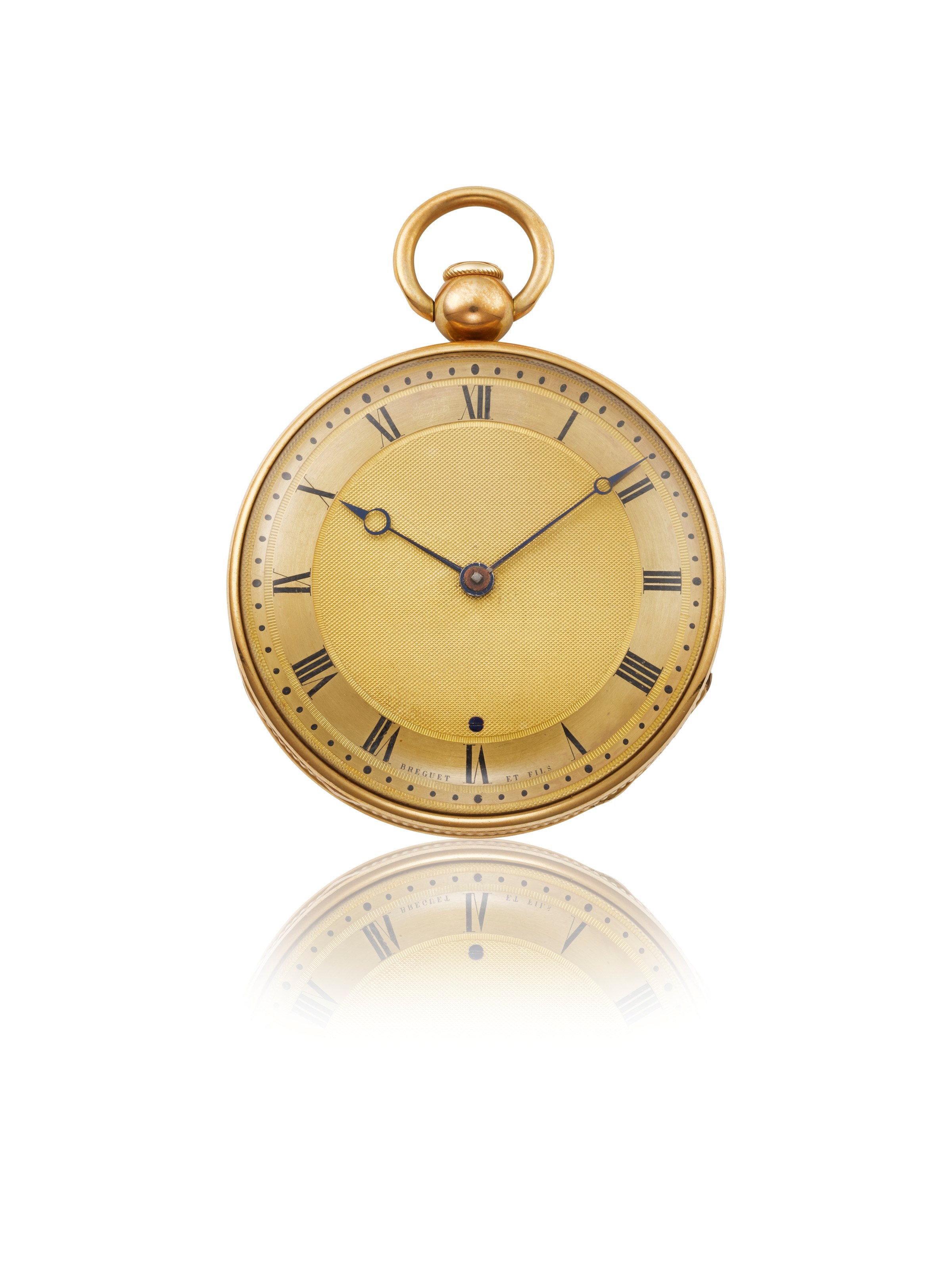
BREGUET, 18K GOLD JUMP HOUR A TOC QUARTER REPEATING CYLINDER WATCH WITH GOLD DIAL, SOLD TO MONSIEUR JAMES
NO. 2116
Fermé18 May 2021
Prix réalisé
CHF 13,750
Plus d'informations
Note du spécialiste
According to the Archives of Montres Breguet, this highly attractive quarter repeating watch with case no. 1448 by Joly was sold on 22 July 1808 to Monsieur James for the amount of 2,296 Francs.
Watch no. 2166 is a very attractive example of a Breguet “dumb” quarter repeater with his famous overhanging ruby cylinder escapement. It features an engine-turned gold dial and a gold cuvette, elements considerably increasing the price of a timepiece.
The finely engine-turned case was made in the workshops of the celebrated Jean-Louis Joly, featuring a slim bezel, another of Breguet's signature features, allowing the entire dial to be seen.
Repetition à ponts or “dumb” quarter repeating or repeating “à toc” is the term given to a repeating watch without gongs or bells whereby the hammers strike small metal blocks inside the band of the case during repeating. This system was probably used for reasons of discretion for the wearer.
Breguet’s method of winding the repeating train with the pull-twist-push piston was his own invention and can be found either in the pendant, as in the present watch, or in the band. It was very expensive to make and its purpose was essentially to give the watch a neater appearance.
Breguet used the cylinder escapement throughout his life, it is a frictional rest escapement but of a far superior kind. The first cylinder escapements made by the English makers were not much more accurate in operation than the verge. This was because the diameter of the cylinder was too great in relation to the diameter of the balance, causing a loss of energy through friction. To reduce the friction, the English makers, who were very skilled in the art of jeweling, made the cylinder half-section ruby. The ruby was fitted into a steel frame - it was this form of cylinder escapement first used by Breguet.
The ruby cylinder movement is fitted with a "suspension élastique", Breguet's ingenious elastic balance suspension also known as pare-chute, the ancestor of the shock-protection devices conceived to protect the pivots from blows.