Lot 336
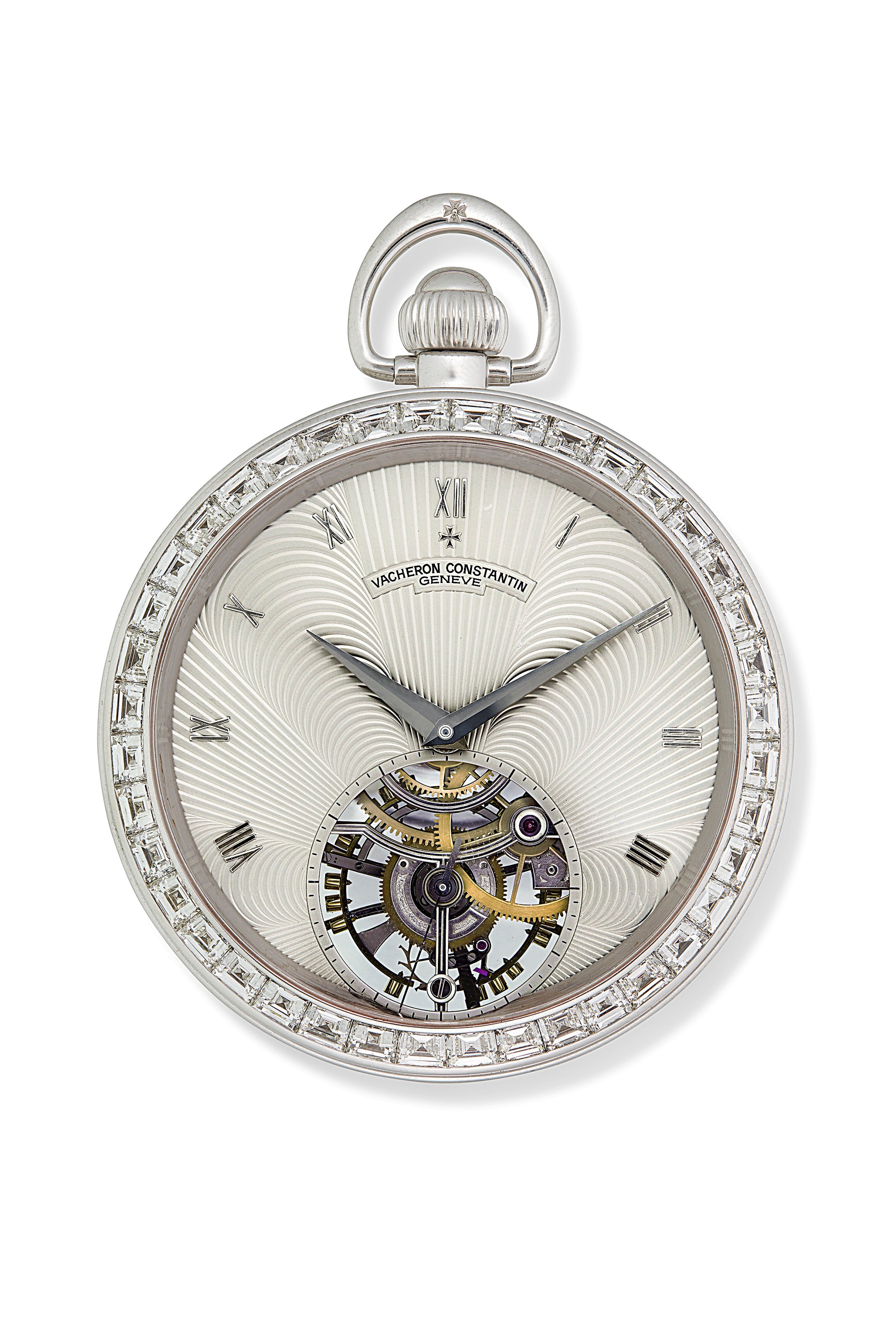
VACHERON CONSTANTIN, POSSIBLY UNIQUE TOURBILLON POCKET WATCH RETAILED BY ASPREY, 18K WHITE GOLD AND DIAMOND-SET
Fermé26 April 2021
Prix réalisé
USD 75,000
Plus d'informations
Note du spécialiste
Made to special order for a distinguished client of Vacheron Constantin, the present tourbillon ref. 92544/000G featuring a white gold case and a trapezoid-cut diamond-set bezel is believed to be a unique piece and certainly among the most impressive tourbillon watches by the celebrated house ever offered at auction.
It combines all aspects of highest qualtiy watchmaking, rendering it a superb example for the demanding collector: one of the most discerning complications, the tourbillon regulator, fitted in a sumptous state of the art white gold and diamond-set case, rarity and excellent overall condition.
For centuries, watchmakers were concerned about the influence of gravity on the accuracy of mechanical watches. Depending on the position of a watch and consequently the change of its centre of gravity, different variations in the frequency of the balance occur and effect the accuracy of keeping time.
This problem was solved in 1801, when the famous watchmaker Abraham-Louis Breguet invented and patented a complex mechanism built to compensate such errors, called the tourbillon. The mechanism consisting of a balance, balance spring and escapement is housed inside a carriage, also called a cage, which rotates on its own axis at regular intervals, thus compensating for positional errors caused by gravity.
Although this device is not absolutely necessary for accuracy purposes today, it is still appreciated as a complication of high-quality watches.