Lot 189
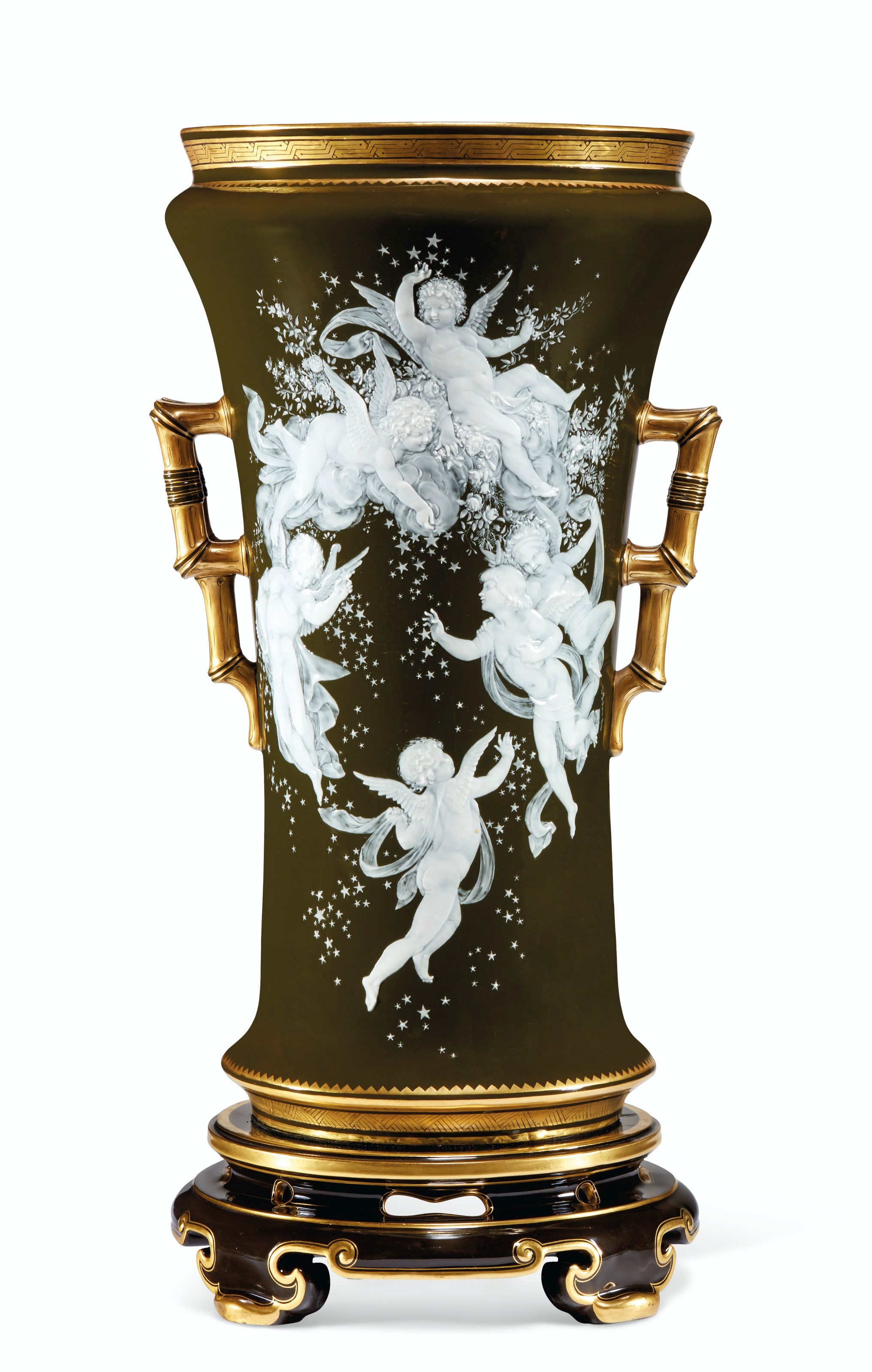
A LARGE MINTONS PATE-SUR-PATE OLIVE-BROWN VASE AND CHOCOLATE-BROWN STAND
DATED 1880 AND 1897, THE STAND WITH IMPRESSED UPPERCASE AND GILT CROWNED GLOBE MARK, IMPRESSED CYPHERS AND INCISED SHAPE NO. 1777, RETAILER'S MARK FOR TIFFANY & CO. NEW YORK, THE VASE SIGNED L.(OUIS) SOLON 80
Fermé8 October 2020
Prix réalisé
USD 50,000
Plus d'informations
Note du spécialiste
A drawing of this distinctive vase can be found in Louis Solon's Illustrated Journal, where the artist notes that it was one a pair decorated between 11 April and 11 May 1880. The pair took him 7 days to complete.
Shape no. 1777 is recorded as "Vase, Bamboo Handles, Oriental Stand". Though the present stand and the vase were produced at separate dates, the stand was likely specifically commissioned by the factory as a replacement in 1897 as the form does not appear to be much produced and would have been out of fashion by that date. For another vase of this unusual Aesthetic form, this one with a metal replacement base, see B. Bumpus, Pâte-sur-Pâte, The Art of Ceramic Relief Decoration, 1849-1992, London, 1992, p. 111.
The celebrated ceramics artist Marc Louis Solon came to England in late 1870 following the outbreak of the Franco-Prussian War. The Minton factory had, under the directorship of Léon Arnoux, acquired a reputation for attracting the most skilled craftsmen from leading porcelain factories on the Continent. Solon enjoyed a long and successful association with the Minton factory producing some of the manufactory's most memorable pieces, including numerous works displayed at the great expositions of the late 19th century. As U.S. Commissioner Blake observed in his Reports of the United States Commissioners to the House of Representatives following the 1878 Paris Exposition Universelle, just prior to the present vase's completion, Solon's "work is incomparably superior to that of any of his imitators, far surpassing in art value the best examples of figure subjects from the kilns of Sèvres. He alone fully and satisfactorily unites skill in the technique of paste and glaze and the genius of sculptor and designer. His favourite subjects, as is well known, are the female form, Cupids and cherubs. He delights in illustrating the pranks Cupid plays with the hearts of maidens." For an exhaustive discussion of Solon's work at Minton, see B. Bumpus, op. cit., pp. 100-151.