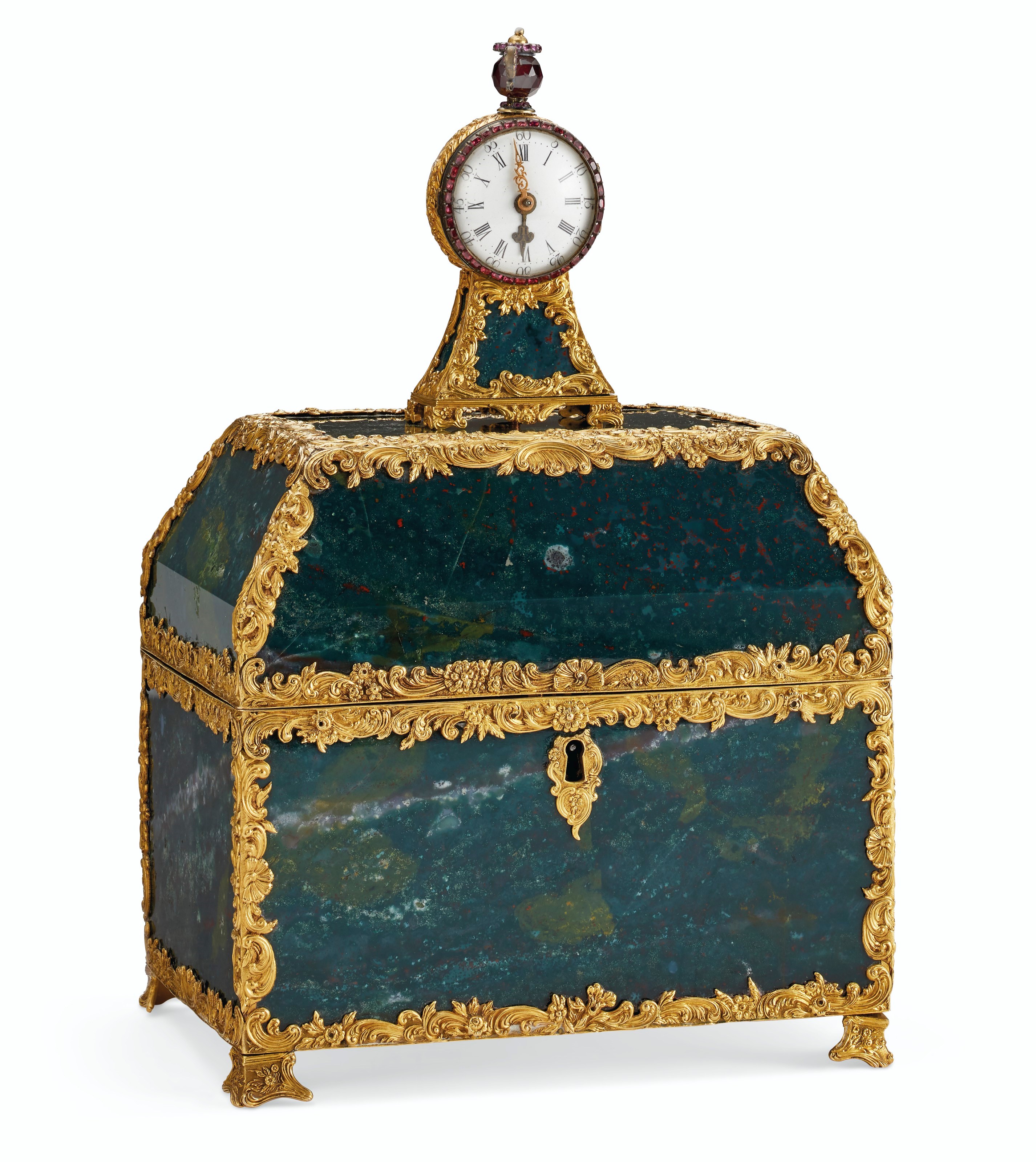
Lot 2PROPERTY FROM THE COLLECTION OF FREDERICK A. AND SHARON L. KLINGENSTEIN
A GEORGE III ORMOLU-MOUNTED BLOODSTONE AND GOLD NECESSAIRE TABLE CLOCK
IN THE MANNER OF JAMES COX, LONDON, LATE 18TH CENTURY, WITH LATER FITTED INTERIOR, THE CLOCK 18TH CENTURY AND ASSOCIATED
Fermé8 October 2020
Prix réalisé
USD 37,500
Plus d'informations
Note du spécialiste
James Cox's works made for export to the eighteenth-century courts of Russia, India and China are amongst the most distinctive of the George III period. Cox's workshop is first recorded in 1745 as located on Racquet Court, Fleet Street, from where he moved to Shoe Lane in Farringdon in 1756, having formed a partnership with Edward Grace. In the 1760's, he began to produce extravagant clocks, automata, necessaires and snuff-boxes, which made him fashionable in London circles and popular in the Far East and Russia, see R. Smith, 'James Cox [c. 1723-1800]: a revised biography', Burlington Magazine, vol. CXLII, no. 1167, June 2000, p. 355.