Lot 14
LUCIO FONTANA (1899-1968)
Concetto spaziale
Fermé30 July 2020
Estimation
GBP 150,000–200,000
Plus d'informations
Note du spécialiste
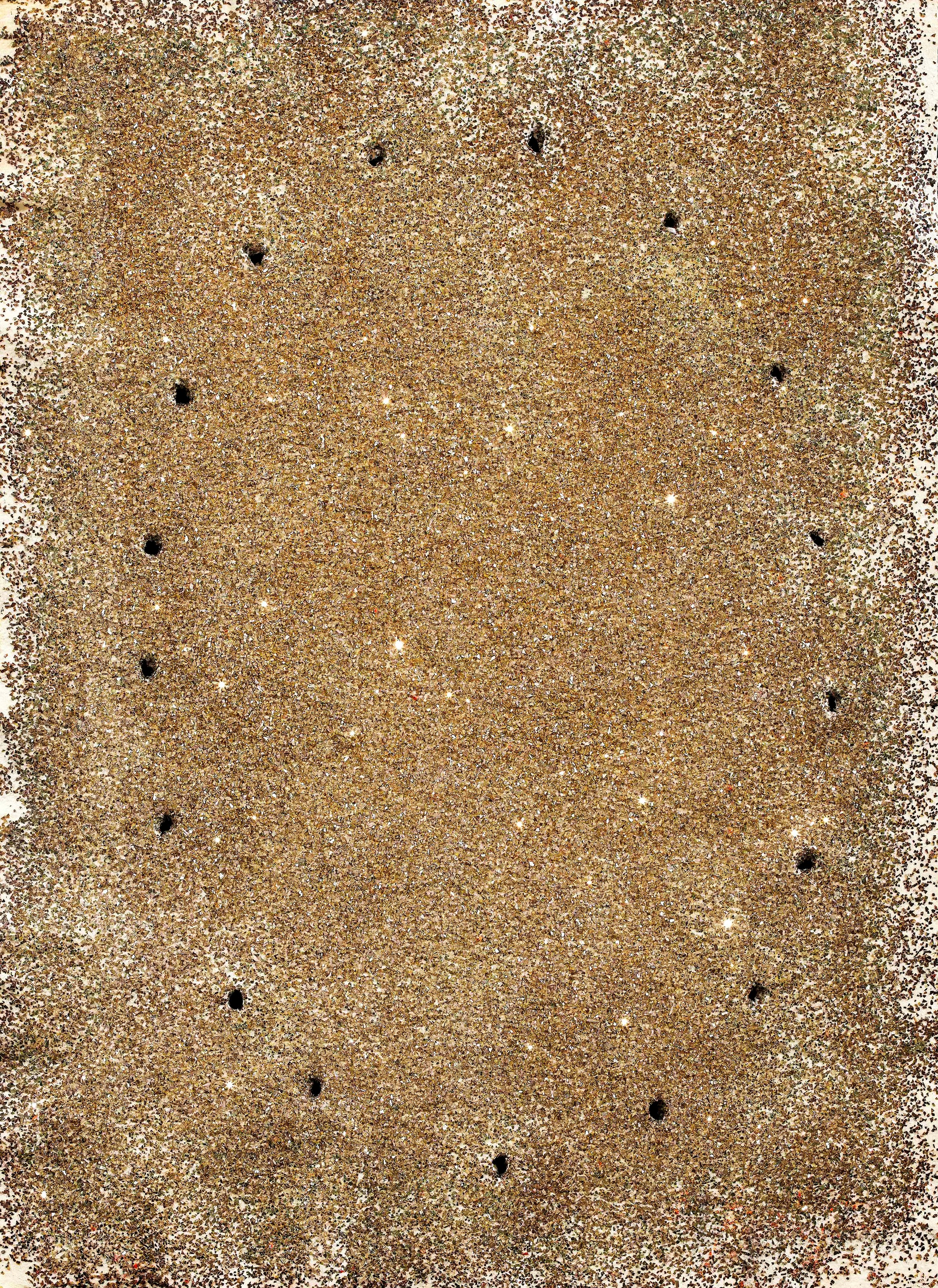
Penetrating a resplendent golden surface, Lucio Fontana’s constellation of holes in Concetto spaziale (1962-63) sees his iconic concept of ‘spatial art’ at its most dazzling. It is one of only two works on paper that the artist covered entirely in gold glitter. In using gold, Fontana was referencing not only the solar glory of stars and the sun, but also the religious art of the Baroque and Byzantine periods that he had seen in Venice in 1961. Fontana’s visits to Venice and New York that year resulted in iridescent oil paintings and metal works inspired by the glimmering reflective surfaces he encountered. From the gilded glory of St. Mark’s to the futuristic splendour of Manhattan’s skyscrapers, Fontana felt he had glimpsed the machinations of the universe on earth. Works such as Concetto spaziale reflect his desire to incorporate this celestial radiance into his art, much as the ancient icons he saw used gold to venerate their holy subjects. At the same time, he was creating a gleaming, lustrous vision of the splendour of the cosmos: a magnificent abstract reliquary that celebrates the openings into pure space that lie at its heart.
This opulent quality newly synthesised earth and the heavens in Fontana’s work. There is a Venetian sense of luxury in the surface of Concetto spaziale, as well as the feeling of sublime movement that had led the artist through much of his career to look to the Baroque – a style which he considered to have ‘represented space with a magnificence that is still unsurpassed and added the notion of time to the plastic arts’ (Manifesto Blanco, Buenos Aires 1946, in E. Crispolti et al. (eds.), Lucio Fontana, Milan 1998, p. 115). Where his earlier ceramics echoed Baroque arabesques and muscular figures in their attempt to convey a sense of motion in space, in Concetto spaziale this motion is captured in the circle of buchi (holes) that pierce its surface, preserving the artist’s gesture like the trail of a meteor.
Concetto spaziale’s enigmatic presence is heightened by the use of gold: this is an earthbound object, but cloaked in the radiance of suns, supernovas, the haloes of saints. Its sparkling, ovoid composition seems to foreshadow the cratered canvases of the Fine di Dio series, Fontana’s great masterworks of 1963-64, which saw his Baroque approach reach elaborate new heights in grand reflections on creation, rebirth and divinity. As with all Fontana’s work, we are enthralled by his masterly, sensuous command of material even as we are sent on a cosmic journey, our minds sent reeling into the infinite, captivating mysteries of space.