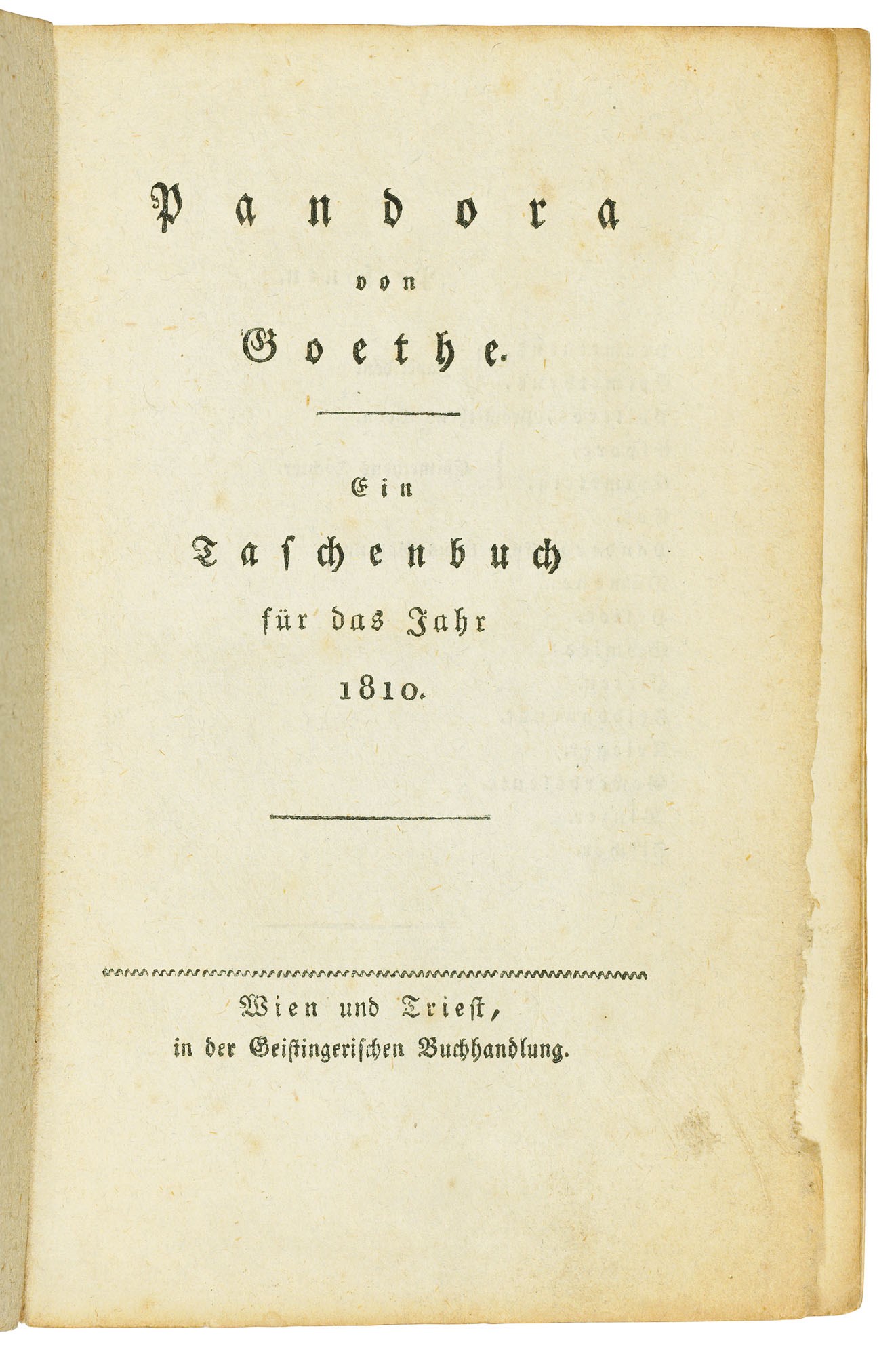
Lot 59
Johann Wolfgang von Goethe (1749-1832)
Pandora. 1810
Fermé4 June 2020
Prix réalisé
GBP 250
Plus d'informations
Johann Wolfgang von Goethe (1749-1832)
Pandora. 1810
GOETHE, Johann Wolfgang von (1749-1832). Pandora. Ein Taschenbuch für das Jahr 1810. Vienna and Trieste: Geistingerische Buchhandlung, 1810.
First edition, first issue, rarely to be found complete with all the plates. Some of the scenes had appeared in the journal ‘Prometheus’ in 1808, with the title Pandora’s return, as contributions solicited by the editors Stoll and Seckendorff. ‘Goethe's unfinished drama Pandora was intended to be a Festspiel. But unlike other plays of its group, the fragment was not written to celebrate a specific occasion. Its characters and plot therefore express a wider and deeper meaning, than do those of the typical, merely decorative and allegorical, Festspiele. […The characters of] Epimetheus and Epimeleia, who voice to a certain extent Goethe's own feelings, assume a wider significance which makes them more than mere creations of the poet's need for confession’ (H. Moenkemeyer, 1958, p.270). Kippenberg I, 385; Hagen 346.
Octavo (153 x 99mm). With 4 outline etchings by Vinzenz Raimund Grüner (title-page a little dusty, plates lightly spotted, light browning to initial leaves.) 19th-century wrappers.
No VAT is payable on the hammer price or buyer’s premium on this lot.