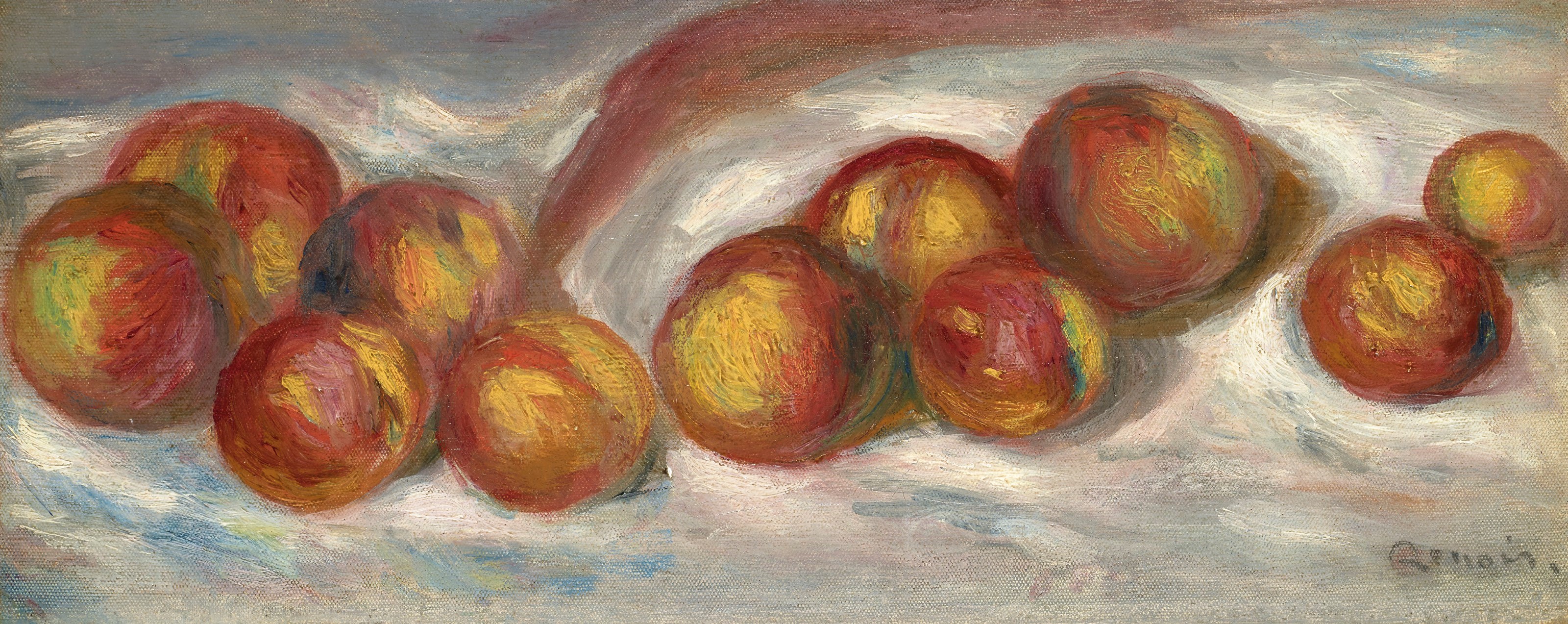
Lot 12
Pierre-Auguste Renoir (1841-1919)
Pêches
Fermé28 May 2020
Prix réalisé
USD 162,500
Plus d'informations
Note du spécialiste
This work will be included in the forthcoming Pierre-Auguste Renoir Digital Catalogue raisonné, currently being prepared under the sponsorship of the Wildenstein Plattner Institute, Inc.
This work will be included in the second supplement to the Catalogue raisonné des tableaux, pastels, dessins et aquarelles de Renoir being prepared by Guy-Patrice and Floriane Dauberville, published by Bernheim-Jeune.
The present work is being offered for sale subsequent to an agreement between the consignor and the heirs of Richard Semmel. This resolved any dispute over ownership of the work and title will pass to the buyer.
Still life occupies a prominent position in Renoir's work from the early 1880s onward. Among the most academic of the Impressionists, Renoir is frequently remembered as a painter of the female figure. Although he recommended to Edouard Manet's niece Julie to paint still life "in order to teach yourself to paint quickly" (quoted in J. Manet, Journal, 1893-1899, Paris, n.d., p. 190), the numerous works, often elaborate and ambitious, which Renoir executed in this genre over the course of his career attest to his sustained interest in still life as an end in itself. Indeed, it was in his still life compositions that Renoir pursued some of his most searching investigations of the effects of light and color on objects and surfaces.
As with Paul Cézanne, another devotee of the still life subject, the masters of French eighteenth-century painting exerted a strong influence on Renoir. While his figure pictures looked towards Jean-Antoine Watteau and François Boucher, his still lifes found their inspiration in Jean-Baptiste-Siméon Chardin's unique vision. Discussing Renoir's pictorial dialogue with Chardin, Charles Sterling has rendered a statement of Renoir's achievement in still life which could well describe the present painting: "Nurtured on the traditions of eighteenth-century French painting, Renoir made no attempt to energize his compositions, as Monet did, but carried on the serene simplicity of Chardin... Pale shadows, light as a breath of air, faintly ripple across the perishable jewel of a ripe fruit. Renoir reconciles extreme discretion with extreme richness, and his full-bodied density is made up, it would seem, of colored air. This is a lyrical idiom hitherto unknown in still life, even in those of Chardin. Between these objects and us there floats a luminous haze through which we distinguish them, tenderly united in a subdued shimmer of light" (Still Life in Painting from Antiquity to the Present Time, Paris, 1959, p. 100).