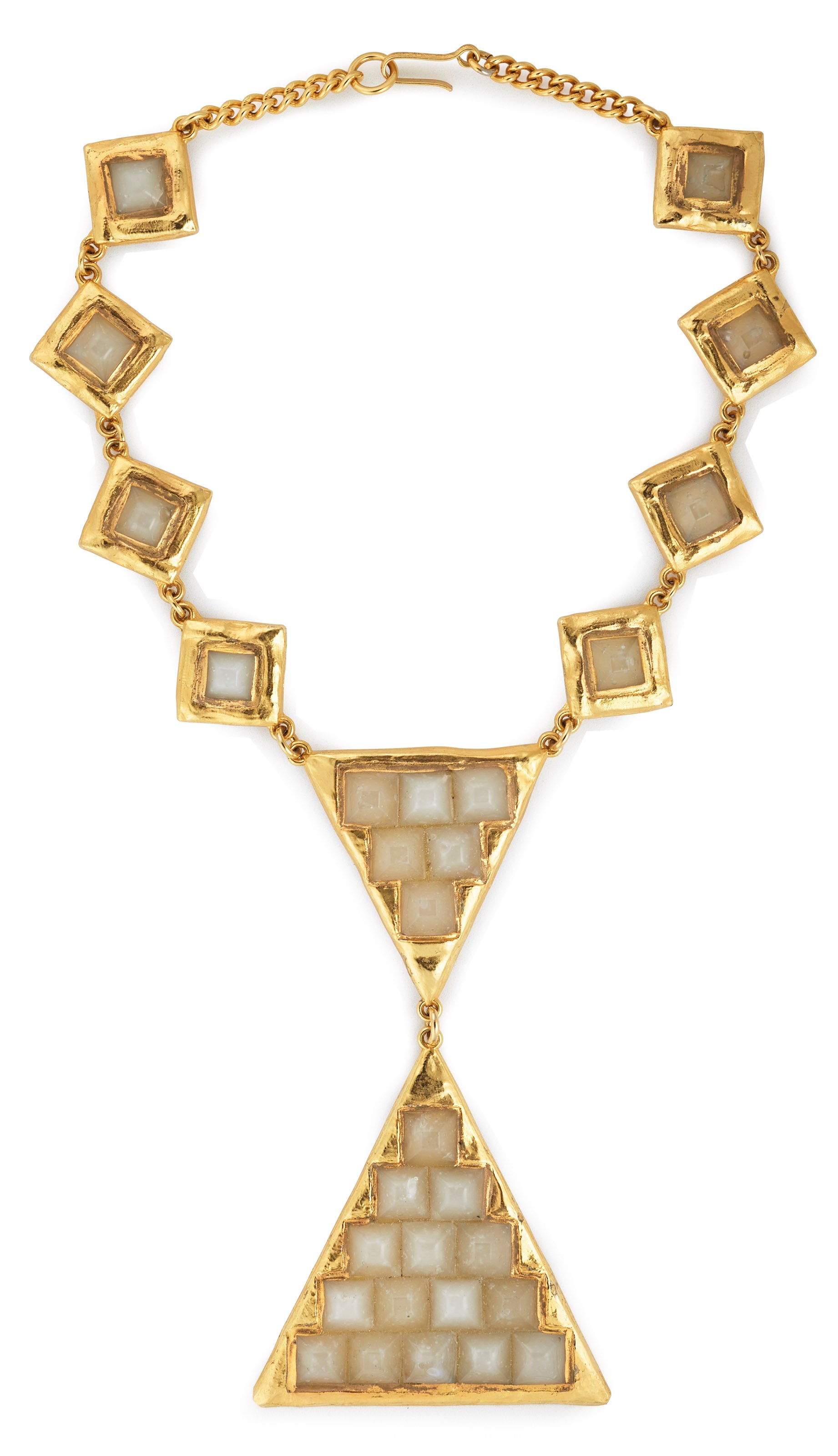
Lot 4THE PROPERTY OF A DISTINGUISHED MODERN GENTLEMAN
BILLYBOY* (b. 1960)
Joan of Arc
Prix réalisé
USD 2,250
Plus d'informations
Note du spécialiste
"Mon credo is Life is Fabulous. It may sound phony, but the thing to remember is that you never know when you're going to be amused." - BillyBoy* in New York magazine, aged 23.
Spanning all disciplines, BillyBoy*'s extraordinary creative output unites the genres of performance, fine art, design, curation and literature into a myriad whole of expression. His repertoire unabashedly combines seriousness with satire, sartorialism with surrealism and life with art. True to his maxim, BillyBoy* exposes the extraordinary in the everyday in the vast emporium of life where beauty lies in the unexpected.
After being the first individual with his own signature on the packaging of two Barbie dolls he had designed for Mattel and a now iconic bestselling book, Barbie, Her Life and Times (Crown Publishers, 1988), BillyBoy* decided to explore the medium of the doll as an artistic expression and used as a medium to create fine art. The pinnacle of this idea came when Andy Warhol, who considered BillyBoy* a muse, did a portrait of him as a Barbie doll. This work would be Warhol’s his last portrait before his untimely death in 1987.
The creative concept which inspired the present necklace came during a lunch with Warhol, Stuart Pivar and Fred Hughes, humorously recorded by BillyBoy* in his diary entry on January 1986. It began with an animated discussion about Meret Oppenheim’s famous fur creations, Le Déjeuner en fourrure (1936), the fur covered cup now in the Museum of Modern Art and the fur bracelet created for Schiaparelli. Upon discussing the concept, BillyBoy* came upon the idea of simulating the ice-cube in his Joan of Arc series of jewellery. His diary entry from 16th January 1986 recounts:
“January 16th 1986 New York,
Andy and I had lunch with Stuart and Fred today at Elaine’s. It was fun, it was a bit greyish outside, NY “gloomth" as you would… so being inside was cozy and very close to what I’d feel if I were at home… I told them how I had just seen in real, in Paris, Meret Oppenheim’s fur bracelet, the only piece of jewellery she did for Schiaparelli according to some of the research I have done so far…I told Andy about how Picasso and Oppenheim were lunching, just as we were, and Meret said anything could be made of fur. […] I said "well, Oppenheim has a point. You CAN do anything with anything” […] Toying with my glass of particularly good ice tea, I said maybe you could make jewellery out of ice. It’d be so cool to wear an ice collar necklace and cuff bracelets in summer that would melt away as the evening wore on. […] Andy said it in monotone voice, “You should do that, maybe it can be done” to which I replied, "I could make something probably, like jewellery LOOKING like trompe l’oeil ice. Not Lucite or Plexiglas though, that’s been done, you know, Andy, when you were young…back in the 1920s or something". Signal pursed lips and eye roll from Andy. I'd already thought though I’d love to make real ephemeral, temporary REAL ice jewellery worn in the summer at the beach or on a yacht. I could make them into moulds and get clients to acquire ice jewellery moulds to make them at home like the way one sells them jewels which are already made up. Andy said I should try to make ice-looking jewellery. I told him I will. Lala will love the challenge.”
Joan of Arc employs the tactile combination of gilt-metal and pâte de verre, providing naturally the contrast of ice-like stone against a lavishly textured matte gold surface. Abstract in design and beautifully weighted, the bold, graphic simplicity of this piece speaks to both the futuristic and the ancient, with a versatility and universality of message. This pendant, as well as several others from this collection, were worn extensively by Andy Warhol in New York, Paris and London. Both this necklace and Warhol's famous last portrait which was painted of BillyBoy* as Barbie, were painted in 1986, marking a creative interchange between the two artists at this important moment. A rare and special example, Joan of Arc was showcased at numerous stores including Liberty of London (London), Henri Bendel (New York), Barney’s (New York), Bloomingdale's (New York) and has been exhibited on several occasions in Europe.
BILLYBOY* & LALA
Born in Austria, BillyBoy* was raised between continental Europe and the United States. As he develops in his recently published memoirs Frocking Life – In Search of Elsa Schiaparelli (Rizzoli, 2016), his discovery of a hat by Elsa Schiaparelli at age of 14 in a Paris marché aux puces famously propelled his imagination, inspiring a lifelong identification with the famous designer which would encourage his resolutely creative disposition. Now the world's foremost expert on the designer, and an authority on European couture, dolls and modern design, BillyBoy* began equally as a scholar, albeit of the under-recognised medium of fashion. His creative output reflects the seriousness of his passion for these subjects and yet the knowingness of his endeavour, whilst sharply intelligent and witty, remains devoutly curious and joyously playful amid the richness and breadth of creative possibilities.
BillyBoy*'s oeuvre to date is extensive. Having undertaken his first curatorial project in New York at the tender age of 16, Pizzaz Gallery, BillyBoy* would create under designer labels such as Surreal Couture and his own gallery Fly By Nite, undertaking performance, modelling and painterly projects during the 1970s and into the early 1980s. Androgynous, irreverent and avant-garde, BillyBoy* became established within the milieu of New York's extraordinary creative scene, frequenting the galleries, studios and clubs amongst the best known icons of the time. He was recognised as one of the foremost exponents of wearable art whose exuberant unisex creations were seen in publications such as Vogue, the New York Times and The Village Voice. A protégé of Diana Vreeland, his work was revered by both the art and fashion communities with examples of his work under the label Surreal Couture now held in, amongst many other museums, the Costume Institute at the Metropolitan Museum of Art and the Musée du Louvre in the prestigious Union Française des Arts du Costume department. BillyBoy* sees his warble artworks as autobiographical Theosophical talismans and Wiccan totems. Having been raised into Theosophy and Wicca by his families, the jewels are not created just as adornments but positive amulets with a spiritual power and a strong metaphysical story.
In the late 1970s, BillyBoy* took the decision in to relocate to Paris, the city forever at the spiritual heart of the artist's imagination. In the following years, by early 1982, BillyBoy* met his life partner and now husband Jean-Pierre Lestrade, dit Lala. A Frenchman born in Algers, Lala was an artist who had starred in cabaret and film projects, written for publications Gaie-Presse and Magazine and was, at the time of their meeting, the singer and songwriter for New Wave band Lala et les Emotions. Their synergy engendered an instant natural creative partnership, inspiring a new endeavour, the Surreal Bijoux creations. Jewellery and accessories were a natural and fundamental element of BillyBoy*'s repertoire from the beginning. This was not least in the sense that they had engendered his first creative epiphany and continued the trajectory of his spiritual guardian and mentor Elsa Schiaparelli who had collaborated with an impressive array of surrealist artists including Salvador Dalí, Alberto Giacometti, Jean Cocteau and Méret Oppenheim to realise inspired creations.
Surreal Bijoux began in the kitchen of the pair's new home in Paris whereby they would create pieces together by hand. The collection grew out of an artistic manifesto into a brand when worn by former fashion model and high society personality Bettina Graziani who was an early convert to their work. Their appearance on her caused quite a sensation and were at one point spotted by Gerry Stutz, owner of Henri Bendel, the prestigious Manhattan store, who at once ordered one hundred pieces. Following this, John Duka of the New York Times wrote a rave review of the jewels entitled Winning with a 'Cartoon Chanel' Collection, remarking "It is the best work of this kind since Ken Begun revitalized costume jewelry six years with its golden mesh, putty and gold leaf... It has a free-form chic to it." and describing the Surreal Bijoux necklaces as "pure, heaped-up luxe."
Within several hours, the collection was sold out and the acknowledgment of Surreal Bijoux was firmly established in New York. The popularity of the jewels would continue with BillyBoy*'s wearable works of art featuring on many a celebrity including Elizabeth Taylor, Jackie Onassis, Lauren Bacall, Debbie Reynolds, Cary Grant, Gene Kelly, Yma Sumac, Andy Warhol and Fred Hughes, Diana Vreeland, Michael Jackson, Boy George, Madonna, Leigh Bowery, Leonor Fini, Salvador and Gala Dali, Mrs Norman Mailer, Slash, Honorable Mme Bettina Bergery, Marchesa Cacciapuoti di Guigliano,(also known as Go Go Schiaparelli), Régine, Mme Marie-Hélène de Rothschild, Mme Liliane Bettencourt, Ray Charles, Natalie Cole, Prince Mubarak de Al-Sabbat and many others.
Each of the spectacular jewels here presented comes from BillyBoy*’s two famous lines, Surreal Couture (Park Avenue, New York City) and Surreal Bijoux (Rue de la Paix, Paris). All but one of these jewels are created entirely by hand, with a purity of expression and tactility in their uniqueness that surpasses machine technology and manufacture. To be worn with care and pride, each of these jewels makes a statement, embodying preciousness, personality and spontaneity in equal measure as wearable pieces of art. BillyBoy* and Lala feel that the personalities who wore these pieces, Andy Warhol, Lauren Bacall and Elizabeth Taylor, have imbued their spiritual imprint on them as well which BillyBoy* has said are “indelible and eternally fused with the art works themselves.”
References:
https://www.mdvanii.ch/en/article/surreal-bijoux-en
https://en.wikipedia.org/wiki/Mdvanii