Lot 116
CAREL WEIGHT, R.A. (1908-1997)
The Road to Calvary
Fermé24 November 2017
Prix réalisé
GBP 17,500
Plus d'informations
Note du spécialiste
Carel Weight was not religious himself but explained in a 1981 interview to Norman Rosenthal how 'Religion in itself isn't that important to me, but it provides one with wonderful themes.' (R.V. Weight, Carel Weight: A Haunted Imagination, Newton Abbot, 1994, p. 65)
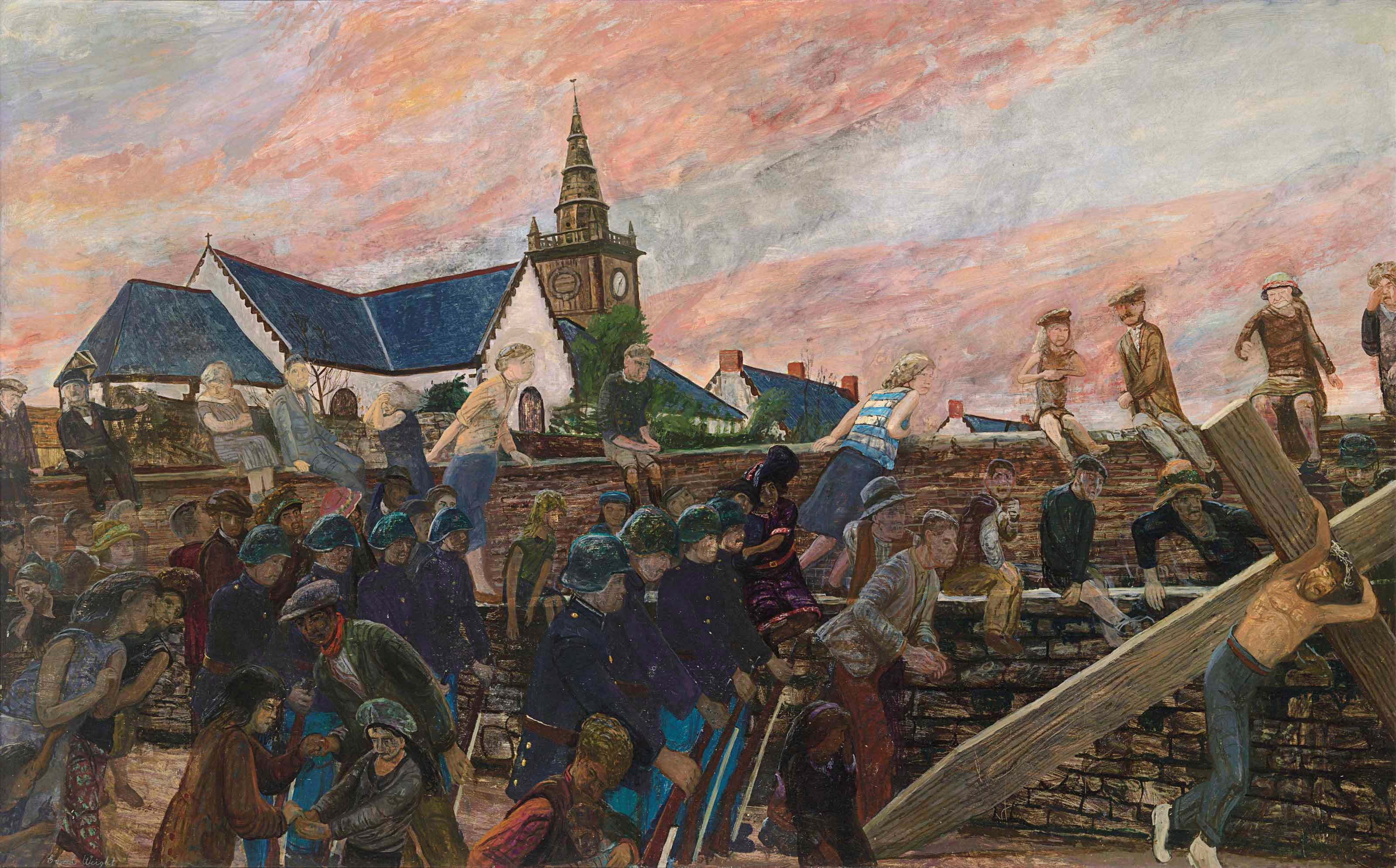
During the 1960s, Weight had an increased interest in the theme of religion and was instructed with two notable commissions: the mural Christ and the People for Manchester Cathedral; and his illustrations for the Oxford Illustrated Old Testament. The Road to Calvary was initially inspired by a holiday to Brittany when Weight sketched a typical Breton church, which was later to feature in the background.
In the present work Weight demonstrates his extraordinary draughtsmanship in conveying the vivid pink and blue sunset, which occupies half of the composition. The sky is almost reminiscent of a Turner skyline and this remarkable skill can also be seen in Weight's painting The Dogs (1955-56, Tate, London). Beneath the dramatic skyline The Road to Calvary focuses on a crowd that have earnestly gathered on the street to watch Christ being escorted through the streets by eight soldiers in Nazi uniform. Amongst the figures are leading characters; the man leaning forward in front of the troops could be Simon of Cyrene (the man compelled by the Romans to carry the cross of Jesus as Jesus was taken to his crucifixion) and the Virgin could be the girl to the left of the base of the cross. The present work is not only an important example of Weight's exploration of religion as a theme but also demonstrates the artists' unique imagination and ability to create a scene that is both theatrical and tense.