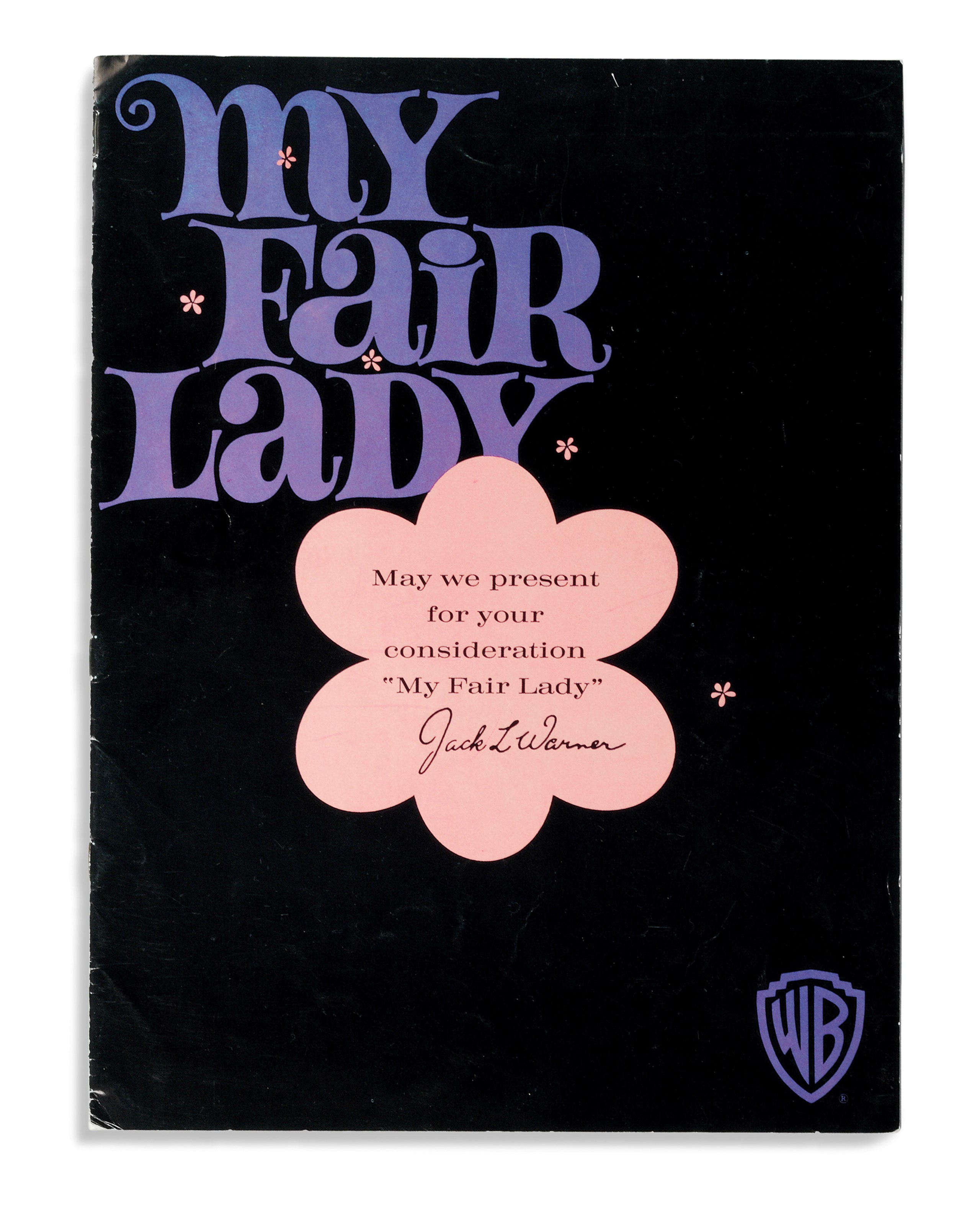
Lot 447
MY FAIR LADY, 1964
A COLLECTION OF MATERIAL
Fermé4 October 2017
Prix réalisé
GBP 3,000
Plus d'informations
Note du spécialiste
The promotional brochure was printed by the studio for release to the Academy of Motion Picture Arts and Sciences, featuring images of the cast and crew, to encourage the Academy to recognize the production with Oscar nominations.
Eliza Doolittle was the most coveted role in a decade, and Audrey was desperate to have it, telling a reporter years earlier I'd do anything to play Eliza Doolittle in My Fair Lady. Agent Kurt Frings gave her the news over the telephone You've got My Fair Lady! Hepburn told Modern Screen magazine how she dragged her mother out of the shower in her haste to share the exciting news. Based on George Bernard Shaw's Pygmalion, Alan Jay Lerner and Frederick Loewe's musical adaptation opened on Broadway in 1956 with Julie Andrews as Eliza and Rex Harrison as Professor Henry Higgins, becoming one of the biggest hits in Broadway history and running for over six years. Warner Bros. won the screen rights for an unprecedented $5 million. It would be Jack Warner's swansong, with the largest production budget ever at that time.
Fans of the Broadway show clamoured for Julie Andrews to be cast in the lead, but she was an unknown in Hollywood and Warner wanted big name movie stars that would be known all over the world - he wanted Audrey Hepburn. Hepburn too felt that the role was Julie's, and was reticent at first, but when she saw that Warner would only offer the role to another star if she turned it down, she swiftly accepted, telling Barbara Walters years later I thought I was entitled to do it as much as the third girl. According to Andrews, Hepburn would say to her in later years You should have done My Fair Lady, Julie — but I didn't have the guts to turn it down. Many in the industry were outraged at Andrews being overlooked, so much so that Warner publicly justified his casting decision, stating With all her charm and ability, Julie Andrews is just a Broadway name... In my business, I have to know who brings people and their money to a theatre box-office. Cary Grant, Warner's first choice to play Higgins, responded There is only one man who could play this and that's Rex - so the part went to Harrison. Warner already had his big name to guarantee the success of the picture.
After weeks of rehearsals, lessons and fittings, filming began on the elaborate production in August, Audrey enduring hours in make up each day to be transformed into the grubby Covent Garden flower girl. No one had ever seen such dedication. From day one, Audrey had been determined to make it a success, announcing to Beaton and director George Cukor This picture is one we must all remember. Wonderful talents, everyone right, everyone happy. It's the high spot, let's enjoy it!
In taking on the role of Eliza, Audrey had been determined to perform all her own songs, having previously exemplified her talents in Funny Face and Breakfast At Tiffany's. However, Audrey became nervously aware of circulating rumours that she would be dubbed. Music director André Previn later noted to biographer Barry Paris Audrey's voice was perfectly adequate for a living room... But this was the movie to end all movies, with six giant surround speakers. Even so, I was of the opinion that if you had bought Audrey Hepburn to play it, so she didn't sing so hot - it wasn't such a crime. But you can imagine how Lerner and Loewe felt... Marni Nixon was brought in to dub Audrey's vocals. Previn recalled that Audrey was ...very hurt because she felt that if she had taken Julie Andrews place and then couldn't sing, it would reflect very badly on her. He tried to cut in her vocals as much as he could, revealing I used more than they were aware of at the time. But I couldn't get away with too much. The press soon found out that Audrey had been dubbed in the part and drummed up a scandal before the film had even been released, suggesting it added insult to the injury of depriving Andrews of her rightful role.
Despite the dubbing controversy, My Fair Lady was hailed as a great success on its release in October 1964 and Audrey’s performance a triumph. Even devotees of the original stage production were delighted, The New Yorker praising her Utterly different though no less captivating Eliza. Yet when the Academy Award nominations were announced in February 1965, My Fair Lady swept the board in every possible category except best actress, while ironically the snubbed Julie Andrews was nominated for her performance in Mary Poppins. A scandal erupted in the media - Variety bluntly explained: Hepburn did the acting, but Marni Nixon subbed for her in the singing department and that’s what undoubtedly led to her erasure. Many in the industry, including Jack Warner, were outraged over the Academy’s decision, however a disappointed Audrey was gracious as always, agreeing to make the best actor announcement at the ceremony, beaming with pleasure as she announced her co-star Rex Harrison as the winner. Harrison gallantly suggested he should divide the statue in half and thanked both his fair ladies.