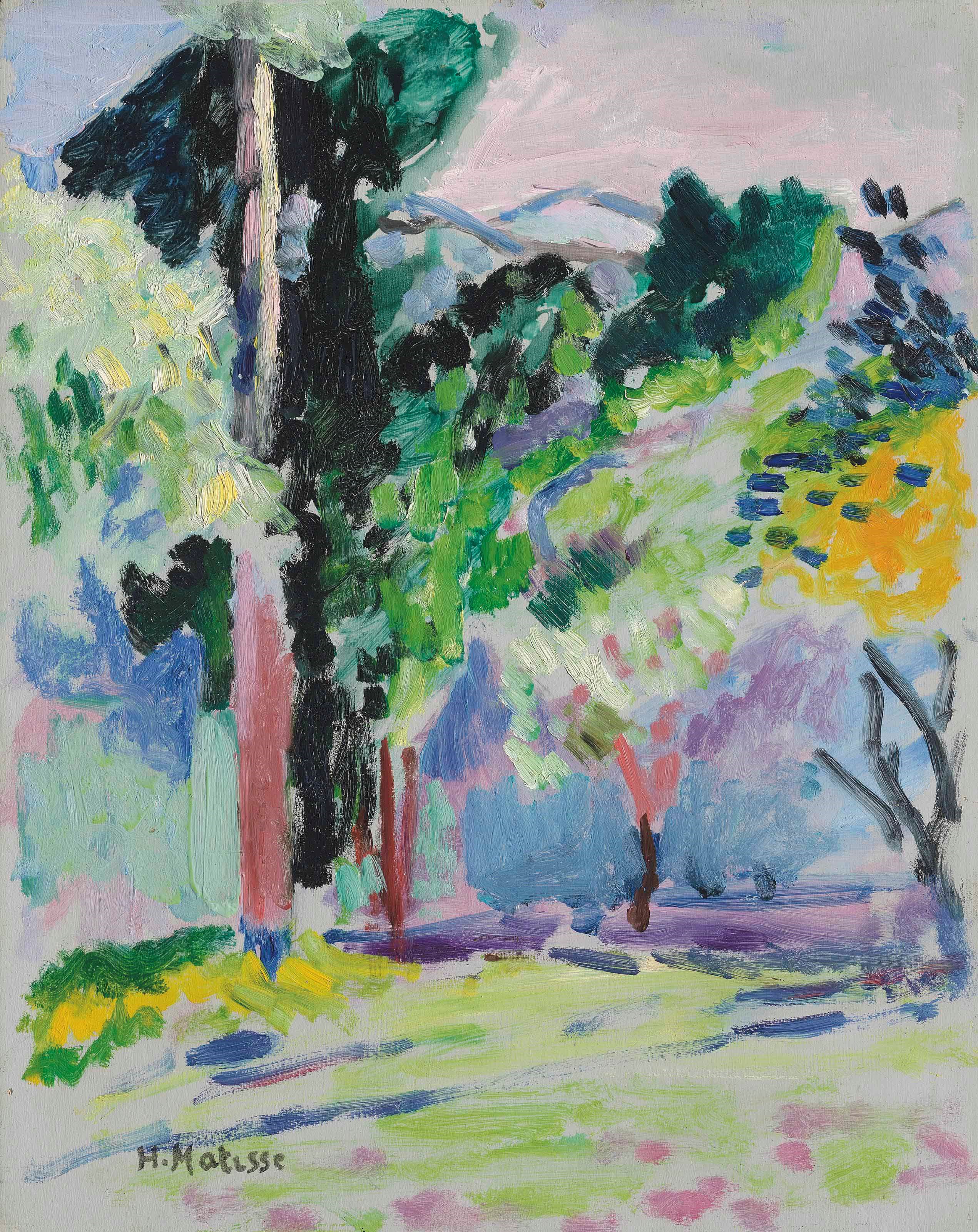
Lot 15THE PROPERTY OF A NEW YORK COLLECTOR
Henri Matisse (1869-1954)
Paysage à Collioure
Fermé28 February 2017
Prix réalisé
GBP 665,000
Plus d'informations
Note du spécialiste
Wanda de Guébriant has confirmed the authenticity of this work.
Painted circa 1905-1906, Henri Matisse's Paysage à Collioure dates from the very pinnacle of the artist’s first experiments in Fauvism, inspired by his experiences in the small harbour town of Collioure in the South of France. Stimulated by the lush vegetation and intense light of the pure, untouched landscape that he found there, Matisse created a succession of pictures in which he honed the vivid, intensely colourful style that would make such an extraordinary splash at the Salon d'Automne in 1905. Abandoning the highly controlled pointillist style of Neo-Impressionism which had dominated his paintings in recent years, Matisse began to employ a more dynamic, expressive brushstroke and explosive colour palette in his paintings, combining yellows and purples with varying shades of green and blue, as he sought to capture the energy of the surrounding landscape on canvas. Speaking about his time in Collioure, Matisse exclaimed: ‘Working before a soul-stirring landscape, all I thought of was making my colours sing, without paying any heed to rules and regulations’ (quoted in P. Schneider, Matisse, London, 1984, p. 203).
Enchanted by the beauty of this location, Matisse called on his close friend and colleague, André Derain, to join him at Collioure. In a letter to Derain, Matisse wrote, ‘I cannot insist too strongly that a stay here is absolutely necessary for your work. I am certain that if you take my advice you will be glad of it. That is why I say to you again, come!’ (Matisse, quoted in H. Spurling, The Unknown Matisse: A Life of Henri Matisse, vol. I, 1869-1908, New York, 1998, p. 316). Derain arrived in July 1905, and the pair spent the remainder of the summer engaged in intense theoretical discussions regarding the nature of art, painting alongside one another and exploring the idyllic countryside that surrounded the town. As a result of this collaboration, Matisse’s style was emboldened, his palette pushed to new extremes, as he constantly probed the power and potential of pure colour, using the landscape as a vehicle for his explorations. Shortly after its creation Paysage à Collioure entered the collection of Etienne Terrus, a local artist whom Matisse had befriended at Collioure. Terrus, who had studied under Alexandre Cabanel at the École des Beaux Arts in Paris, was twelve years older than Matisse and offered the younger artist invaluable advice and support whenever he was struck by a crisis of confidence.