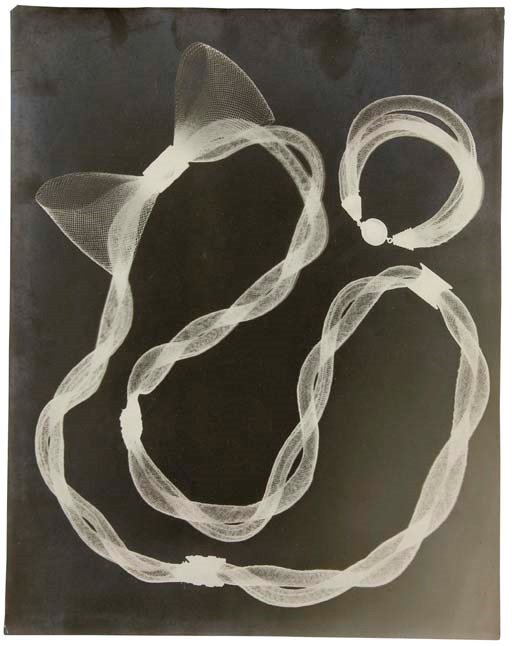
Lot 73MAN RAY PHOTOGRAPHS FOR COLLIERS BY ELSA TRIOLET
'Il fallait trouver du travail. Du travail, comme on sait, il n'y en a pas. Et quand on en cherche, les mots "pas de travail" prennent tous leur sens. Pour les amateurs de "belle vie", porter une valise de colliers est un travail dont on n'a pas à se vanter. On dit qu'être mineur, forgeron, pêcheur est plus romantique. Tout ce que je sais, c'est que notre travail était dur. Et romantique.' -- Elsa Triolet1
This Rayograph and the following four photographs by Man Ray (lots 73-75) are the actual vintage prints used to illustrate Elsa Triolet's book Colliers, which was written in Russian in 1932-33, intended for publication in Leningrad (St. Petersburg) but was only published decades later in French in the 42-volume work Oeuvres romanesques croisées d'Elsa Triolet et Aragon (1964-74). Colliers appears in volume 40, published in 1973, and includes five photographs taken by Man Ray (lots 73-75).
The 'Rue Campagne Première' stamps on the two mounted prints (lots 73 & 75) include Man Ray's Paris telephone number 'Littré 76-57'. In Behind the Photo: The Stamps of Man Ray, Man Ray Research Scholar Steven Manford explains: '...only the Littré number is represented among the stamps. The Littré stamps (M4 & M7) were in use approximately between the years of 1929 and 1930.'2
At the time of the events described in Colliers, Triolet, Louis Aragon, whom she met in 1928, and Man Ray were all living on rue Campagne Première: 'Je m'installais à l'hôtel Istria, rue Campagne-Première....A l'Istria habitaient Marcel Duchamp, Jeanne Léger (la première femme de Fernand), Man Ray, Picabia, la belle Kiki y amenait son nez pointu....'3 At the core of Colliers is the celebrated love story between Aragon and Triolet. In the face of poverty, Triolet worked 20 hours a day making necklaces for the Haute Couture, and Aragon -- one of the founding figures of Surrealism -- was reduced to the role of a door-to-door salesman. Carrying a valise filled with Triolet's necklaces, Aragon spent his days approaching noted couture houses such as Schiaparelli and Poiret while scribbling down poetry in between visits.
MAN RAY (1890-1976)
Rayograph (Necklace and bracelet in white horsehair by Elsa Triolet), before 1932-33
Prix réalisé
GBP 24,000
Plus d'informations
Note du spécialiste
'J'ai inventé des colliers presque impondérables, en crin blanc, dont on a écrit, quand ils furent exposés au "Salon des Artistes Modernes", que c'étaient "des colliers de neige et de rêve.' -- Elsa Triolet4
This Rayograph depicts Triolet's innovative necklace and bracelet made of white horsehair. In typical Man Ray fashion, what appears at first glance to be an effortless composition -- a necklace and bracelet placed directly on photographic paper -- reveals his ingenuity: the negative silhouetteing, inherent in the photogram, not only emphasizes the whiteness but also defines the fine strands of the white horsehair. In this Rayograph, Man Ray captures the essence of Triolet's creation -- its colour, texture and movement.
1 'Colliers', Oeuvres romanesques croisées d'Elsa Triolet et Aragon, Vol.40, Jaspard, Polus & Cie/Robert Laffont, 1973, p.93.
2 Carnet de Rhinocéros Jr, 2006, p.11.
3 Oeuvres romanesques croisées d'Elsa Triolet et Aragon, Vol.1, Jaspard, Polus & Cie/Robert Laffont, 1964, pp.16-17.
4 'Colliers', p.101.